
by Joseph Dedvukaj.
Abstract
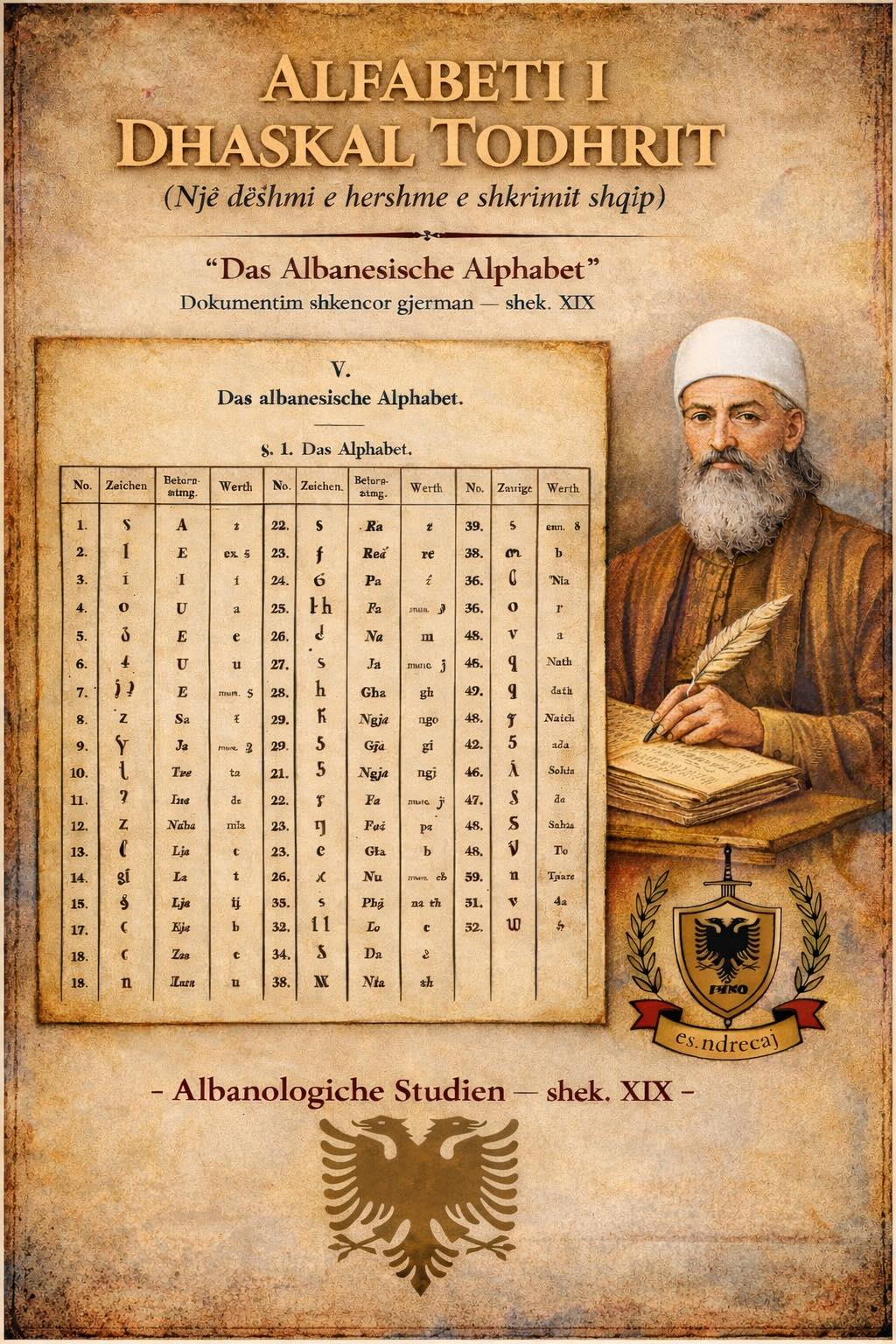
The Todhri alphabet, attributed to Dhaskal Todhri (Theodhor Haxhifilipi) of Elbasan (c. 1730–1805), represents one of the most significant material testimonies to pre-modern Albanian literacy. First documented scientifically by Johann Georg von Hahn in the mid-nineteenth century, this script forms part of a broader group of indigenous Albanian writing systems that emerged prior to the standardization of the modern Albanian alphabet in 1908. The Todhri script, consisting of approximately fifty characters designed to represent the phonological structure of Albanian, demonstrates a conscious effort to create a functional orthographic system tailored specifically to the Albanian language. Its documented use in both religious and commercial contexts confirms its practical role within Albanian urban society, particularly in Elbasan, an important cultural and economic center during the Ottoman period.
The existence of the Todhri alphabet, alongside other indigenous Albanian scripts such as the Elbasan, Vithkuqi, and Vellara alphabets, provides compelling evidence of autonomous Albanian literacy practices developed within Albanian-speaking communities. These writing systems reflect linguistic self-awareness, intellectual initiative, and cultural continuity independent of externally imposed orthographic traditions. Although limited in geographic and social distribution, the Todhri alphabet forms part of a broader historical framework demonstrating the persistence of Albanian linguistic identity. Its preservation in manuscript form and recognition in scientific scholarship confirm the existence of a native scribal tradition that contributed to the long-term continuity of Albanian as an indigenous Indo-European language in the western Balkans.
VIII.7.1. Introduction: The Todhri Alphabet in the History of Albanian Literacy
Among the most important material witnesses to the pre-modern written culture of Albanian is the script associated with Dhaskal Todhri (Theodhor Haxhifilipi) of Elbasan (c. 1730–1805). This alphabet, preserved in manuscript form and first documented scientifically in Western Europe by Johann Georg von Hahn in the nineteenth century, constitutes one of several locally developed Albanian writing systems predating the standardization of the modern Albanian alphabet at the Congress of Manastir (1908).¹
The existence of such scripts demonstrates that Albanian-speaking communities maintained literacy practices in their own language prior to modern national codification. These local alphabets, including those of Elbasan, Todhri, Vithkuqi, and Vellara, represent a broader phenomenon of Albanian intellectual self-expression within Ottoman-period urban and ecclesiastical environments.
⸻
VIII.7.2. Discovery and Publication by Johann Georg von Hahn
The Todhri alphabet first entered Western scientific literature through the work of Johann Georg von Hahn, Austrian consul in Ioannina and founder of scientific Albanology. Hahn reported his discovery to the Austrian Academy of Sciences in 1849 and later published a description in his seminal work Albanesische Studien (1854).²
Hahn’s study represented the first systematic philological analysis of the script and established the scientific foundation for subsequent research into Albanian orthographic traditions.
Source Box VIII.7-A. Hahn’s Description of the Elbasan/Todhri Script
“This alphabet was discovered in Elbasan and appears to have been used locally for writing the Albanian language. It was employed not only in religious texts but also by merchants for correspondence and accounting purposes. However, its use seems to have been limited to a small number of individuals.”³
This description confirms several critical facts:
1. The script originated within an Albanian urban environment (Elbasan).
2. It was used for both religious and secular purposes.
3. It functioned as a practical writing system within Albanian society.
These observations demonstrate the existence of a local Albanian scribal tradition independent of externally imposed orthographic systems.
⸻
VIII.7.3. Structure and Characteristics of the Todhri Alphabet
The Todhri script consists of approximately fifty characters, including primary letters and ligatures.⁴ Its design reflects the phonological structure of Albanian rather than Greek or Latin orthographic conventions.
Unlike simple adaptations of foreign alphabets, the Todhri system represents a deliberate attempt to provide a comprehensive phonetic representation of Albanian speech. This reflects linguistic self-consciousness among Albanian intellectuals and confirms the recognition of Albanian as a distinct linguistic system.
Although certain graphical features show influence from contemporary cursive traditions, the script’s functional role as a vehicle for Albanian-language literacy places it firmly within the indigenous cultural sphere of Albanian intellectual life.⁵
⸻
VIII.7.4. Elbasan as a Center of Albanian Scribal Culture
The geographic origin of the Todhri alphabet—Elbasan—is historically significant. Located in central Albania along major trade and communication routes, Elbasan served as an important urban and cultural center throughout the Ottoman period.
The existence of an original Albanian writing system in this city confirms that Albanian literacy was maintained locally within Albanian-speaking populations.
This urban continuity aligns with broader archaeological and historical evidence demonstrating persistent settlement and cultural continuity in central Albanian regions from antiquity through the medieval and early modern periods.
⸻
VIII.7.5. The Todhri Alphabet in the Context of Albanian Linguistic Continuity
The Todhri alphabet constitutes important evidence for the continuity of Albanian linguistic identity. Its existence demonstrates that:
• Albanian was actively written prior to modern standardization.
• Albanian speakers recognized the need for specialized orthographic representation.
• Albanian literacy developed within Albanian communities themselves.
These facts reinforce the broader conclusion established by comparative linguistics: Albanian represents an indigenous Indo-European language with deep historical roots in the western Balkans.⁶
While the Todhri alphabet itself dates to the eighteenth century, it forms part of the cultural infrastructure through which Albanian linguistic continuity was preserved.
⸻
Appendix VIII.7-B. Comparative Table of Indigenous Albanian Alphabets
Alphabet Creator Location Date Primary Source
Elbasan Alphabet Anonymous Elbasan 1761 Elbasan Gospel Manuscript⁷
Todhri Alphabet Theodhor Haxhifilipi Elbasan c. 1760–1805 Hahn, Albanesische Studien⁸
Vithkuqi Alphabet Naum Veqilharxhi Korçë/Vithkuq 1840s Veqilharxhi primers⁹
Vellara Alphabet Unknown Southern Albania 18th century Elsie studies¹⁰
Arbëresh alphabets Various Southern Italy 16th–18th century Arbëresh manuscripts¹¹
⸻
VIII.7.6. Historical Significance
These alphabets collectively demonstrate that Albanian literacy developed through local initiative rather than external imposition.
They provide evidence of:
• linguistic continuity,
• cultural continuity,
• intellectual continuity,
• and regional identity.
Such developments form part of the broader historical framework within which Albanian linguistic continuity must be understood.
⸻
Bibliography:
Elsie, Robert. Albanian Literature: A Short History. London: I.B. Tauris, 2005.
Elsie, Robert. “The Elbasan Gospel Manuscript.” PDF offprint.
Everson, Michael. “Proposal for Encoding the Todhri Script.” Unicode Working Group, 2020.
Geitler, Leopold. Die albanesischen und slavischen Schriften. Vienna, 1883.
Hahn, Johann Georg von. Albanesische Studien. Jena: Mauke, 1854.
Wilkes, John. The Illyrians. Oxford: Blackwell, 1992.

