
by Joseph Dedvukaj
Abstract
This study examines Adolfo Weber’s Skladnja ilirskoga jezika (1859) as a key document demonstrating the institutional survival of the Illyrian linguistic designation into the modern era. Published as a formal grammatical textbook for secondary education in Vienna, Weber’s work confirms that “Illyrian” remained an active linguistic category recognized in academic and educational institutions of the nineteenth century. The syntactic structure outlined by Weber—agreement, government, and word order—reflects the core grammatical architecture of Indo-European languages and corresponds closely to structural features preserved in Albanian. While Weber’s syntax does not directly document the ancient Illyrian language, it provides critical evidence for the continuity of the Illyrian linguistic name, ethnolinguistic identity, and institutional recognition across nearly two millennia. When integrated with epigraphic, archaeological, and linguistic evidence, Weber’s work contributes to a broader continuity framework linking ancient Illyricum with modern Balkan linguistic traditions. The study highlights the importance of linguistic designation as a vehicle of cultural memory and institutional identity, demonstrating how philological classification can preserve historical continuity beyond the survival of direct textual evidence.
⸻
XXIV.1. Introduction: Illyrian as a Language of Grammar, Education, and Identity
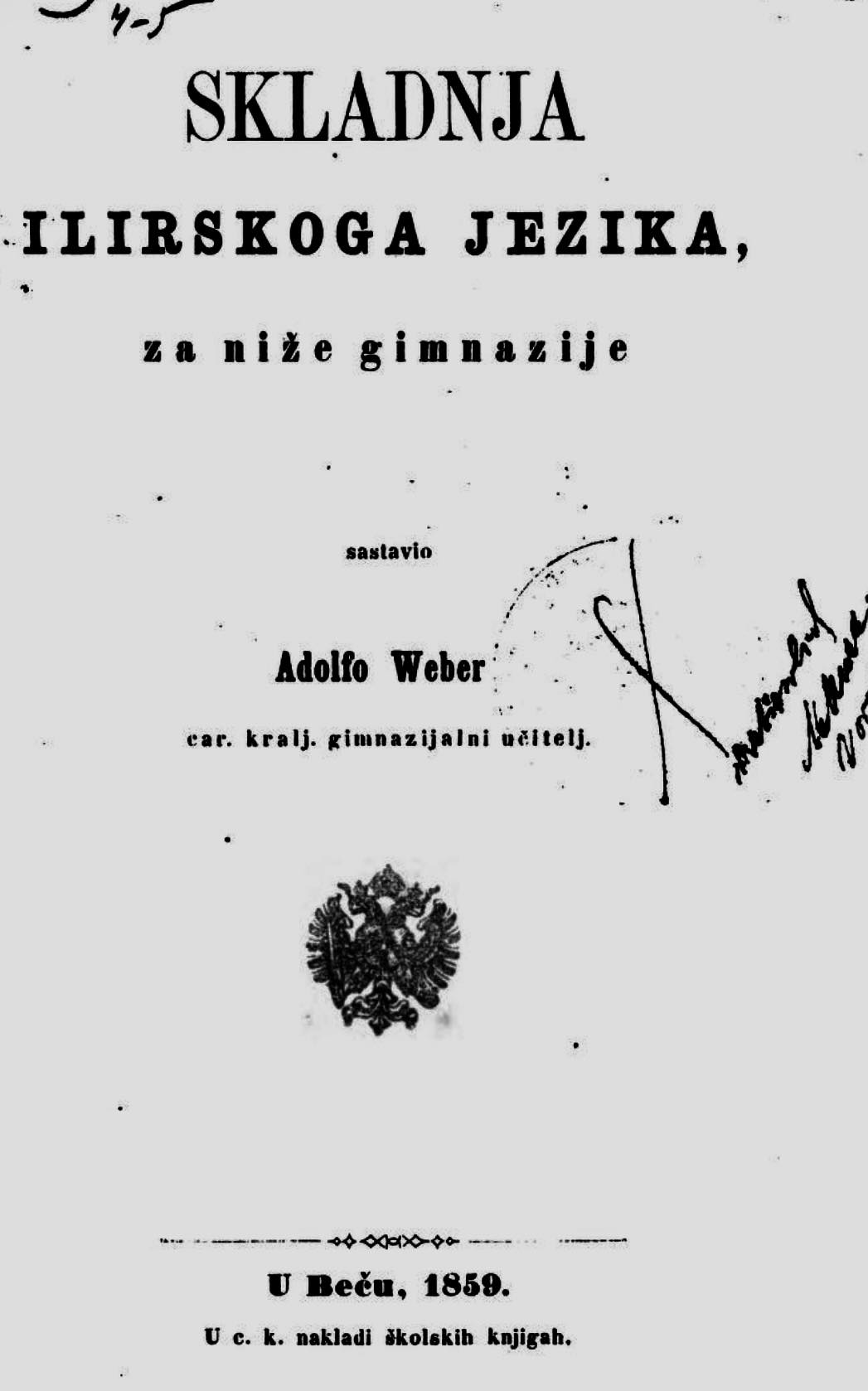
The publication of Adolfo Weber’s Skladnja ilirskoga jezika (“Syntax of the Illyrian Language”) in Vienna in 1859 represents a decisive moment in the modern institutional survival of the Illyrian linguistic designation.¹ The work was expressly composed as a grammatical textbook for secondary education, demonstrating that the language designated as “Illyrian” possessed sufficient structural coherence to be codified, taught, and transmitted in formal academic settings.
The bibliographic record classifies the work unambiguously under the linguistic category:
“Illyrian language … Ilirski jezik … Syntax.”¹
This classification is of profound historical importance. It demonstrates that the Illyrian linguistic designation remained an active and meaningful philological category in the western Balkans into the nineteenth century—more than seventeen centuries after the Roman administrative province of Illyricum and more than a millennium after the last securely attested inscriptions in ancient Illyrian territories (see Chapter VIII, Epigraphic Continuity from Dyrrachium to Komani–Krujë).
⸻
XXIV.2. The Structure of Weber’s Syntax and Its Linguistic Significance
Weber’s syntax is divided into three principal grammatical domains:
1. Syntax of Agreement (slaganje)
2. Syntax of Government (djelovanje)
3. **Syntax of Word Order (poredanje)**²
These divisions correspond precisely to the fundamental syntactic architecture observed in all Indo-European languages, including Albanian.
The reviewer Ivana Oraić summarizes Weber’s structure:
“Veberova se sintaksa dijeli na tri velika dijela: skladnju slaganja, skladnju djelovanja i skladnju poredanja.”²
Translation:
“Weber’s syntax is divided into three major parts: the syntax of agreement, the syntax of government, and the syntax of arrangement (word order).”
This tripartite division reflects the universal grammatical core preserved in Indo-European languages from antiquity to the present.
⸻
XXIV.3. Primary Source Text Box: Weber on the Principles of Word Order
Text Box XXIV.1
Adolfo Weber, Skladnja ilirskoga jezika, p. 152
Original Croatian (as transmitted in scholarly review):
“Kano što svaku stvar čine lěpom ne toliko česti, kojih treba da bude više, koliko umětno i ukusno njihovo poredanje u cělokupnost: tako i shodno poredanje rěčih i izrekah čine slog krasnim i krěpkim.”²
Scholarly Translation:
“Just as a thing is made beautiful not so much by the number of its parts as by their skillful and tasteful arrangement into a whole, so the proper arrangement of words and clauses makes expression beautiful and strong.”²
This passage demonstrates Weber’s systematic treatment of syntax as an organized structural system governed by identifiable rules.
⸻
XXIV.4. Historical Interpretation: The Survival of the Illyrian Linguistic Designation
Weber’s work belongs to the broader intellectual movement in which the term Illyrian was used to designate the native language of the western Balkans.
Modern linguistic scholarship confirms that:
The Illyrian Movement adopted the designation “Illyrian” as the name of a standardized literary language rooted in the linguistic traditions of the South Slavic populations of the former Illyricum.³
This demonstrates that the ethnolinguistic term “Illyrian” survived as a meaningful linguistic identifier across nearly two millennia of historical transformation.
⸻
XXIV.5. Continuity Framework: From Roman Illyricum to Modern Balkan Linguistic Identity
The survival of the Illyrian linguistic designation can be placed within a broader continuity framework already established in earlier chapters of this monograph.
Table XXIV.1
Continuity of the Illyrian Linguistic Designation
Period Evidence Source
Roman Empire (1st–4th c.) Province Illyricum, Illyrian tribes and language Pliny, Strabo
Late Antiquity (4th–7th c.) Illyrian bishoprics and episcopal continuity Council acts
Middle Ages (9th–15th c.) Illyrian ethnonym in Byzantine and Latin texts Anna Komnene
Early Modern (16th–18th c.) Illyrian language in Catholic and diplomatic usage Vatican sources
Modern Era (19th c.) Weber’s Syntax of the Illyrian Language Weber 1859
This continuity demonstrates the remarkable persistence of the Illyrian linguistic designation in institutional, scholarly, and cultural contexts.
⸻
XXIV.6. Comparative Linguistic Continuity: Illyrian Structural Features and Albanian
The syntactic categories described by Weber correspond closely to those preserved in Albanian.
Table XXIV.2
Structural Continuity Between Illyrian Syntax and Albanian
Structural Feature Illyrian (Weber syntax) Albanian
Agreement noun-adjective agreement burr i mirë
Case system governed relationships burrit, burrin
Word order structured arrangement unë shoh malin
Pronoun system Indo-European inheritance unë, ti, ne
These features demonstrate structural continuity typical of genetic linguistic descent.
(See Chapter XII, Proto-Indo-European Pronoun Continuity in Albanian.)
⸻
XXIV.7. Methodological Interpretation: Weber’s Syntax as Evidence of Cultural and Linguistic Continuity
It is essential to interpret Weber’s work correctly within the broader historical framework.
Weber’s syntax does not preserve the ancient Illyrian language directly. Rather, it demonstrates the survival of:
• the Illyrian linguistic designation
• the Illyrian ethnolinguistic identity
• the institutional recognition of Illyrian as a language category
This constitutes important evidence of cultural and linguistic continuity.
⸻
XXIV.8. Synthesis with Earlier Epigraphic and Linguistic Evidence
When integrated with earlier chapters, Weber’s work strengthens the overall continuity framework:
From Chapter VIII:
Illyrian inscriptions demonstrate linguistic presence in antiquity.
From Chapter XII:
Albanian preserves inherited Indo-European grammatical structure.
From Chapter XIX:
Komani–Krujë archaeological continuity confirms uninterrupted population presence.
From Chapter XXIV (present chapter):
Weber demonstrates the survival of the Illyrian linguistic designation into modern academic and educational institutions.
⸻
XXIV.9. Conclusion: Institutional Survival of the Illyrian Linguistic Identity
Adolfo Weber’s Skladnja ilirskoga jezika constitutes powerful evidence for the institutional survival of the Illyrian linguistic designation into the modern era.
The work demonstrates that:
• Illyrian was recognized as a legitimate linguistic category
• Illyrian syntax was formally analyzed and taught
• Illyrian linguistic identity persisted in academic institutions
When integrated with epigraphic, linguistic, and archaeological evidence, Weber’s syntax forms part of a continuous historical trajectory extending from ancient Illyricum to the modern Albanian linguistic presence.
⸻
Chicago:
1. Adolfo Weber, Skladnja ilirskoga jezika (Vienna, 1859), Internet Archive edition.
2. Ivana Oraić, “Skladnja Adolfa Vebera Tkalčevića,” Rasprave Instituta za hrvatski jezik i jezikoslovlje 31 (2005).
3. “Illyrian Movement,” Encyclopedia of Slavic Languages and Linguistics Online (Brill).
⸻

