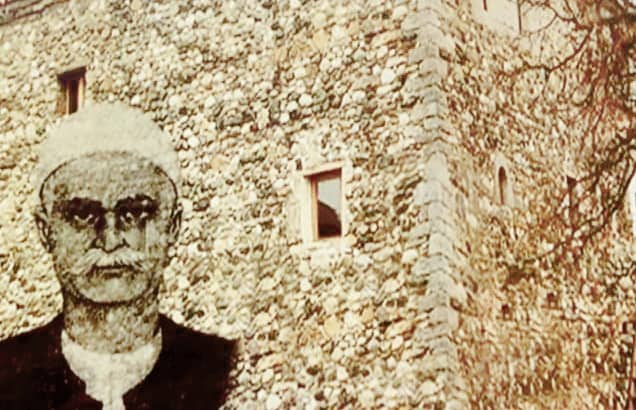

image from EpokaeRe.
Abstract
This study examines the historical and cultural significance of Xhemail Abria (1830–1908), a prominent Albanian mediator, moral authority, and symbol of traditional justice, often described as a “national encyclopedia” of popular wisdom. Abria devoted his life to resolving conflicts, reconciling feuding families, and strengthening social cohesion through customary law and ethical leadership.
Renowned for his incorruptibility, fairness, and intellectual insight, he played a crucial role in promoting justice, unity, and national consciousness during a period of political uncertainty and foreign domination. His authority extended beyond his local region, influencing communities throughout Albanian territories.
The study argues that Abria’s legacy represents the intersection of traditional knowledge, moral philosophy, and proto-national leadership. His methods, grounded in reason, observation, and ethical judgment, demonstrate an indigenous intellectual tradition capable of resolving complex social conflicts without formal institutions.
Xhemail Abria (1830–1908) was an encyclopedia of popular and national wisdom.
He dedicated his entire life to reconciliation and mediation in the men’s chambers (odas) of his time. He also participated in national assemblies concerning war, the salvation of the people, and freedom. He was regarded as a visionary, as he predicted that at least another century would pass before Albanians would fully achieve their national form. Many of his predictions proved accurate.
Along the asphalt road in the village of Abria e Epërme in Drenica stands a proud tower that has witnessed many regimes and occupiers. This traditional Albanian tower, nearly two centuries old and recently restored, transports visitors back to a time when the oda functioned as the people’s court and when popular wisdom was valued as highly as bread itself. Nearby stands the large oak tree under which elders gathered before departing on reconciliation missions. Abria would remind them that greed had no place in justice, because greed and reconciliation could not coexist.
In his family legacy, his great-grandson Vesel Xhemajli continues the tradition of mediation and reconciliation according to the customary law of the Kanun of Lekë Dukagjini. People continue to trust respected elders as the most reliable source of fair judgment. Vesel also notes that modern social changes, especially the influence of social media, have altered society and contributed to growing conflicts, many of which are now brought to traditional mediation forums.
Abria was known for his extraordinary intelligence, objective judgment, and commitment to justice. He contributed significantly to national causes and fought strongly against internal divisions, emphasizing that a nation cannot achieve freedom while internal conflicts persist. He believed that justice, unity, and moral integrity were essential for national development.
Justice made Xhemail Abria great
According to family testimony, what made Abria great was his unwavering commitment to justice. His authority extended beyond Kosovo, reaching regions such as Malësia e Madhe. He was incorruptible and known for resolving even the most complex conflicts. His mission was to reconcile families, heal divisions, and strengthen social harmony.
He reminded fellow mediators that corruption had no place in reconciliation. His moral authority and integrity elevated him to a respected national figure. He was known by several names, including Xhemail Aga, Xhemail Seferi, and Xhemail Abria, reflecting both family lineage and social respect. His life’s work strengthened national unity and preserved justice through traditional institutions.
He devoted his life to bringing people together, transforming enemies into friends, and strengthening the moral foundations of society. His wisdom and decisions became part of collective memory, transmitted orally across generations.

