
by Aleksander Hasanas
Abstract
The text discusses claims presented in a book by Risto Stefov regarding the origins of modern Greek identity. It argues that a unified Greek nation did not exist before the 19th century and that Greece historically consisted of multiple ethnic groups including Albanians, Vlachs, Turks, and others. The passage states that political elites and foreign powers helped shape a modern Greek national identity after independence. It also highlights demographic changes in the early 20th century and debates about language, ethnicity, and historical continuity in the region.
While reading the latest book by the Macedonian author Risto Stefov titled The Little Book of BIG Greek Lies, we find historical and scientific documents presented in it.
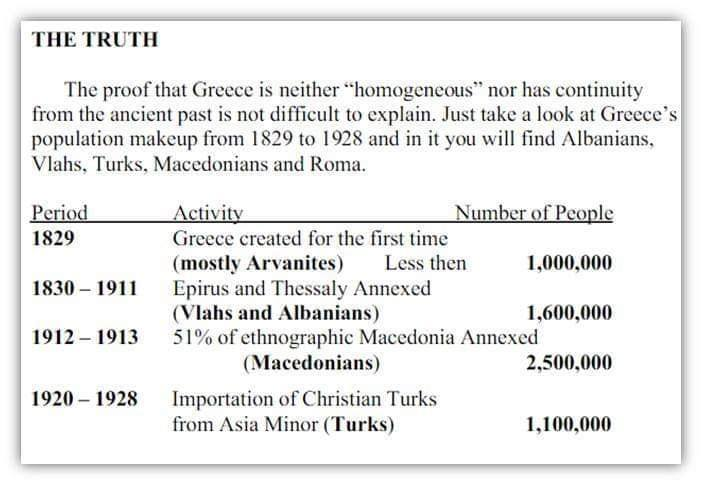
According to the text, a “Greek nation” did not exist before 1829. It argues that Greece was not homogeneous and did not have a direct continuation from ancient times. Looking at the population composition of Greece from 1828 to 1929, one can find Albanians, Vlachs, Turks, Macedonians, and Roma.
In 1928 Greece recorded a population of about 6.2 million people and later declared itself homogeneous, describing the population as purely Greek with only a small Muslim minority that was still considered ethnically Greek.
The text claims that in the 1920s Greece brought about 1.1 million Christian Turks from Asia Minor, presenting them as descendants of the “Ancient Greeks,” although many reportedly did not speak Greek or identify as Greek.
It further argues that modern Greece includes assimilated Albanians (Arvanites), Vlachs, Turks, and Macedonians, and claims that a Greek ethnic identity was artificially formed by the Phanariots with the support of the Great Powers. These Phanariots are described as a multi-ethnic group of educated Christians within the Ottoman system who worked as clergy, bankers, sailors, translators, and merchants.
The text concludes that when Greece became a state in 1829 it faced an identity crisis due to its multicultural population, and that many people in the region at the time spoke Albanian, Turkish, Vlach, or Slavic languages rather than Greek. It also claims that even Athens was largely an Albanian village during that period.

