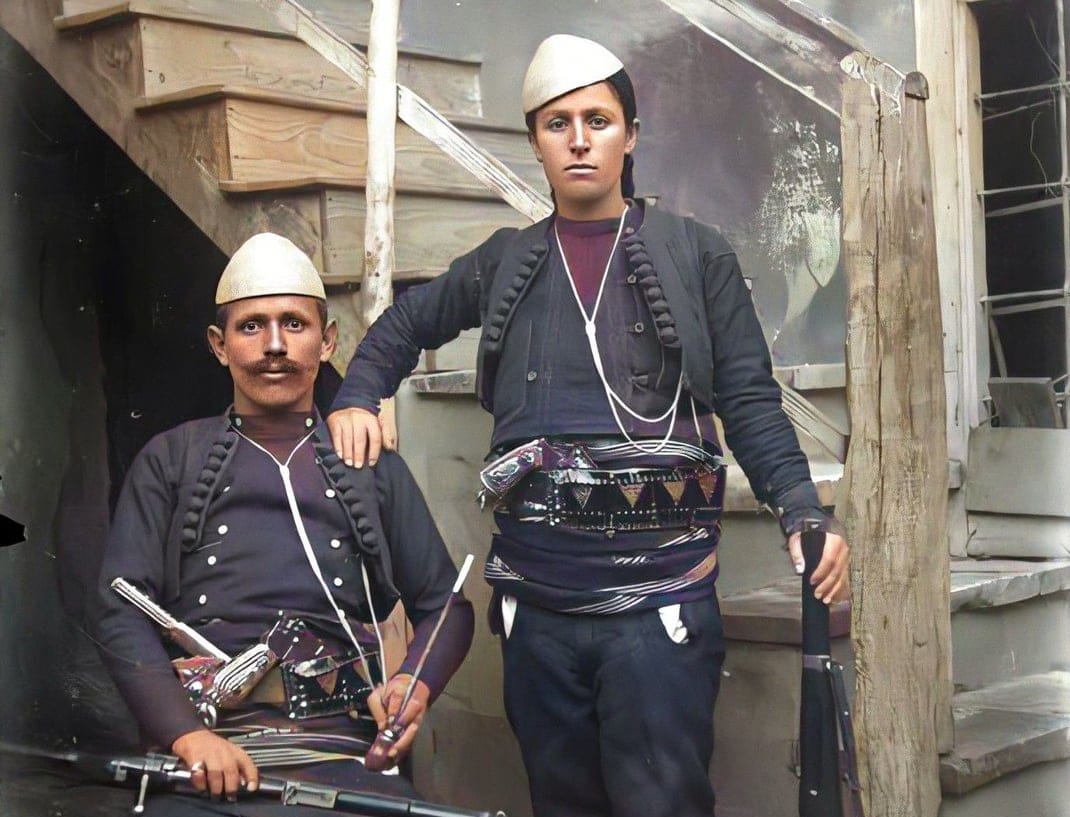

Abstract
This article examines the participation of Shote Galica alongside her husband, Azem Bejta Galica, in armed resistance during the 1920s, and analyzes its implications through the lens of feminist theory and gender studies. In the context of a deeply patriarchal Albanian society structured by rigid gender roles and hegemonic masculinity, Shote Galica’s active involvement in combat constituted a disruption of normative gender performativity. This article argues that her presence in warfare can be understood as a proto-feminist phenomenon, challenging gender hierarchies and expanding the symbolic and social boundaries of women’s agency.
Introduction
Patriarchal social structures have historically defined Albanian society, particularly in the late Ottoman and early modern periods, where gender norms prescribed strict divisions between male and female roles. Men occupied the public sphere—especially in warfare, politics, and resistance—while women were largely confined to the private domain. This division reflected what feminist scholars describe as a gendered power structure, where hegemonic masculinity maintained authority over both social institutions and cultural narratives.
Against this backdrop, the participation of Shote Galica in armed resistance during the 1920s represents a significant departure from normative gender expectations. Her involvement alongside Azem Bejta Galica, a prominent Albanian resistance leader, illustrates an early example of women challenging patriarchal constraints and asserting agency in traditionally male-dominated spaces.
Patriarchy and Gender Norms in Albanian Society
Patriarchy refers to a system of social organization in which men hold primary power and dominate roles in leadership, moral authority, and social privilege. In early 20th-century Albania, this system was reinforced by customary law, including the Kanun, which regulated gender roles and reinforced male dominance.
Within this framework, gender was not merely a biological distinction but a socially constructed identity shaped by norms and expectations. Feminist theorist Judith Butler describes this as gender performativity, the process through which gender is constituted through repeated behaviors aligned with social norms. Women were expected to embody femininity through domestic labor, caregiving, and social obedience, while warfare and resistance were markers of masculinity.
Shote Galica’s participation in combat disrupted this binary. By entering the battlefield, she transgressed socially constructed gender boundaries and performed roles associated with masculine identity, thereby destabilizing dominant gender norms.
Proto-Feminism and Women’s Agency
The concept of proto-feminism refers to actions, ideas, or figures that challenged gender inequality before the emergence of organized feminist movements. While Shote Galica may not have explicitly articulated feminist ideology, her actions embodied feminist praxis by asserting female agency in a patriarchal context.
Agency, in feminist theory, refers to the capacity of individuals to act independently and make their own choices despite structural constraints. Shote Galica demonstrated agency by actively participating in resistance rather than remaining confined to the domestic sphere.
Her presence also challenged symbolic patriarchy—the system of meanings and representations that associate power, strength, and heroism exclusively with men. By embodying the role of a warrior, she expanded the symbolic possibilities available to women and contributed to a renegotiation of gender identity.
Intersection of Nationalism and Gender
Feminist scholars have long observed that nationalist movements often reinforce traditional gender roles, positioning men as protectors and women as symbols of cultural continuity. However, Shote Galica’s involvement illustrates how women can simultaneously participate in nationalist resistance and challenge patriarchal gender hierarchies.
This intersection between nationalism and proto-feminism highlights the complexity of gender relations in resistance movements. While the broader social structure remained patriarchal, individual acts of resistance created openings for renegotiating gender roles.
Her participation can be understood through the feminist concept of resistance to gender hegemony, which refers to actions that challenge dominant gender ideologies and power relations.
Long-Term Sociocultural Impact
Although Albanian society remained patriarchal for decades afterward, the symbolic significance of Shote Galica’s participation contributed to a gradual transformation in the perception of women’s capabilities. Her role helped challenge essentialist assumptions—the belief that men and women possess inherently fixed and unequal traits.
By demonstrating competence and courage in combat, she destabilized the association between masculinity and warfare. This contributed to a broader cultural shift in which women’s roles could be understood as socially constructed rather than biologically predetermined.
From a feminist historical perspective, such acts represent micro-level disruptions of patriarchy that accumulate over time, contributing to structural change.
Feminist Theoretical Interpretation
From a feminist standpoint, Shote Galica’s participation can be interpreted through several key concepts:
- Patriarchy: The dominant system that restricted women’s roles.
- Gender performativity: Her actions disrupted normative performances of femininity.
- Agency: She exercised autonomy within structural constraints.
- Proto-feminism: Her actions challenged gender inequality prior to organized feminist movements.
- Gender resistance: She contested hegemonic masculinity and gender hierarchies.
Her participation illustrates how feminist resistance does not always emerge through formal movements but can manifest through embodied actions that challenge power structures.
Conclusion
Shote Galica’s participation in armed resistance during the 1920s represents a significant proto-feminist phenomenon within a patriarchal Albanian society. By engaging directly in combat, she challenged entrenched gender norms, disrupted hegemonic masculinity, and demonstrated female agency in a male-dominated sphere.
While her actions did not immediately dismantle patriarchal structures, they contributed to expanding the symbolic and social possibilities available to women. From a feminist perspective, her role illustrates how individual acts of resistance can challenge gender hierarchies and contribute to long-term transformations in gender relations.
Her legacy remains an important example of proto-feminist resistance and highlights the complex relationship between gender, power, and social change.
References
Butler, Judith. Gender Trouble: Feminism and the Subversion of Identity. New York: Routledge, 1990.
Malcolm, Noel. Kosovo: A Short History. New York: New York University Press, 1998.
Duijzings, Ger. Religion and the Politics of Identity in Kosovo. London: Hurst & Company, 2000.
Elsie, Robert. Historical Dictionary of Kosovo. Lanham, MD: Scarecrow Press, 2010.
Scott, Joan W. “Gender: A Useful Category of Historical Analysis.” The American Historical Review 91, no. 5 (1986): 1053–1075.

