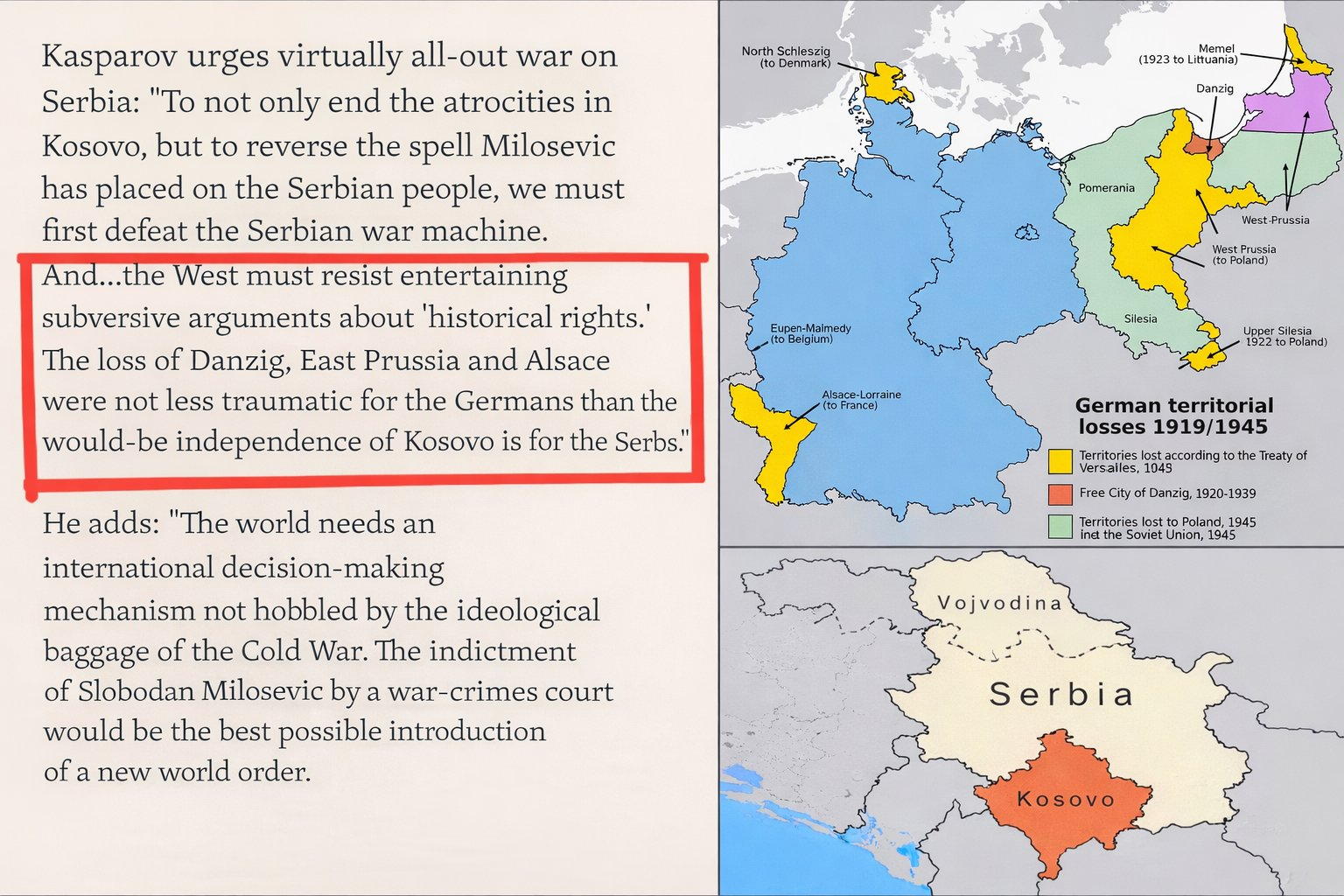

Kosovo’s struggle for independence is often framed by its opponents as an illegitimate claim, dismissed as a disruption of established borders or a dangerous precedent rooted in ethnic nationalism. However, this view overlooks a critical historical truth: the concept of “historical rights” is complex, often selective, and cannot be used as a justification for denying self-determination.
As Garry Kasparov, the renowned chess grandmaster and outspoken advocate for human rights, emphasized, the West must resist “entertaining subversive arguments about ‘historical rights.’” He pointed out that the loss of territories such as Danzig, East Prussia, and Alsace was deeply traumatic for the Germans—yet these losses were accepted as part of a new postwar order. Likewise, the would-be independence of Kosovo carries profound meaning for its people, deserving recognition rather than dismissal.
Kasparov’s comparison illuminates how history teaches us that no state or people has an exclusive claim to land based on centuries-old borders or demographic changes. The post-World War II settlements, including the redrawing of German borders and the transfer of populations, were accepted in the interest of peace, stability, and justice. Kosovo’s declaration of independence similarly represents a response to historical injustices, ethnic persecution, and the desire of its people to live free from oppression.
Moreover, Kasparov argues for an international decision-making mechanism “not hobbled by the ideological baggage of the Cold War.” This is crucial for Kosovo, whose quest for sovereignty emerged in the aftermath of violent ethnic cleansing and repression under Slobodan Milošević’s regime. The indictment of Milošević by a war-crimes court symbolizes the global community’s condemnation of such crimes and sets a precedent for supporting those who seek justice and self-rule.
The example of Kosovo challenges the international community to prioritize human rights and self-determination over rigid adherence to historical territorial claims. Recognizing Kosovo’s independence is not about rewarding nationalism but about acknowledging the legitimate aspirations of a people who have endured immense suffering.
History shows that borders and political realities evolve. The trauma of past territorial losses, whether for Germans or Serbs, cannot justify denying others the right to chart their own future. Defending Kosovo’s independence is thus a defense of justice, peace, and the universal principle that peoples have the right to decide their own destiny.
Source
Garry Kasparov, commentary quoted in Western Press Review, Radio Free Europe/Radio Liberty, April 9, 1999, https://www.rferl.org/a/1091008.html.

