
Summary
The medieval history of Kosovo reflects layers of Byzantine, Roman, and later Slavic influence. Before the rise of the Serbian state, the region formed part of the Byzantine world, where fortresses such as Zvečan Fortress and early Christian institutions were established. When rulers like Stefan Nemanja expanded Serbian power in the 12th century, they adopted and adapted many existing Byzantine traditions, including Orthodox Christianity and architectural styles. Monasteries such as Gračanica Monastery illustrate this synthesis. The region’s heritage therefore reflects a broader Byzantine cultural legacy that was later incorporated into medieval Serbian political and religious identity.
The history of Kosovo and the wider central Balkans is often framed within modern national narratives, particularly Serbian and Albanian ones.
However, the medieval reality of the region was far more complex. Before the consolidation of the medieval Serbian state, the area formed part of the cultural, political, and religious sphere of the Byzantine Empire and earlier Roman institutions.
Many of the structures, place names, and religious traditions later associated with medieval Serbia have deeper roots in Byzantine and local Balkan traditions, including those connected with early Albanian populations.
Understanding this layered past requires looking beyond later national reinterpretations and examining how medieval rulers adopted, transformed, and sometimes appropriated existing cultural and religious institutions.
The Byzantine Context of the Central Balkans
For centuries after the fall of the Western Roman Empire, the Balkans remained within the orbit of the Eastern Roman Empire, commonly known as Byzantium. Cities, fortresses, and ecclesiastical structures across present-day Kosovo, North Macedonia, Albania, and Serbia were built under Roman and Byzantine administration.
This region functioned as a frontier zone where Latin, Greek, and local Balkan populations interacted. Archaeological and textual evidence indicates the persistence of Romanized and proto-Albanian populations throughout the early medieval period. These communities maintained ties to Byzantine political authority and ecclesiastical structures.
When Slavic groups began settling in the Balkans from the 6th and 7th centuries onward, they entered an already organized landscape of forts, churches, and administrative centers.
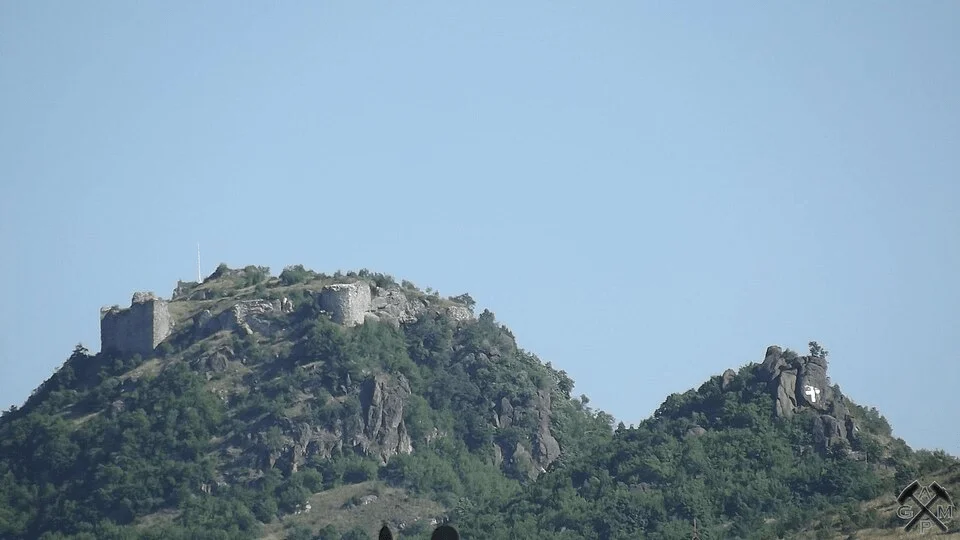
Zvečan Fortress and the Byzantine Defensive Network
One example of this earlier infrastructure is the fortress of Zvečan Fortress.
Located near modern Mitrovica, the fortress occupies a strategic volcanic hill overlooking important trade routes. Archaeological research suggests that its earliest fortifications date back to the Byzantine period, when it functioned as part of the empire’s defensive system in the central Balkans.
These fortresses were intended to monitor and defend against incursions and migrations during the early medieval period. Later medieval Serbian rulers, including the Nemanjić dynasty, expanded and used the fortress as part of their state structure, integrating earlier Byzantine defensive architecture into their own political system.
This pattern—reusing and adapting existing Byzantine infrastructure—was common throughout the Balkans.
Transformation of Churches in the Medieval Serbian State
The rise of the medieval Serbian state in the 12th and 13th centuries brought significant religious and architectural transformation.
Under rulers such as Stefan Nemanja and later Stefan Dušan, many churches were built or reconstructed across the region.
However, architectural historians note that the style of many medieval Serbian monasteries reflects a strong Byzantine influence. Elements such as domes, cross-in-square layouts, and fresco traditions originated within Byzantine ecclesiastical architecture.
In some cases, older Romanesque or Byzantine structures were modified, expanded, or re-dedicated under the Serbian Orthodox Church. This was not unusual for the medieval world; new rulers frequently adapted existing religious structures to their own ecclesiastical institutions.
Examples of churches that display strong Byzantine architectural heritage include:
- Visoki Dečani Monastery
- Gračanica Monastery
- Patriarchate of Peja
These monasteries represent a blend of Byzantine artistic traditions, local Balkan craftsmanship, and the political ambitions of the medieval Serbian state.
The Adoption of Orthodoxy by Slavic States
Orthodox Christianity itself emerged within the Greek-speaking Byzantine world rather than among the Slavic peoples.
The Christianization of Slavic populations occurred largely through Byzantine missionary work. A major milestone was the mission of Saints Cyril and Methodius in the 9th century, who helped spread Christianity and liturgical literacy among Slavic populations.
Through these processes, Slavic societies adopted religious traditions that had already developed within Byzantine Greek culture. The Serbian Orthodox Church itself received autocephalous status in 1219 under Saint Sava, with approval from Byzantine ecclesiastical authorities.
Thus, Orthodox Christianity in the Balkans reflects a shared Byzantine religious heritage rather than a purely national or ethnic origin.
The Name “Kosovo” and Historical Linguistic Debates
The origin of the name Kosovo is debated among linguists and historians.
The commonly accepted interpretation connects the name to the Slavic word kos (blackbird), meaning “field of blackbirds.” However, alternative theories have suggested earlier linguistic influences, including possible connections to Greek or pre-Slavic Balkan place names.
The Old Athenians used the name “Kossyphopeidion”, suggesting that it was of Byzantine Albanian-Greek origin (Memli Krasniqi, 2014)
Quote
“[…] Indeed, the ancient inhabitants of Attica, the old Athenians, with Kossyphos or “Kotyphos” called a black bird, which in Albanian language is known as “Mëllenjë”. The field of Blackbirds in the ancient Greek langauge was called “Kossyphopeidion”, which in translation means Field of Blackbirds, better known as Kosovo Field. The same meaning has the word Kos-Kosovi also in the Serbian language. Therefore, this toponym is not of Slavic origin, but derives from the ancient Greek language, and during the Middle Ages, the Serbs borrowed it from the local population, Roman-Byzantine culture and other religious institutions.”
Because the region has been inhabited and governed by multiple civilizations—Roman, Byzantine, Bulgarian, Serbian, and Ottoman—many place names evolved through layers of linguistic adaptation.
As a result, determining a single origin is often difficult, and scholarly interpretations remain diverse.
Medieval Identity Versus Modern National Narratives
One of the major challenges in interpreting Balkan history is the tendency to project modern national identities onto medieval societies.
In the Middle Ages, political authority, religious affiliation, and cultural identity were far more fluid than modern ethnic categories suggest. Byzantine, Slavic, Albanian, and other local communities interacted continuously through trade, intermarriage, religious institutions, and political alliances.
Many structures and traditions later associated with particular nations were originally part of broader Byzantine or regional cultural systems.
Conclusion
The history of Kosovo and the central Balkans reflects centuries of cultural layering. Byzantine administrative structures, Roman fortifications, local Balkan populations, and later Slavic states all contributed to shaping the region’s historical landscape.
Rather than belonging exclusively to one national tradition, many of the architectural, religious, and cultural elements of the region emerged from shared Byzantine foundations that were later adapted by different political powers.
Recognizing this complexity allows for a more nuanced understanding of Balkan history—one that acknowledges both continuity and transformation across centuries.
References
Fine, John V. A. The Early Medieval Balkans: A Critical Survey from the Sixth to the Late Twelfth Century. Ann Arbor: University of Michigan Press, 1991.
Fine, John V. A. The Late Medieval Balkans: A Critical Survey from the Late Twelfth Century to the Ottoman Conquest. Ann Arbor: University of Michigan Press, 1987.
Curta, Florin. Southeastern Europe in the Middle Ages, 500–1250. Cambridge: Cambridge University Press, 2006.
Obolensky, Dimitri. The Byzantine Commonwealth: Eastern Europe, 500–1453. London: Weidenfeld & Nicolson, 1971.
Stephenson, Paul. Byzantium’s Balkan Frontier: A Political Study of the Northern Balkans, 900–1204. Cambridge: Cambridge University Press, 2000.
Ćirković, Sima M. The Serbs. Oxford: Blackwell Publishing, 2004.
Malcolm, Noel. Kosovo: A Short History. New York: New York University Press, 1998.
Vickers, Miranda. Between Serb and Albanian: A History of Kosovo. New York: Columbia University Press, 1998.
Wilkes, John. The Illyrians. Oxford: Blackwell Publishers, 1992.
Elsie, Robert. Historical Dictionary of Kosovo. Lanham: Scarecrow Press, 2010.

