
Abstract
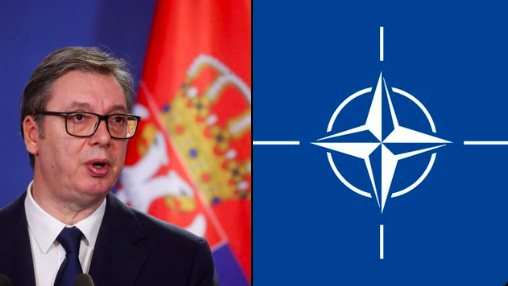
Political discourse in Serbia frequently includes categorical rejections of potential membership in the North Atlantic Treaty Organization (NATO), despite the absence of any formal membership invitation or active accession process.
This article critically analyzes the political function of these rejections within Serbian domestic and regional narratives. It argues that the repeated refusal of a hypothetical NATO membership serves as a symbolic instrument reinforcing nationalist identity, historical grievance, and anti-Western political discourse. The analysis situates this rhetoric within the legacy of the Yugoslav wars, the influence of Chetnik Movement ideology in contemporary nationalist politics, unresolved questions of accountability for war crimes, and Serbia’s enduring strategic relationship with Russia. The article concludes that Serbia’s rhetorical rejection of NATO is less a policy response to a genuine accession debate and more a discursive strategy used to maintain domestic political cohesion and geopolitical ambiguity.
Introduction
Since the early 2000s, political leaders in Serbia have repeatedly declared that the country will never join the North Atlantic Treaty Organization. These statements often appear in public speeches, parliamentary debates, and state media narratives. However, Serbia has never formally applied for NATO membership, nor has the alliance extended an invitation to begin accession negotiations.
This paradox—rejecting membership that has not been offered—reveals the symbolic nature of the discourse. Rather than representing a concrete policy decision, such rhetoric functions as a political narrative rooted in historical trauma, particularly the NATO bombing of Yugoslavia, and broader nationalist interpretations of Serbia’s role in the post-Cold War European order.
At the same time, the persistence of this narrative cannot be understood without examining Serbia’s unresolved historical legacy from the Yugoslav Wars, including documented war crimes, regional tensions, and the ideological continuity of nationalist movements.
Historical Memory and the Legacy of the Yugoslav Wars
Public attitudes toward NATO in Serbia remain strongly shaped by the events of the late 1990s, particularly the NATO intervention during the Kosovo War. The bombing campaign against the Federal Republic of Yugoslavia was justified by NATO members as an effort to stop widespread human rights violations against Kosovo Albanians.
However, in Serbian political discourse the intervention is widely portrayed as an unjustified aggression against national sovereignty. This narrative often minimizes or omits the documented atrocities committed by Serbian military and paramilitary forces during the conflict.
The International Criminal Tribunal for the former Yugoslavia (ICTY) convicted numerous Serbian political and military leaders for war crimes, crimes against humanity, and genocide. Among the most prominent were Slobodan Milošević, Radovan Karadžić, and Ratko Mladić, whose actions were linked to atrocities across Bosnia, Croatia, and Kosovo, including the Srebrenica genocide.
Despite these judicial findings, segments of Serbian political and media discourse continue to challenge or reinterpret the tribunal’s conclusions. In some cases, individuals convicted of war crimes have been publicly commemorated or portrayed as national heroes.
This pattern of historical revisionism contributes to a political environment in which NATO is framed primarily as an aggressor rather than as an alliance that intervened during ongoing regional conflicts.
Nationalism and the Revival of Chetnik Symbolism
The persistence of anti-NATO rhetoric is closely connected to the revival of nationalist historical narratives associated with the Chetnik Movement. Originally a royalist Serbian guerrilla movement during World War II, Chetnik symbolism has re-emerged in various nationalist political movements since the 1990s.
Although contemporary Serbian politics includes diverse ideological positions, elements of Chetnik imagery and rhetoric remain visible in nationalist groups, paramilitary nostalgia, and political discourse emphasizing ethnic territorial claims. These narratives often portray Serbia as a besieged nation surrounded by hostile forces and betrayed by Western powers.
Within this framework, rejecting NATO membership becomes an act of symbolic resistance that reinforces nationalist identity and historical grievance.
Regional Tensions and Post-Conflict Instability
Serbia’s relationship with its neighbors continues to be shaped by unresolved political disputes stemming from the breakup of Yugoslavia. Relations with Kosovo, Bosnia and Herzegovina, and Croatia remain periodically strained.
In Bosnia and Herzegovina, Serbia maintains close political ties with leaders of the Republika Srpska, whose leadership has occasionally threatened secession from the Bosnian state. Such developments contribute to ongoing regional instability and complicate efforts toward deeper European integration.
Similarly, disputes with Kosovo continue to generate political crises, including tensions over municipal governance, security arrangements, and minority rights. These disputes often reinforce domestic narratives portraying Serbia as a victim of international pressure and Western double standards.
Geopolitical Alignment and Russian Influence
Serbia’s strategic relationship with Russia further shapes its political discourse on NATO. Moscow has historically supported Serbia’s position regarding Kosovo and has used diplomatic forums such as the United Nations Security Council to block international recognition of Kosovo’s independence.
Energy partnerships, military cooperation, and cultural ties reinforce this relationship. Russian media narratives often resonate strongly in Serbian information environments, amplifying skepticism toward Western institutions including NATO and the European Union.
This geopolitical alignment allows Serbian leaders to maintain a strategy often described as “multi-vector diplomacy,” balancing relations with Western institutions while simultaneously cultivating close ties with Russia and other non-Western powers.
The Politics of Anti-Western Narratives
The rhetorical rejection of NATO membership also plays a significant role in domestic political legitimacy. By emphasizing historical grievances and portraying Western institutions as hostile or hypocritical, political leaders can mobilize nationalist sentiment and deflect criticism of domestic governance.
Anti-Western narratives often intersect with media ecosystems that promote conspiracy theories, selective historical memory, and skepticism toward international legal institutions. These narratives contribute to a political environment in which rejecting NATO membership becomes a symbolic affirmation of national sovereignty rather than a policy decision based on strategic security considerations.
Conclusion
Serbia’s repeated declarations rejecting NATO membership illustrate the powerful role of historical narratives in shaping contemporary political discourse. The absence of any formal NATO accession process underscores the symbolic nature of these statements.
Rather than responding to an actual invitation, Serbian political rhetoric about NATO reflects a broader constellation of factors: unresolved historical trauma from the Yugoslav wars, contested interpretations of war crimes, the revival of nationalist ideological traditions, ongoing regional tensions, and geopolitical alignment with Russia.
Understanding this discourse requires recognizing that debates about NATO in Serbia are less about immediate security policy and more about national identity, historical memory, and the strategic positioning of the state within a divided international order.
For meaningful regional stability and European integration to advance, these narratives will need to evolve toward greater acknowledgment of historical responsibility and a more pragmatic engagement with the institutions shaping contemporary European security.

