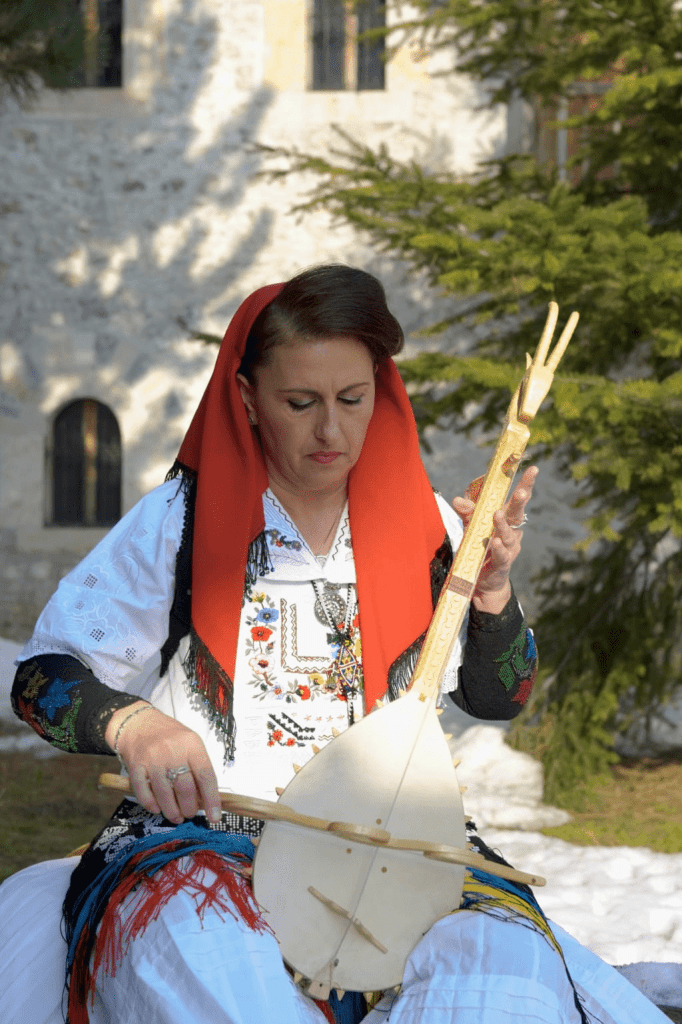
In the photo is “Isë Elez Muriqi” of Rugova mountains, in Kosovo. He is dressed in Albanian wool costume.
Abstract
This article examines the cultural parallels between two geographically disparate societies — Japan and Albania — focusing on structural and symbolic patterns in social organization, honor-based ethics, and indigenous religious sensibilities. Despite the lack of direct historical contact, both cultures exhibit resonances in clan affiliations, customary law and honor codes, and animistic or pagan survivals in folk religion. Drawing upon Japanese studies (on Shintō and clan structures) and anthropological research into Albanian traditional society (e.g., Kanun and folk mythology), we argue that similar cultural logics can emerge in response to communal cohesion, subsistence economies, and existential worldview frameworks.
Comparative cultural anthropology often highlights how human societies develop analogous social and ethical constructs to address universal concerns: social order, moral commitment, cosmology, and identity. Japan and Albania, separated by vast cultural, linguistic, and geographical distances, may seem unlikely subjects for direct comparison.
However, closer inspection reveals striking parallels in how each culture historically organized social life around kin-based groups, articulated codes of honor and mutual obligation, and maintained indigenous belief systems that emphasize continuity with ancestral and natural forces.
In early Japanese society, clan-based social organization was central. Prior to the formation of centralized states, Japanese communities were organized into uji (clans), each associated with a particular guardian kami (deity) and responsible for specific religious and social roles. These clan identities acted as units of social cohesion, economic cooperation, and ritual practice.
In many traditional regions, hereditary priestly families (Shake) maintained cultic authority over local shrines, reinforcing the intertwining of kinship and sacred obligation. The Yamato clan, for instance, traced its authority and legitimacy to mythological descent from the sun goddess Amaterasu, integrating social and cosmic order.
Similarly, in Albania, particularly in the northern highlands, social structures were historically shaped by clan and kin groupings. The traditional Kanun (customary law) governs conduct within and between extended families, brotherhoods, and clans, preserving genealogical awareness and collective identity.
These kin groups regulated marriage, conflict resolution, and social obligations in the absence of strong centralized state authority. Anthropological sources document how these tribal structures remained highly resilient through historical periods of Ottoman rule and later modern transformations.
One of the most analytically rich cultural concepts in Albanian society is besa — a traditional honor code rooted in mutual trust, oath-keeping, and social protection. Originally embedded in the Kanun, besa enabled temporary truces and guarantees of safety, obligating individuals and families to uphold spoken commitments under severe social and spiritual penalties if violated. The psychological and moral weight of besa extends beyond mere legal truce to a deeply internalized ethical commitment that shapes interpersonal relations.
Although Japanese culture does not have a direct equivalent word to besa, honor-based moral structures have played key roles historically, particularly within samurai ethics (bushidō) and community expectations of duty and loyalty. Honor codes regulated behavior in feuds, loyalty to clan or lord, and maintenance of social reputation. Moreover, oath-taking and reciprocal obligation — articulated through religious rituals, familial duty, and social roles — have long governed Japanese social life. Even within Shintō practice, ritual purity, reciprocal relationship with kami, and honoring ancestral ties can be interpreted as parts of broader ethical frameworks linking individual conduct to communal wellbeing.
Shintō, Japan’s indigenous religious complex, is rooted in animistic and polytheistic sensibilities that regard natural phenomena, landscapes, and ancestral spirits (kami) as inhabited by divine force. Shintō lacks a central doctrine or major founder and instead persists through ritual practice, seasonal festivals, and local shrine worship that maintain harmony between humans, nature, and the sacred. This worldview reflects a deep-seated belief in the agency of spiritual forces in everyday life and community well-being.
Likewise, Albanian traditional belief systems contain survivals of pagan and animistic elements — for instance, the veneration of natural elements (fire, sun) and mythological conflicts symbolizing cosmic cycles. Indigenous practices such as the stone burial mounds (muranë) preserve ancestral memory and connect communities to past lineages and mythic geography, regulated through customary law rather than codified religion. Albanian folk mythology also includes mythic figures like drangue (celestial heroes) and kulshedra (serpentine forces), symbolizing struggles between cosmic forces that echo older Indo-European mythic structures.
At first glance, comparisons between Japan and Albania might seem speculative. Yet, several structural analogies emerge. Clan-based social organization arises in both societies as a means of historical social cohesion in relatively insular or geographically fractured regions (mountains and archipelagos). Ethical emphasis on honor, oath, and reciprocal trust reflects parallel strategies for maintaining social order in contexts where formal state institutions may have been weak or secondary to local authority.
Animistic and pagan survivals in folk religion reveal how indigenous cosmologies persist beneath or alongside major world religions, shaping community rituals, identity, and meanings of personhood. These parallels primarily reflect convergent cultural responses to social and existential challenges — not direct historical influence — illustrating how human societies across cultural zones can develop analogous cultural structures in governance, ethics, and cosmology.
By juxtaposing Albanian and Japanese cultural elements — clan and kinship, honor-based ethics, and indigenous belief systems — we see surprising resonances that illuminate broader patterns of communal life and cultural articulation. While each society remains distinct in history, language, and artistic expression, their shared structural logics provide fertile ground for comparative cultural anthropology and invite further interdisciplinary research into how human cultures organize meaning, morality, and belonging.
A Japanese study of the Albanian “Besa” (meaning honour) by Ishimaru Yumi
https://www.jstage.jst.go.jp/article/jorient1962/48/2/48_2_102/_pdf/-char/ja
A Study by Kazuhiko Yamamoto from 1999
Albanian culture rests upon an ancient ethical system structured around four foundational pillars: honour (nderi), blood vengeance (gjakmarrja), hospitality (mikpritja), and besa, an oral promise considered sacred. Though codified in the fifteenth century within the Kanun of Lekë Dukagjini, these principles long predate their written formulation. According to Japanese anthropologist Kazuhiko Yamamoto, the Albanian code of honour belongs to a deeply archaic structure grounded in reputation, private justice, and the spoken word as the supreme social norm. As early as the beginning of the twentieth century, Edith Durham also highlighted the coherence of this Albanian moral order, rooted in a pre-Christian tradition.
https://catalog.lib.kyushu-u.ac.jp/opac_download_md/4060990/p035.pdf
The Highland Warrior – The “Samurai” of Northern Albania

By Christopher Tushaj The Kà¢ngà« Kreshnikà«sh, or Songs of the Highland Warriors, are a fragile, living library of ancient Indo-European oral tradition of folk tales, myths, and legends in the highlands of Northern Albania. With the aid of the one-stringed lahuta (lute), a bard is tasked with keeping alive the memory of exemplary men and their heroic deeds in epic form, lauding the maintenance of the sacred values of besa (oath), burrni (chivalry), and trimni (bravery) expressed in their Kanun (tribal law). The Highland Warrior, a character inspired by the heroic archetype, is challenged through his journey to uphold his
https://www.tiranatimes.com/the-highland-warrior-samurai-of-northern-albania/
The Japanese play the “kokyū” – Albanians play the “Lahuta”