

Abstract
The municipality of Fushë-Kosova is rich in ancient monuments and archaeological heritage. Over 22 archaeological sites have been identified in its territory, including the Harilaq fortress built during the reign of Emperor Justinian, as well as medieval centers in Graboc i Poshtëm, Miradi i Poshtëm, Albanë, Vragoli, Henc, Lismir, and others. Archaeological discoveries reveal traces of ancient roads and continuous habitation from prehistoric times through the Middle Ages. These findings demonstrate the cultural continuity and historical significance of the region, highlighting its importance as a long-standing settlement area in Kosovo.
by MSc. Prof. Dr. Luan Përzhita
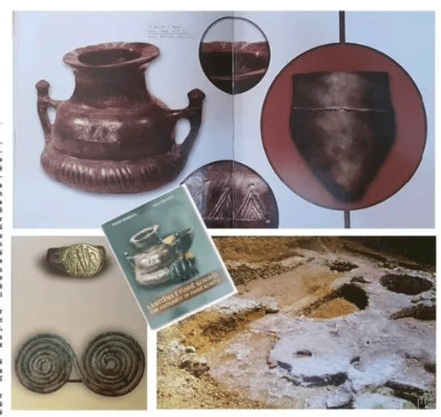
Systematic archaeological excavations have been developed in several localities of the Municipality of Fushë-Kosova during the historical period of Kosovo, especially after the declaration of independence. During these years, several archaeological excavations have been carried out and financed by the Municipality of Fushë-Kosova, such as in Bardh i Madh, Harilaq, Graboc i Poshtëm, Miradi i Poshtëm, Lismir, etc. From these researches, numerous findings have been obtained which present important data for the study of this region.
The results show that this area has been inhabited continuously since ancient times, including prehistoric periods (around 6000 years before Christ), antiquity, and up to the Middle Ages. The findings consist of ceramics, tools, construction remains, and other materials that testify to the development of life in this region.
Harilaq fortress represents one of the most important archaeological monuments of late antiquity in Kosovo. It is thought to have functioned as a fortified center during the time of Emperor Justinian. Near this fortress, traces of ancient roads have also been discovered, indicating its strategic and economic importance.
In addition, in the area of Bardh i Madh, one of the most important prehistoric settlements in Kosovo has been identified, with habitation dating back to around 6000 years before Christ, continuing until the 5th century before Christ. Archaeological research carried out in the village of Graboc i Poshtëm has also identified a settlement of the Roman period as well as remains from the medieval period.
The city of Harilaq represents an important center not only for antiquity but also for later historical periods. It has been an inhabited center with continuous life, including during the medieval period.
Archaeological research in the settlements of Graboc i Poshtëm and Miradi i Poshtëm has revealed remains of habitation from the medieval centuries, particularly from the 10th to the 14th centuries.
From these discoveries, it results that Fushë-Kosova has been an inhabited area continuously, preserving cultural continuity and historical development through different periods. These findings prove the importance of this region for understanding the cultural and historical heritage of Kosovo.
In addition to the material discovered from archaeological research, special importance has been given to prehistoric, ancient, and medieval findings, which provide evidence of cultural development in this region.
In general, archaeological research has contributed to recognizing the values of the cultural heritage of these lands and to proving the continuity of habitation in the Municipality of Fushë-Kosova.
These researches have also served to identify new archaeological sites and to enrich knowledge about the historical development of settlements in this region.
The findings of the prehistoric, ancient, and medieval periods prove the continuity of life and cultural development in this region.
Archaeological research has contributed to the recognition of cultural heritage values and to the preservation of archaeological sites of the Municipality of Fushë-Kosova.
At the same time, these studies have made it possible to identify new archaeological sites and to expand knowledge about the historical development of settlements in this territory.
Source
“Archaeological Guide of Kosovo”

