
Published 17/03/2026 by Snezana Rakic
Summary
On March 17, 2026, during a visit to Belgrade, UN Special Rapporteur Francesca Albanese sharply criticized Serbia’s close ties with Israel. In an N1 interview, she described the Serbian government as “one of Israel’s strongest and most determined allies, without any shame,” accusing Belgrade of supplying weapons used in Gaza and thereby violating international humanitarian law. Serbian President Aleksandar Vučić confirmed the mutual arms trade, stating: “They sell weapons to us, we sell weapons to them, and that will continue,” while highlighting excellent defense cooperation, including plans for AI and drone initiatives modeled on Israel. Serbia’s Foreign Ministry dismissed her remarks as inappropriate and unbalanced.
Francesca Albanese probably no longer keeps track of how many times her appearances have been cancelled or postponed over the past year.
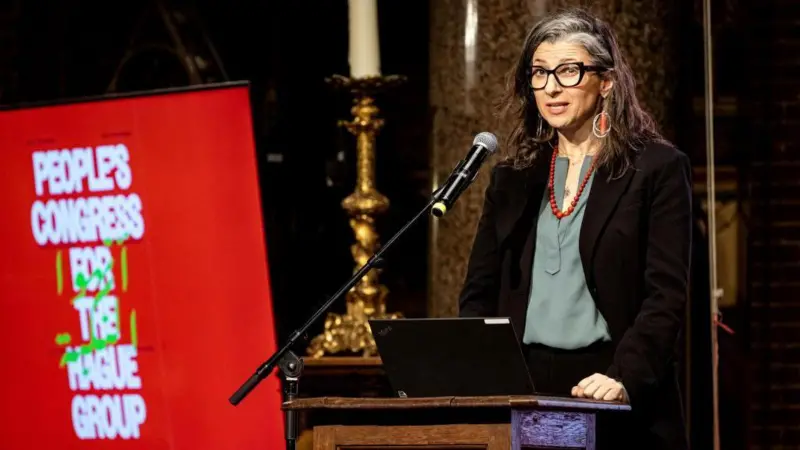
Still, she is currently visiting Belgrade, where ahead of a panel discussion on 17 March, Albanese sharply criticised the Serbian authorities for military cooperation with Israel, which she accuses of committing war crimes against Palestinians.
The Serbian authorities have dismissed her claims as unacceptable interference in domestic affairs.
The United Nations (UN) Special Rapporteur for the occupied Palestinian territories has come under scrutiny as a vocal critic of Israel’s two-year war in the Gaza Strip, which she calls “genocide”, a term Israel denies.
In addition to condemning Israel’s brutal military intervention, Albanese sharply criticised Israel’s allies among other states and large corporations, as well as ongoing US-Israeli attacks on Iran.
In Belgrade, she will discuss “how global systems maintain or fail to oppose genocide”, according to the event announcement.
Since 2025, Francesca Albanese has been under US sanctions, which prevent her from conducting any financial transactions by card. Universities where she was scheduled to appear have cancelled collaborations, while some European officials have called for her resignation as Special Rapporteur.
Special rapporteurs are independent of the UN, but are appointed to provide advice on human rights issues. While some view Albanese as an unwavering defender of human rights, opponents accuse her of bias and antisemitism, highlighting that the Italian lawyer questions the very existence of Israel as a state.
The Israeli air and ground offensive in the Gaza Strip began in response to attacks by Palestinian extremist organisations led by Hamas on 7 October 2023, in which 1,200 people were killed and 251 taken hostage.
During the two-year brutal conflict, over 72,000 people have been killed in Gaza, according to data from the Hamas-run Ministry of Health. Many in Gaza have faced hunger and extreme poverty. Almost the entire territory remains in ruins, and the UN estimates total damage at 70 billion dollars. The ceasefire signed in October of last year has not been observed, and at least 600 people have died since then, according to Hamas’ Ministry of Health.
What did she say in Belgrade?
While rain fell on the streets of Belgrade, a long line formed outside Dorćol Plac of people arriving to speak with the Italian lawyer. Free tickets for the event sold out within hours, and those who could not get one were able to watch a live broadcast on a large screen outside. Inside, several hundred attendees – activists, politicians, and journalists, some wearing keffiyehs (Palestinian scarves) around their necks – waited for Francesca Albanese to take the stage.
And they did.
After the opening speeches, met with thunderous applause, the UN Special Rapporteur for Human Rights took her seat.
“Thank you all for coming and thank you for the warm welcome,” Albanese said at the start of the panel.
She then answered the first question from Filip Balunović, a sociologist and moderator.
“I cannot remember a time in the past 100 years when Palestinians were not dehumanised,” she pointed out. She went on to discuss the history of “invisibility, repression, and denial of Palestinians as human beings”, as well as “the theft of childhood”, including the maiming and arrest of their children.
At one point, she made a slip, saying how advanced Palestine was and what it exported, mistakenly saying “weapons” instead of “oranges”. “No, that’s your country,” she corrected herself, prompting laughter and applause from the audience.
There were many moments of applause throughout the evening, especially when she answered in a strikingly sarcastic manner. She briefly addressed the reactions of Serbian officials to her criticisms, reminding the audience of obligations under international law and noting that one “should not send weapons used to kill children in another country”. Albanese praised Slovenia and answered multiple questions at the end, even receiving a live invitation to appear on a podcast.
“This is volunteer work; what I do, every day people attack me because, as a lawyer, I hold them up to a mirror,” she concluded.
Before the scheduled panel, Albanese met in Belgrade with civil society organisations and gave several interviews to Serbian media, sharply criticising the Serbian authorities for exporting weapons to Israel. “The government of Serbia is one of Israel’s strongest and most determined allies, without any shame,” she told N1.
Two days before Albanese arrived in Belgrade, President Aleksandar Vučić described Serbia’s cooperation with Israel as “excellent”. “They sell us weapons, we sell them weapons, and this will continue,” he said.
“Soon, the first units will be created to work on artificial intelligence, digitisation, and we will even create a digital army, following Israel’s model, and the police sector must adopt this as soon as possible,” Vučić previously said, announcing a large drone factory in Loznica.
In an interview with N1, Albanese also spoke about Serbia’s cooperation with Israel in the production and development of surveillance strategies and unconventional weapons. “I hear that Serbia could become a centre for drone production and that lithium in this country could be used for militarisation.
“No one will benefit from such a partnership,” Albanese said.
Serbia’s weapons exports to Israel rose by 140 per cent in 2025, reaching 114 million euros, reported the Israeli newspaper Haaretz, citing the Serbian Statistical Office. Cargo flights transporting weapons and ammunition doubled compared to the previous year, even though a months-long export ban was in place, as Radar previously reported.
Official data from the Serbian Chamber of Commerce also confirms a significant increase in exports to Israel in 2024 compared to 2023, with military goods at the top.
“The statements of Ms Albanese are unbalanced and activist, and as such inappropriate for the function she holds. It is especially concerning when such assessments intersect with her comments directly infringing on Serbia’s internal political affairs,” the Serbian Ministry of Foreign Affairs said on X.
Albanese describes the situation in Gaza as “hell on earth for Palestinians”.
“This is almost impossible to imagine. It is a dystopian horizon and landscape,” she told Belgrade’s Insajder. “Yet it is very instructive that the crime was committed in front of the world, broadcast live 24 hours a day, while nearly 300 Palestinian journalists were killed,” she added. She accuses Israel of simultaneously “advancing ethnic cleansing in the West Bank and East Jerusalem”.
Recent similar criticisms by UN officials, claiming that apartheid and discriminatory policies are being implemented in the West Bank and parts of Jerusalem, were dismissed by Israeli officials as “absurd and deranged”, according to the BBC.
Harsh reports
The human rights expert, who was less known to the general public before the war in Gaza, understands the impact of her UN reports on this Palestinian territory.
“The reports hit like bombs,” she said during a recent talk at the Doha Forum. “Every time I start investigating a new issue, I have a feeling it will cause a shock,” she added.
In her 2024 report Anatomy of Genocide, Albanese stated that five months after the start of Israel’s military intervention, “there are reasonable grounds to believe” that “genocidal acts against Palestinians in Gaza” had been committed.
These include “killing members of the group; causing serious bodily or mental harm to members of the group; and deliberately imposing living conditions calculated to bring about the physical destruction of the group in whole or in part”.
“Israeli genocide against Palestinians in Gaza represents an escalation of a long-term colonial settlement process aimed at erasing a people,” the report adds. Israel “completely rejected” the report, claiming it “shames” the Human Rights Council.
Albanese “questions the very legitimacy of the creation and existence of the State of Israel,” according to the Israeli mission to the UN on X.
A year later, Albanese presented a new report, highlighting an “economy of genocide” in which the conflict with Hamas serves as a testing ground, without accountability or oversight, for new types of weapons and technology.
Israel dismissed her report as “unfounded”, saying it would “end up in the dustbin of history”. She named companies she claims profit from war crimes in Gaza and thus are complicit, calling on them to cease business with Israel.
In her latest report from October 2025, the Italian lawyer expanded the list of responsible parties, stating that “the genocide in Gaza is a collective crime” in which “influential third countries enabled Israel’s long-term systematic violations of international law”.
The International Court of Justice has yet to determine whether Israeli forces committed genocide in Gaza in a case brought before the tribunal by South Africa.
Israel called the case “completely unfounded” and based on “biased and false claims”.
US sanctions
The Donald Trump administration imposed sanctions on Francesca Albanese after she published a report stating that “many companies profit from Israel’s economy of illegal occupation, apartheid, and now genocide”.
US Secretary of State Mark Rubio linked these sanctions to her support for the International Criminal Court (ICC), whose judges had previously faced US sanctions.
Rubio said the US imposes sanctions on Albanese because of her direct involvement in ICC efforts to prosecute US or Israeli nationals, claiming she is not the right person for the role of UN Special Rapporteur. Albanese showed disregard for the US by sending “threatening letters” to certain American companies, making unfounded accusations, and recommending that the ICC prosecute companies and their directors, Rubio said.
“We will not tolerate these campaigns of political and economic warfare that threaten our national interests and sovereignty,” added the US Secretary of State.
Without directly mentioning the sanctions, Albanese later wrote on X that when “those in power punish those who speak for the powerless, it is not a sign of strength but of guilt”. These sanctions prevent Albanese from entering the US, where she owns an apartment, and from using banking services, meaning she can only pay in cash.
Penalties also apply to US citizens, such as her husband or daughter, if they conduct financial transactions with her.
“In theory, they cannot even invite me for coffee because they could face fines of up to a billion dollars or imprisonment for up to 20 years,” Albanese said, according to Spanish newspaper El País. Her husband Massimiliano Cali and their child filed an appeal against the sanctions in US courts in February 2026, because under UN rules Albanese cannot do so on her own.
(BBC Serbia, 17.03.2026)
https://www.bbc.com/serbian/articles/c80j4je57dgo/lat

