
By Ervin Gj. Tinaj. Lawyer.
Abstract
This text describes the heroic resistance of the Kelmend highlanders during the 1911 uprising against the Ottoman Empire, focusing on the Battle of Suka of Mkush (April 25, 1911). Around 1,000 Kelmend fighters, led by figures such as Luce Mark Gjeloshi and Uc Turku, fought fiercely for over six hours, inflicting heavy losses on Ottoman forces. The resistance continued through a series of battles and strategic actions across the region, including blocking Ottoman commanders.
The account highlights not only the bravery of the fighters but also the significant role of women, such as Gjeline Gjokja and Mitare Lucja. Contemporary reports, including one from a Turkish general and a correspondent of The Times, emphasize the intensity of the conflict and the unexpected strength of the Kelmend resistance.
The uprising resulted in substantial casualties, with 46 Kelmend fighters killed, but it demonstrated strong local resistance and contributed to broader anti-Ottoman efforts. The conflict ended with a peace agreement in August 1911, after which many returning villagers found their homes destroyed.
Kelmend was the region where Ottoman authority had the weakest influence in the Highlands.
On April 6, 1911, the greatest success was recorded. In the battles, the brave men of Kelmend stood out, numbering around 600 fighters.
On April 25, fighting took place at Suka of Mkush, where the Kelmend fighters heroically confronted the enemy, led by Luce Mark Gjeloshi, Uc Turku, and Mirash Pali. The fighting lasted 6 hours, leaving the enemy with 150 soldiers killed and wounded. During the battles, brave women such as Gjeline Gjokja and Mitare Lucja also distinguished themselves.
On May 19, the Kelmend fighters blocked E’them Pasha, while on May 27–28 they halted the troops of Xhafer Bey.
On June 5, a battle took place in Selcë. The dates June 8, 9, 10, 13, and 14, 1911 have remained unforgettable.
In the battles of June 18, fighters from Shala and Shoshi also took part alongside the Kelmend warriors.
On June 20, a battle took place between Vukli and Turkish forces.
After this, the Assembly was held at the Plain of Greçë in Kelmend, from June 10 to June 23, 1911. The Greçë Memorandum consisted of 12 points.
The highlanders of the Mat coast, Gurëz, and Fushëkuqe, led by the Kelmend fighters, on June 22, 1912 killed the commander of the Turkish army along with 187 soldiers.
Throughout 1912, especially during the summer, Kelmend (Selca), led by Uc Turku and Prek Cali, defended the lands of Vermosh and Kelmend.
The Battle of Suka of Mkush – April 25, 1911
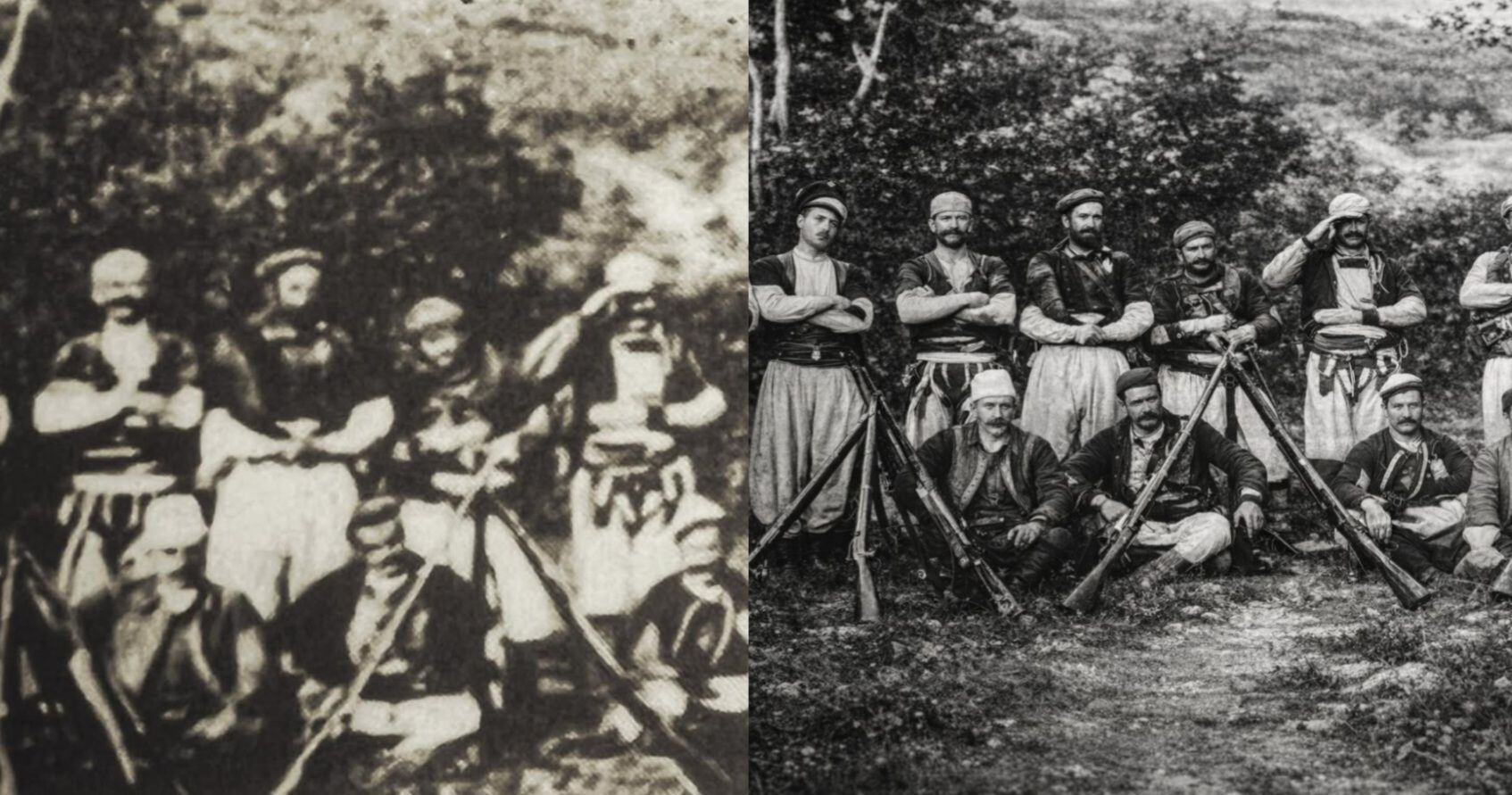
IN THE BATTLE OF SUKA OF MKUSH
(Archive of the University Library “Luigj Gurakuqi”)
On April 25, 1911, the fiercest fighting took place at Suka of Mkush, where the Kelmend fighters, especially those from Selca, heroically confronted the enemy, inflicting very heavy losses.
That day, the column of Ethem Pasha, which sought at all costs to subdue the Highlands, particularly Kelmend, was met with intense fire from about 1,000 Kelmend fighters under the leadership of the well-known warrior Luce Mark Gjeloshi.
The fighting lasted more than 6 hours, leaving the enemy with over 150 soldiers killed and wounded.
(Source: Risto Siliqi, Rreze Agimi, prepared for publication by Teodor Siliqi, Tirana, 1998)
Fighters who distinguished themselves in battle
Many others stood out for bravery in combat, such as:
- Marash Ujka
- Maç Luca
- Tom Preka
- Marash Marku
- Luc Shqutaj
- Vate Gjeli
- Luce Loshku
- Ujk Leka
- Marash Preka
- Kolë Ujka
- Zef Preçi
- and others.
The bravery of the women of Selca
During the frontal battles, the help of the brave women of Selca was also present.
Gjeline Gjokja collected 52 rifles for her brothers Gjekë and Zef Prekë Mark Leka, who fell heroically fighting hand-to-hand with the enemy.
Their mother, Mitare Lucja, said:
“Now I have reason to rejoice for the sons I had, since they did not spare their lives for the defense of the land of their ancestors.”
(Source: Heroinat e Maleve, Hylli i Dritës magazine, Shkodër, 1934)
Report of the Turkish general to Istanbul
Regarding this battle, a Turkish general wrote to Istanbul:
“I am ashamed to inform you that your order was not carried out. Kelmend and the Great Highlands did not submit to us. Not because we did not try, but despite our great efforts and sacrifices, we lost the war.
Here, Your Majesty, the land itself fights more than Kelmend.
The Albanians kill you where you least expect it.
Only in the battle at Suka of Mkush we fought for 6 hours hand-to-hand, and it was precisely here that we suffered our greatest losses.
Besides those killed on the front, 95 soldiers and officers were captured, and most were thrown from a cliff into a stream over 1,500 meters high.
In this war, even the weather was against us, and God was on their side.”
Martyrs from Kelmend
According to researcher Ndue Bacaj, in the book:
“The Uprising of the Great Highlands against the Ottoman Empire – 1911”
the following martyrs from Kelmend are identified:
- Prekë Mark Rudi
- Nikë Marash Ujka
- Mirash Shyta – Bujaj
- Gjekë Prekë Tinaj
- Zef Prekë Tinaj
- Voc Gjoni
- Pjetër Gjon Rapuka
- Kolec Luku
- Gjon Marash Këku
- Dakë Nikë Bog’jani
- Kole Toma
- Kole Lekë Bori (fell in 1912 in Breg i Matës)
Another important source for this battle
The fighting of Kelmend at Suka of Mkush, near Selca, entered legend and remained forever in the memory of the people of this heroic region.
A large number of Turkish soldiers and officers lost their lives here, as well as 12 men from Selca, whose names are mentioned in the works of Ndue Bacaj.
A correspondent of The Times of London wrote on July 21, 1911:
“This was a glorious defense, which, when the history of that time is written, will rank among the most brilliant episodes of modern warfare.”
(The Times, London – July 21, 1911)
The role of the leaders of the uprising
According to researcher Gjergj Nikprelaj in the book “The Highland Uprising of 1911”, a great contribution with his advice was given by the veteran of the war for freedom:
Nikë Lekë Pepa, legendary commander of the Albanian army of the League of Prizren (1878).
Also contributing were:
- Luce Ujka
- Luce Marku
- and many other fighters.
Testimonies of veterans
The testimonies of veterans such as:
- Maç Luca
- Marash Marku
- Lucë Shqutaj
- Vate Gjela
- Luce Loshka
- Ujkë Leka
- Marash Prënga
- Zef Preçi
- and especially Palo Luca, an old vojvoda from Selca,
have also been used by later researchers.
Losses and the end of the war
According to researchers, Kelmend lost 46 fighters during this uprising.
Unlike other Highland tribes, the Kelmend fighters fought while defending their own territory, where their families lived.
Only at the end of the war did some of them move into the territory of Montenegro, mainly in the mountains of Triepsh and Kuç in July 1911.
In August 1911, a peace agreement was reached between the insurgents and the Ottoman Empire in Podgorica.
On August 2, 1911, the Highland fighters returned to their homes in Kelmend, which they found burned and reduced to ashes.

