
Written by Engjell Gishti
Summary
Engjell Gishti challenges the narrative that Albanian beys, pashas, and viziers merely served Ottoman interests. He argues they contributed significantly to Albania’s infrastructure, defense, and national movements, including the League of Prizren, independence, and the Congress of Lushnja. In contrast, Serbs and Greeks used propaganda to delegitimize the Albanian aristocracy, expropriating their lands and advancing territorial ambitions. Gishti highlights how Albanian leaders balanced survival under Ottoman rule with patriotic action, and how later communist and leftist ideologies falsely blamed them for collaboration. He concludes that Albanian beys were patriots acting under extreme circumstances, not mere servants of foreign powers.
On some conceptual misunderstandings about Albanian historiography
Once again, in recent days, the idea has repeatedly appeared: were the Albanian beys, pashas, and viziers collaborators with the Turks who worked against the interests of their country, or were they patriots who tried and did what they could in the interest of our land? Since there are many famous historians who think differently than I do, I decided to write a few lines on this delicate topic for our history.
I begin this discussion with a question:
For us as a people, during those 550 years, would it have been better not to have beys, pashas, and viziers at all, or was it better that we had this class under such a brutal rule?
In discussing this topic, many commentators take the example of the Serbian vizier Rustem Sokolović, who ruled during the time of Sultan Suleiman the Magnificent, because he killed the Albanian vizier from Parga, Ibrahim Pargali.
Personally, I agree that the Serbian shepherd Sokolović did an extraordinary amount for his country, but are you sure that the Albanian viziers did nothing for Albania?
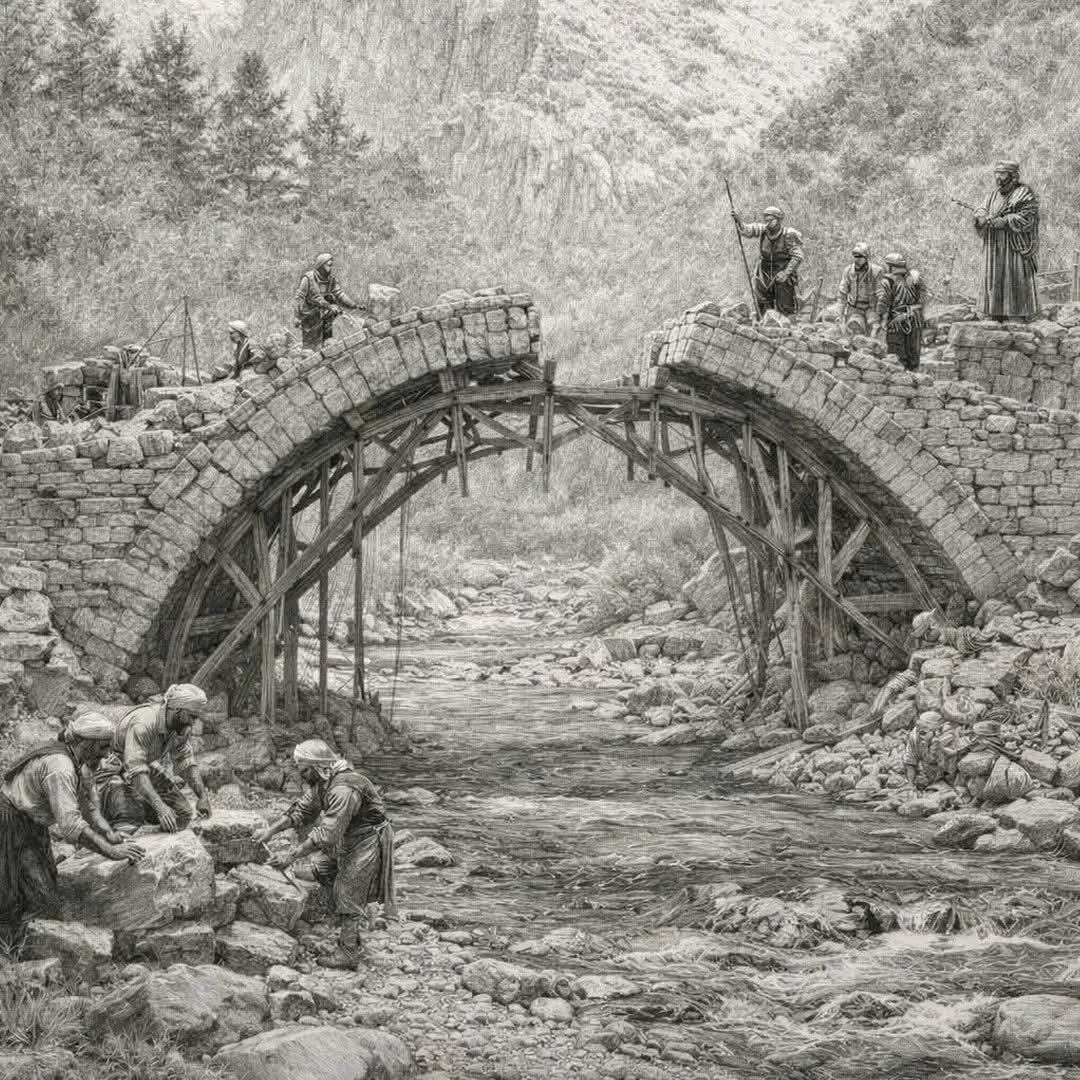
Who built those bridges that are still called “Vizier’s Bridge” all over Albania today, and the paved roads that crossed the entire country? Did the poor villagers build them, or did they serve the sultan with their stomachs?
Since they created their states, the Greeks and Serbs began a strong propaganda campaign against the Albanian aristocracy of the Ottoman era. This was because they were interested in denigrating this class to achieve three objectives:
- Expropriation of their estates without compensation – In Greece between 1821-31, all large estates (farms of 1,000–3,000 hectares) were the property of Albanian pashas. Similarly, in much of Serbia up to Belgrade. These lands were expropriated, and in many cases the title of ownership was not legally recognized, in an abusive way.
- The second objective was the “liberation” of other “Turkish” regions and incorporating them into their states. Initially, Greece did not even dream of taking Macedonia, Epirus, or even Thessaly. They didn’t even have the courage to claim them. Who were they afraid of? Logically, the pashas and beys, who were mostly Albanian.
They made the law, financed the armies, and resisted Greek or Serbian attacks. Edith Durham shows that in 1896, the entire Greek army began an attack to conquer Epirus from two directions: Corfu–Saranda and Thessaly–Metsovo. What happened? The southern pashas and beys gathered and confronted the Greek army. These were the pashas who, according to some leftist historians, “did nothing for Albania.”
Look at who organized the League of Prizren. Is there anyone there who was not a bey or pasha? Who provided for the army and administration of the League for three years? With whose money were the weapons made?
Look at the Declaration of Independence: are they all beys or wealthy Christians? Did almost all the Albanian beys contribute with their gold?
Look at the Congress of Lushnja: are all those gathered again beys who saved the nation from extinction?
Can these historians tell us what a landless peasant or shepherd could have done for Albania under those conditions? I don’t think they could have done more than Haxhi Qamili and his men: mere tools in the hands of foreigners.
During Zog’s era, we were fortunate to still have the children of the beys, who no longer had wealth but had great knowledge because their parents had educated them well in the West.
When the Serbo-Croatian monarchy proposed forming a Balkan Federation (a kind of Open Balkan) boasting of good and sincere intentions, in principle all states agreed, including Turkey. Only Albania remained in the role of observer. (It was a time when Zog was no longer a tool of the Serbs.) The final meeting took place in Ankara, and the Serbian foreign minister criticized Albania for not taking steps forward. Our representative, Mehmet Bey Konica, replied: “Albania hesitates because it does not trust the sincerity of your enterprise.” Serbs, Greeks, Montenegrins, etc., verbally attacked Mehmet and Albania… Our bey remained calm, waiting for the end of the insults. In the end, he declared: “Gentlemen. It is very easy to test the truth and see how sincere you are towards our crippled and tiny Albania.” “How?” they asked him together.
The bey replied: “You know very well that you have unjustly taken our best regions such as Kosovo, Western Macedonia, and Epirus: the blood of your massacres on these Albanian lands is still fresh. Return these regions to us, and we will accept your Balkan Federation project.”
From the words of this Albanian bey, the project was interrupted at that moment and archived for another historical occasion.
Very quickly, four years later, in 1941, the Serbs returned to their idea, now dressed in communist propaganda. During the war, they managed, through leftist Albanians, to deal a deadly blow to the class of beys. With the liberation of Albania and the establishment of the communist regime, concrete steps were taken to plunder Albania, always within the framework of a Federation centered in Belgrade.
The Serbs knew very well that once the beys were eliminated, the landless peasants who took power would neither respect Serbian policies nor resist, and it would be very easy for them to exploit our country daily, as happens even today.
Why did the Class Struggle come into Albania, and where was this concept invented? Who put it into Enver Hoxha’s mind?
I believe you all know the answer. Through the Class Struggle (which, unfortunately, leftists continue even today), the Serbs managed to eliminate all resistance to plundering Albania. Another thing: Albania was saved by chance from the Tito-Stalin clash – practically we were in the last breaths of freedom. Moreover, with this theory, they also expropriated all property in Kosovo and Macedonia, bringing Slavic settlers into these lands.
The Serbian theory goes further, claiming that the beys’ property was “given by the Sultan”. It’s laughable, reflecting the naivety of Albanians. And sadly laughable, reflecting the illogic of Albanian leftists. I ask a very simple question: IS THERE ANY DOCUMENT THAT PROVES THE SULTAN GAVE 1 M² OF LAND TO AN ALBANIAN BEY? Naturally not, because the Sultan did exactly the opposite: he seized the lands of disobedient beys and sold them at auction.
So leftists accuse Albanian beys and viziers of serving the occupier: BUT WHAT ELSE COULD THESE PEOPLE DO? Not obey the Sultan, meaning accept death?
Vizier Gjedik Pasha, who was sick in 1474 when the Sultan ordered him to attack Shkodra, experienced this. What happened? Sultan Mehmed put him in an iron cage, which was lifted by a ship’s crane to an island in the Marmara Sea. There he lived for 4.5 years: eating and relieving himself in the cage. After the Sultan captured Shkodra, he lifted the cage with a crane and threw it into the sea.
This story, of course, pleases Serbs and Greeks, but I ask: do you like it too when you insult the aristocracy of our nation in those centuries?
And what has happened in these 35 years? My words are unnecessary. The Class Struggle was replaced by Law 7501, which again targeted our beys, and we know well the result. Serbia always manages to make us fight among ourselves: the events in Dukat and Rrjoll speak clearly.

