
by Lulzim Osmanaj
Summary
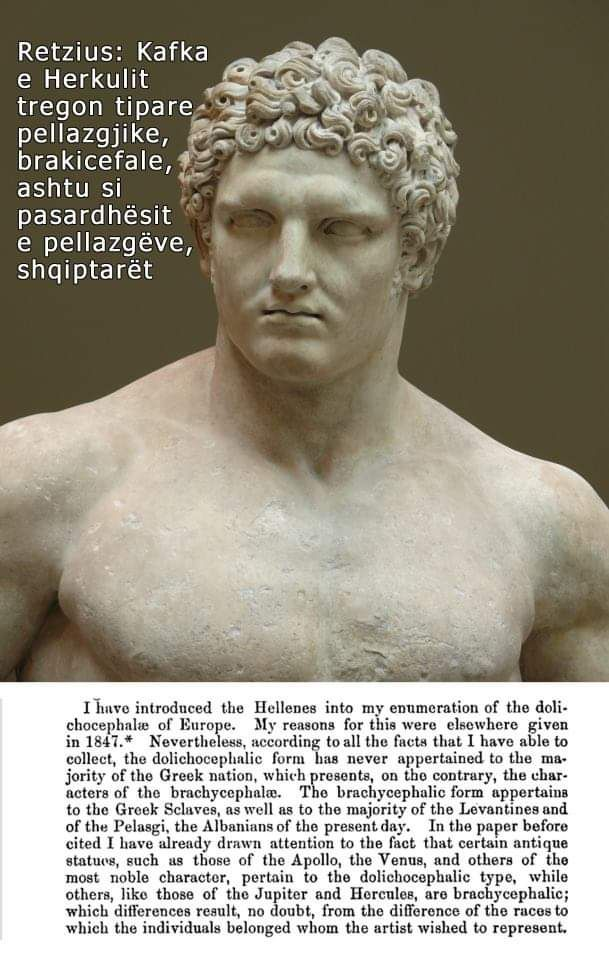
Anders Retzius studied cranial shapes in Europe, distinguishing between dolichocephalic (long-headed) and brachycephalic (short-headed) types. He argued that most Greeks were brachycephalic, while dolichocephaly appeared among the Hellenes. Brachycephalic traits were characteristic of Greek slaves, Levantines, and Pelasgians, including modern Albanians. Retzius noted that some ancient statues, like Apollo and Venus, represented dolichocephalic features, while others, like Jupiter and Hercules, were brachycephalic. These differences, he suggested, reflected the racial types of the individuals the artists intended to depict. His works, published between 1842–1847, remain widely cited in studies of European cranial morphology and racial anthropology.
Retzius emphasizes:
“I have included the Hellenes in my count of Europe’s dolichocephalic populations. My reasons for this were given elsewhere in 1847. Nevertheless, according to all the facts I have been able to gather, the dolichocephalic form has never belonged to the majority of the Greek nation, which, on the contrary, exhibits brachycephalic characteristics.
The brachycephalic form belongs to the Greek slaves, as well as to the majority of Levantines and Pelasgians — the Albanians of today. In the previously cited work, I drew attention to the fact that some ancient statues, such as those of Apollo, Venus, and others of very noble character, belong to the dolichocephalic type, while others, such as those of Jupiter and Hercules, are brachycephalic; distinctions which undoubtedly arise from the differences in the races to which the individuals the artist intended to represent belonged.”
References
- Retzius, Anders (1842–1847). Om formen af Nordboernes cranier (various works published in Kungliga Vetenskapsakademien, Stockholm).
- Retzius, Anders (1845). “Om skallens form hos olika folk i Europa” (On the shape of the skull among different peoples of Europe).

