

by Lulzim Osmanaj
The text examines the Illyrians from linguistic and historiographical perspectives, emphasizing the challenges of studying a language without direct written records. Reconstruction relies on indirect evidence such as names, place names, and ancient sources, requiring careful methodology. Historical debates highlight tensions between interpretation and limited data, warning against overreliance on modern languages like Albanian. Toponymy and hydronymy remain key but must be critically assessed. Ultimately, the Illyrians are best understood within a broader European context, as part of complex cultural and linguistic interactions.
Lulzim Osmanaj writes:
The study of the Illyrians and their language constitutes one of the most complex and, at the same time, most debated fields of historical philology and Indo-European linguistics.
Unlike well-documented linguistic traditions such as Latin or Ancient Greek, Illyrian has not left behind a direct corpus of written texts, which makes its reconstruction dependent on indirect sources such as personal names, toponymy, hydronymy, and references by ancient authors. In this context, any attempt to identify and interpret Illyrian elements across different regions of Europe must rely on a careful and balanced methodology, avoiding both excessive speculation and the a priori rejection of interpretative possibilities.
The debates that developed in the late 19th and early 20th centuries, reflected in the philological literature of the time, clearly demonstrate the tension between the desire to reconstruct the earliest linguistic layers and the limitations of the available material. In particular, discussions concerning the relationships between Celtic, Iberian, Basque, and the supposed “non-Aryan” elements in Western and Northern Europe shed light on the methodological difficulties encountered in this field.
Scholars such as John Rhys attempted to identify a non-Aryan substrate in the Celtic languages, proposing connections with Basque or with a hypothetical Iberian layer, while critics such as Hugo Schuchardt emphasized the dangers of overinterpretation and the lack of sufficient evidence for such conclusions. These debates are especially relevant for the study of Illyrian, as the methodological situation is similar: the absence of direct texts and reliance on fragmentary evidence create fertile ground for both innovative hypotheses and unfounded speculation.
One of the main issues concerns the use of modern languages as interpretative keys for ancient languages. In this regard, Albanian has often been considered the closest descendant of Illyrian or of a closely related dialect; however, philological literature itself emphasizes that its contribution to the direct interpretation of Illyrian inscriptions remains limited. As noted in the debates of the time, the fact that a modern language is historically related to an ancient one does not automatically mean that it can be used without reservation as an interpretative tool for every attested form of that language.
A similar problem arises in attempts to link different languages based on shared structural or lexical features. In discussions of Iberian-Basque or Pictish connections, it has been stressed that partial similarities do not necessarily constitute evidence of a common origin, but may instead result from parallel developments, language contact, or mere coincidence. This also applies to the study of Illyrian, where similarities with other Indo-European languages must be analyzed critically and within a broad comparative framework.
From this perspective, toponymy and hydronymy remain the most important sources for identifying Illyrian elements, as they tend to be more conservative and may preserve very early linguistic layers. However, methodological caution is also required here, since many ancient names may belong to a broader Indo-European stratum that predates later ethnic differentiations. This has led to the formulation of concepts such as the “Old European hydronymy,” which seeks to explain the presence of shared water names across different regions of the continent without necessarily attributing them to a single ethnic group.
In this context, the study of the Illyrians must be placed within a broader European perspective, where interaction among different populations and linguistic layers is a common phenomenon. The Illyrians cannot be understood as an isolated entity, but rather as part of a complex network of cultural and linguistic relationships encompassing the Balkans, the Alps, and parts of Central Europe. This perspective helps avoid one-sided interpretations and contributes to building a more balanced analytical framework.
In conclusion, the study of the Illyrians and their language remains an open field of research that requires an interdisciplinary approach and rigorous methodology. Historical debates in philology show that any attempt to identify early linguistic substrata must be grounded in solid evidence and critical analysis of data. At the same time, the importance of the Illyrians in European history lies not only in what can be reconstructed with certainty, but also in the potential they offer for understanding the processes of linguistic and cultural formation of the continent. In this way, the Illyrians remain a key element in the study of European antiquity—not as a fully resolved object of knowledge, but as a dynamic field of research that continues to challenge and enrich modern scholarship.
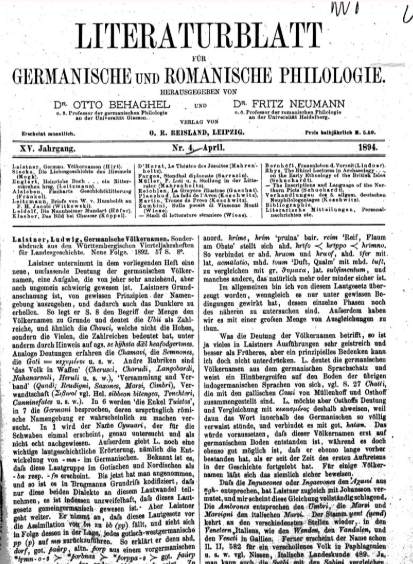
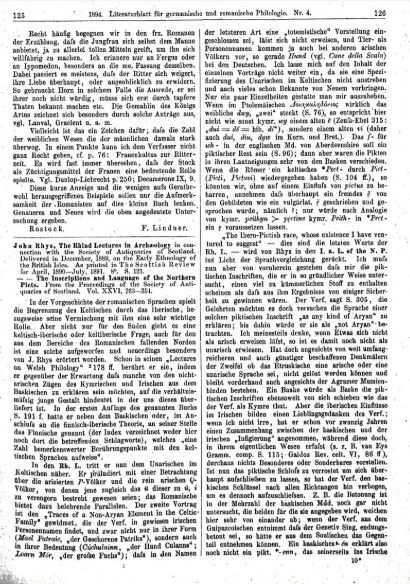
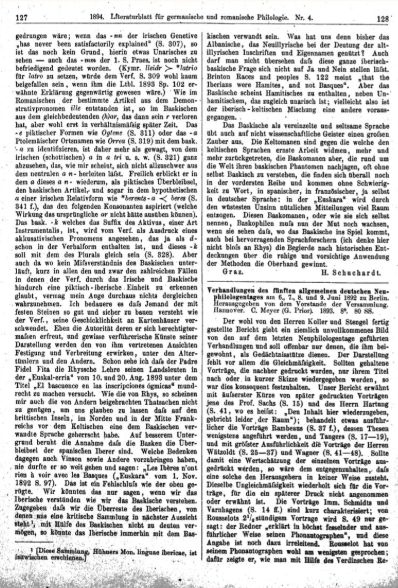
Reference
Behaghel, Otto, and Fritz Neumann, eds. Literaturblatt für germanische und romanische Philologie. Vol. 15, no. 4 (April 1894). Leipzig: O. R. Reisland.

