
Summary
After Alexander the Great pursued Darius III, he buried his fallen soldiers, rewarded his troops, and sent vast treasure to Ecbatana under Parmenio. Reports arrived of conflicts led by Agis III in Greece, another Alexander in Epirus, and Zopyrion in Scythia. Meanwhile, many Greek states, influenced by Sparta, rebelled during Alexander’s absence, hoping to regain independence. Antipater quickly raised an army and suppressed the uprising. Though the rebellion was crushed early, both sides suffered heavy losses, showing the fragile control Macedonia held over Greece without Alexander’s direct presence.
Extracted:
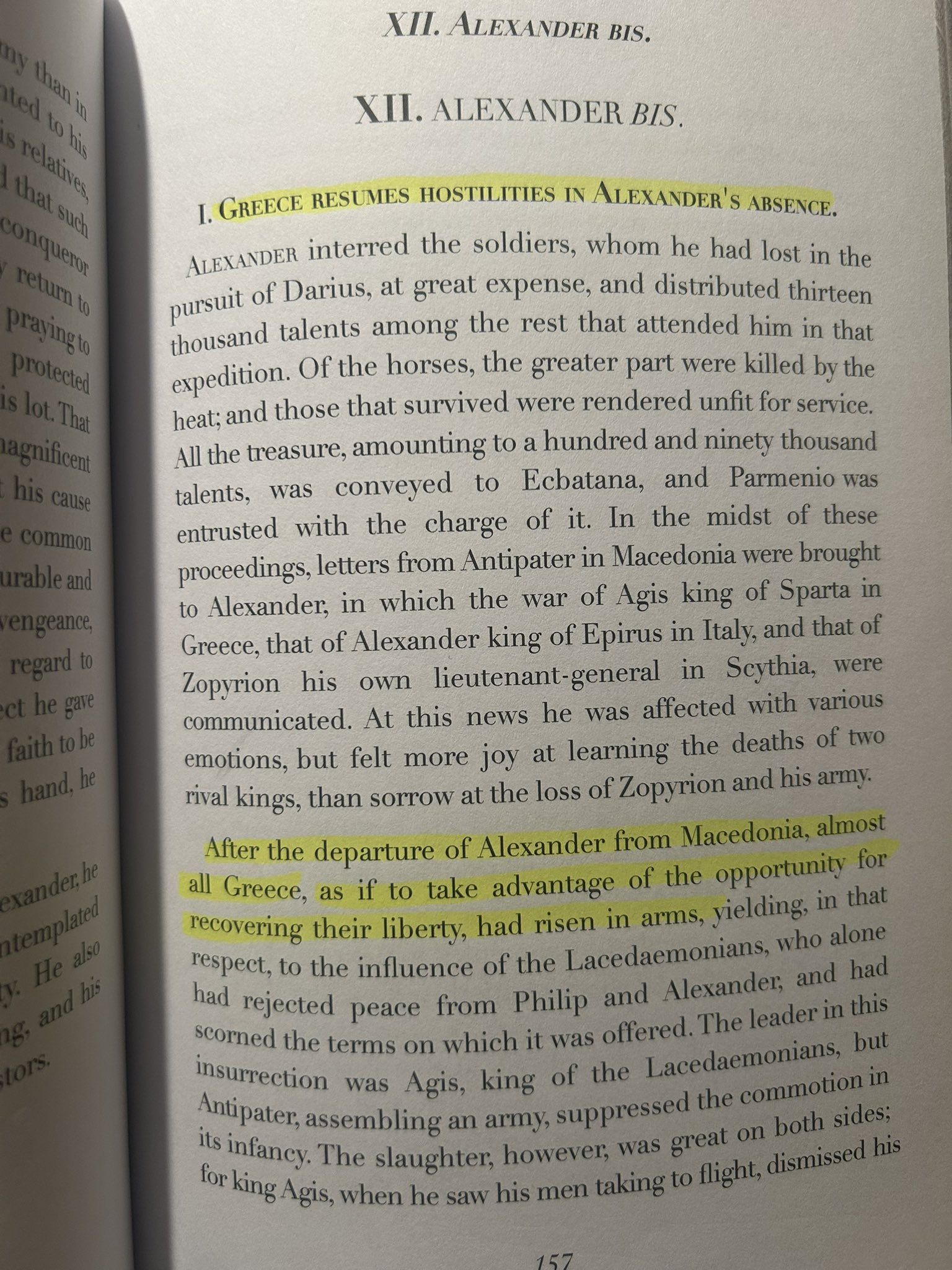
“XII. ALEXANDER BIS.
I. GREECE RESUMES HOSTILITIES IN ALEXANDER’S ABSENCE.
Alexander interred the soldiers, whom he had lost in the pursuit of Darius, at great expense, and distributed thirteen thousand talents among the rest that attended him in that expedition. Of the horses, the greater part were killed by the heat; and those that survived were rendered unfit for service.
All the treasure, amounting to a hundred and ninety thousand talents, was conveyed to Ecbatana, and Parmenio was entrusted with the charge of it. In the midst of these proceedings, letters from Antipater in Macedonia were brought to Alexander, in which the war of Agis king of Sparta in Greece, that of Alexander king of Epirus in Italy, and that of Zopyrion his own lieutenant-general in Scythia, were communicated. At this news he was affected with various emotions, but felt more joy at learning the deaths of two rival kings, than sorrow at the loss of Zopyrion and his army.
After the departure of Alexander from Macedonia, almost all Greece, as if to take advantage of the opportunity for recovering their liberty, had risen in arms, yielding, in that respect, to the influence of the Lacedaemonians, who alone had rejected peace from Philip and Alexander, and had scorned the terms on which it was offered. The leader in this insurrection was Agis, king of the Lacedaemonians, but Antipater, assembling an army, suppressed the commotion in its infancy. The slaughter, however, was great on both sides; for king Agis, when he saw his men taking to flight, dismissed his… […]”
Source
“Book XII. Chapter I: Greece resumes hostilities in Alexander’s absence”. Historiae Alexandri Magni. Quintus Curtius Rufus.

