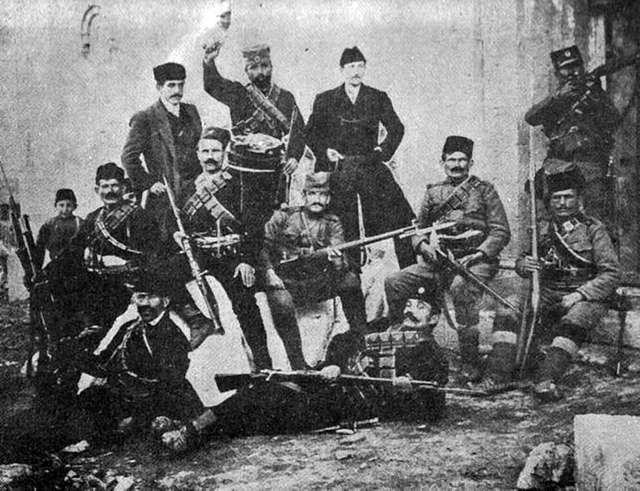

Through out the century, between 1912 up to 1999, Serbian military and paramilitary forces were known to committing appalling atrocities against Albanian and Bosniak civilians. When ever given the chance, the Serbian soldiers would rape, murder, torture, executed, burn alive, shoot and pierce women, children, elderly and unarmed men. And in some cases, they would also pierce infants in the cradles (infanticide). The following articles mention a few reported cases with sources.
Serbian soldiers killed infants in Prishtina, Vilayet of Kosovo, 1912
“The Serbian army subsequently used this as an excuse for the brutal retaliation against civilians, including Albanian families and even their babies”.
Source: Leo Freundlich: Albania’s Golgotha, 1913.
Serbian soldiers killed infants in cradles in 1919
“Robberies and bribery were part of the tragic scenes, as were rapes. It has reached the point where they have taken women’s rings by force, breaking their fingers, taken their earrings, tearing their ears, and even robbed children in their cradles of their clothes, shooting them with bayonets from their cradles..“ (p.272)
Source: The following information is taken from the book “GENOCIDI SËRBOMADH DHE QËNDRESA E SHQIPTARËVET” written by Shaban Braha. These sections are saxed from Gjokë Dabajs articles on Pashtriku.org
Serbo-Montenegrin soldiers killing Albanian babies in World War 2
“One of the Montenegrin terrorists lifted the cradle of a 7-month-old baby vertically and shot the baby with an automatic rifle.” (p. 463) “In the Gjilan region, murders increased, but not graves, because many victims were shot in the same grave. In one case, the number of massacred people, thrown into a pit, reached 96 people.” (p. 463)”
Source: The following information is taken from the book “GENOCIDI SËRBOMADH DHE QËNDRESA E SHQIPTARËVET” written by Shaban Braha. These sections are saxed from Gjokë Dabajs articles on Pashtriku.org
Serbian soldiers killing babies in cradles in 1943 in Sanxhak region
Some of the names of babies in cradles killed by Yugoslav Chetniks Pavle Đurišić in Pljevlja in 1943:
HASOVIĆ A. JUSUF, born in 1942 (one year old)
MUSIC M. BEGIJA, born 1943 (baby)
SHLJIVO M. HAJRIJA, born 1943 (baby)
SNAIL S. EMA, born 1943 (baby)
MOĆEVIĆ J. SIMBULA, born 1943 (baby)
MOĆEVIĆ M. ĐUZIDA, born 1943 (baby)
CHORBO L. LATIFA, born 1943 (baby)
MUSIC S. HAJRO, born 1943 (baby)
MAŠOVIĆ A. ELMASA, born 1943 (baby)
KELEMIS J. RASHID, born 1943 (baby)
SIJAMIC R. ZUMRA, born 1943 (baby)
MAŠOVIĆ D. HAZBIJA, born 1943 (baby)
SHATARA M. NURA, born 1943 (baby)
HEKALO M. MURADIF, born 1943 (baby)
KUBUR M. HAMDO, born 1942 (one year old)
ŠLJUKA M. ZADA, born in 1942 .
PLAKALO R. NURA, born in 1942 (one year old)
SIJAMIC A. ZIZO, born in 1942 (one year old)
GEC P. RABIJA, born 1942 (one year old)
PRLJAČA R. ADILA, born in 1942 (age one year)
MOĆEVIĆ A. ZLATIJA, born in 1942 (one year old)
DRKENDA DZH. RASIM, born in 1942 .
KORORA R. SAFIJA, born 1942 (one year old)
KLAPUH S. FATIMA, born in 1942 (one year old)
RIFLE M. NAZA, born in 1942 (one year old)
KADRIĆ D. MEVLA, born 1942 (one year old)
KISELICA M. HASHIM, born in 1942 .
KISELICA M. SABIT, born in 1942 (one year old)
PUCAR J. HAJIRA, born 1942 (one year old)
Source
Serbian soldiers killing babies in cradles in Ujzë te Hasit in 1913
“Ujzit te Hasit” or “Ujzit Massacre” of 1913 – Serbian and Montenegrin soldiers burn Albanian women and children alive
Written by Besim Muhadri and Nekhat Cocaj.
Ujzit te Hasit or Ujz massacre (Alb: Masakra e Ujzit te Hasit).
In November 1913, the Serbian army in Ujza near Hasi killed and burned 72 Albanians, members of the family of the patriot Avdil Zeća, a participant in the Albanian League of Prizren. Among those massacred and burned were ten children and infants in cradles and the same number of women. This was one of the most horrific massacres of the time, which was also written about in the press of the time.
On November 28, 1912, the independence of Albania was proclaimed, in the meantime, a large part of the Albanian lands remained under foreign occupation, namely neighboring countries, which continued to terrorize the undefended and forgotten Albanian population. The year 1913 also marks the establishment of borders, which was met with great dissatisfaction by the Albanian population, due to the further fragmentation of Albanian villages and the division of the population into many parts.
The annexation of the areas inhabited by the Albanian majority (which remained outside the administrative borders of Albania), sanctioned by the Conference of Ambassadors in London, was accompanied by the establishment of a brutal, repressive and criminal Serbian regime. At this time, in Kosovo, Serbian and Montenegrin terror was unbearable, due to Serbia’s dissatisfaction with the decisions of the London Conference for the failure to realize its hegemonic appetites, and the failure to fulfill the old dream of seizing privileged parts from it and securing a corridor for access to the sea, arbitrarily establishing a “strategic border”, which ran along the Drim valley.
During this time, especially during the summer months of 1913, there were many persecutions and murders of the Albanian population. During this time, executions of Albanians were carried out without any trials, while the resistance of Albanians continued by Kachak groups in many parts of Kosovo, where preparations were made for a major uprising against the Serbian military-police regime, which massacred and terrorized the vulnerable Albanian population.
Meanwhile, in late August and early September of that year (1913), the Albanian National Movement, led by Isa Boletini, Bajram Curii, Elez Isufi, Qazim Lika, Sadik Rama, etc., was making final preparations to launch an armed uprising. The Serbian government, meanwhile, when the uprising broke out, officially declared that it would suppress these uprisings by any means, even using unprecedented methods.
When the Ujzit Hasit massacre (Alb. Ujzit te Hasit) took place, 72 Albanians from the Gashi family from Ujzi were killed and burned alive, as documented by the press of the time. Thus, the researcher Xheladin Shala, in his book “Albanian-Serbian Relations 1912-1918”, citing the Belgrade newspaper “Politika” from 3 and 16 November 1913, writes, among other things, that in a house near Đakovica, the army massacred 72 people and burned them.
While another researcher, Šaban Braha, in the book “Serbian Genocide and Albanian Resistance (1844-1990)”, published in 1991 in Tirana, based on reports from consuls of the great powers sent from Prizren-Vienna, 18.09.1913. and from Shkodra-Paris, 21.09.1913., among other things, says that 35 members of one family died in Ujz.
The same author, in the same book, referring to the data of the newspaper “Përlindja Albanian” No. 14 from 1913, says that “In Ujz, near the Drina, 32 people were imprisoned and burned in one house”. These data are sufficient facts to learn the truth about this terrible event, of genocidal and criminal proportions against humanity in general and the Albanian people in particular, which was committed by the Serbian army 91 years ago.
The dates of this event recorded by the aforementioned scholars, and mentioned in the annals of newspapers of the time, seem to coincide with the testimony of an eyewitness, the elder Ćufa Sadik Gashi from Ujzij (1903–1997), who eleven years ago, at our request, agreed to tell how the event occurred, what he saw and experienced as a child, as well as his close family who managed to escape.
Kufe Gashi, who was a ten-year-old child at the time, not only remembered well what he saw, but also spoke in a certain way about the circumstances and the cause of it. Those who were massacred were not only neighbors, but also people from the tribe, of blood and flesh, as he put it at the time. Now that we are republishing this (because part of the text was published eleven years ago in the local magazine “Etja te Hasit”), the witness Kufe Sadiku is no longer with us, but his authentic words and confessions remain.
The murder of two gendarmes or an excuse for committing a crime
At a time when Albanian uprisings against brutal Serbian violence broke out in many parts of Kosovo, the Serbian regime took all measures to suppress them. Thus, many gendarmerie and military stations were built during that period, which were also turned into graves for undefended Albanians. Such a Serbian gendarmerie station was also established in Fšaj near Has.
“It was the autumn of 1913, during the corn harvest, which means the time between September and November. At that time, Serbian gendarmes in a house in the village of Fšaj were investigating two Albanian criminals. There were three gendarmes in the gendarmerie station, while one of them went to seek reinforcements in pursuit of the criminals, while the other two surrounded the house where the criminals were. But in the meantime, someone from the house informed the Kačaks that they were surrounded by gendarmes. Then he raised his rifle, where both gendarmes were killed. Among the dead was the chief’s secretary (secretary).”
This is how Cufe Sadik Gashi from Ujzi and Has told about the beginning of that event, which would have serious consequences for his family and wider relatives. Cufe was no more than nine years old at the time. “When reinforcements arrived,” he continues the story, “the Kacaci had already fled, while the gendarmerie, seeing their comrades dead, terrified and full of cruelty and madness, called the commander of the gendarmerie in Fshaj, Tome Markou (always according to Cufe Gashi’s confessions).”
On that occasion, they decided to burn Tun Četa’s house, where the Kačacs had taken refuge. The decision was made and, as a sign of revenge, they burned Tun’s house, and with it Tun himself, along with his wife. They burned them alive. The revenge continued. After the burning of Tun’s house, Tun himself, and his wife, reinforcements of the gendarmerie forces constantly arrived and increased.
In addition to the gendarmerie, the Serbian army has now joined the action. In the evening, they learned from Fšaj about the town of Ujzi, where they suspected that the Kačacs, who had killed two gendarmerie officers, might have taken refuge.
After burning Tun Ceta with all the women, the Serbs travel to Gashi’s towers in Ujzi.
In Ujz at that time, the families and towers of the Albanian Gashi were in fashion, who were known for their patriotism and courage, as well as for their generosity, hospitality and wealth. In the towers of Avdil Zeka, Ali Tafa, Jusuf Selman and Daut Sadik, all of whom belonged to the Gashi tribe, the Albanian rebels had their dormitories. All this patriotism and this incomparable generosity were not accidental. They had their roots much earlier.
The eldest of this family, Avdil Zeka (Gashi), was not only a participant in the Albanian League of Prizren, but together with Dervish Salihu from Lugište, he was also the organizer of the Assembly of the League. As a man with a school education (he graduated from a madrasa), Avdil Zeka was also an organizer and participant in the Kachak movement of that time. His closest friends, by the way, were Sulejman Vokshi, Bajram Curi, Šaban Manžoli, Azem Bejta, etc., who found in Avdili and his family a solid home and strong support for organizing uprisings and for developing wars against the invading Serbian hordes, which at that time were unleashing the Albanian population.
“Before the Serbian and Montenegrin army and gendarmerie arrived in Ujz,” said the old man Cufe Sadiku, “Hazir Makoli, who was a policeman at the time, came to our house and told my grandfather, Dauti, to remove the families from the house, because, he told his grandfather, they intend to call you the Cleaner. After this warning, my grandfather went out and told Avdil Zeka to take all measures and remove the families from the house, but Avdil, being the man with fiery feelings that he was, did not agree to such a thing.”
“A job that cannot be done,” he said, also saying that anyone who tries to do such a thing, or who leaves the house, has no place here. I remember what the old man of Kufa, Sadik Gashi, said today, when his grandfather came and told us to leave the house and go to the mountains with the whole family, since he had failed to convince Avdil to do such a thing.
“We took with us what we could take. Halil Sadik’s family went with us to the mountains, but on the way, Halil’s son, Bajram, was told by his wife that he had forgotten his ducats (jewelry) and he returned to get them. In the meantime, the Serbian-Montenegrin army and gendarmerie entered Ujz and caught him leaving his house and immediately killed him at the door.”
Serbian-Montenegrin troops barricaded women and children and burned them alive.
According to the confessions of Cufe Sadik, the families who left without fleeing were surrounded by Serbian-Montenegrin soldiers, initially allegedly to control them, because they suspected that the communists who had killed the gendarmes were there.
First, they told Avdil Zeka to take all his relatives out of the house into the yard (45 in total), and then to place them in Avdirahim Halil’s house, which was built of boards. In the meantime, Serbian soldiers and gendarmes brought 14 members of Ali Tafa’s family, 12 members of Jusuf Selmani’s family, and two guests from Patačani, who were there, to that house. A total of 73 people.
The gendarmerie and Serbian and Montenegrin soldiers searched for the fugitives, but since they could not find them, they separated only Avdili, to whom they said: “We will leave you and the ducats you have alive, otherwise we will skin you and your entire family alive.” In the meantime, old man Avdili, hoping that the cats, after receiving the ducats, would go back to where they came from, decided to give them some of the ducats he had.
However, the Serbian war criminals and terrorists did not stop there. After taking the ducats from Avdili, they ordered him to enter the wooden house, where the other 72 members of three families were. As soon as Avdili entered, the criminals closed the door of the house and began shooting at the people locked inside, among whom were ten children in cradles and many women.
After a while, the guns stopped, which we, who were on the mountain above the village, could hear very well. There were also many children and women with us, including myself, who watched the event with sadness. The criminals, after stopping the guns, began to cut down the oak trees that we had cut down for the cattle, with which they surrounded the house, and then set it on fire.
The flames kept coming and growing between the Gashi towers. At first we only saw the flames, but it wasn’t long before we started hearing the screams of people being burned alive inside. That they were all our people of flesh and blood. There, in that flame, which kept coming and growing, I also had many peers, with whom we were born and grew up together. “They were screaming, they were dying painfully, oh my god,” admitted Uncle Ćufa, whose eyes were full of sadness, remembering that distant day.
According to the confessions of the elder Ćufe Sadik Gashi, Binak Avdili (Avdili’s son and Etem Tafa, Ali’s brother) managed to escape when the fire broke out. But they were also injured. Binak died after only a few days, while Etemi after two or three years. As Ćufe Sadik Gashi told it, Etemi, who managed to survive for another three years, saw people burning and how he saw a Montenegrin soldier pulling a child out of the fire, but on orders from his superiors that if he did something like that (that is, if he did not allow the child to burn), he would be burned instead of the child, so he threw him back into the fire. According to Ćufe, this child was called Uke and was the same age as his.
Serbian and Montenegrin soldiers burned alive the children and women of the Avdil Zeća family.
And so, on that autumn day in 1913, Serbian and Montenegrin criminals killed, and even burned alive, 45 members of Avdil Zeka’s family, of whom only two survived, Smajli, Avdil’s son, who was not at home, and his wife Shaha, who was at home in Ramok. Then 13 members of Ali Tafa’s family were killed and burned, and then the fourteenth, Etemi, also died of his wounds.
From the family of Jusuf Selman, all twelve were burned, not one remained. Not even from Avdil’s family would anyone have remained, if Smajli’s wife, Shaha, had not been shot in the groin, who was also pregnant and only three months later gave birth to a son, who was baptized with the name of the first in the family. , Avdilit. which today has 60 members. The gendarmes will kill Smajli upon his return to Kosovo, with the sole aim of losing traces of this crime and extinguishing the family of the patriot Avdil Zeća.
Serbian and Montenegrin war criminals stole animals and livestock
After committing the barbaric and inhumane act of massacre and burning of 72 Albanians, the Serbian and Montenegrin criminal army and gendarmerie completely burned down the Gashi towers, taking with them 1,500 sheep, about 100 cows and some horses and selling them at the market. Before burning the towers, the Serbs looted everything that was worth looting.
Only the tower of Daut Sadik remained unburned, also Gashi’s. “They left it with the intention of turning against us and killing us alive inside,” said the elder of Cufe Sadik Gashi. But we, knowing the insidious intention of the criminals, did not return home for almost two years, during which time we stayed in Albania. When the Serbs saw that we had no intention of returning, they burned our tower as well, so by burning our tower, the entire homeland of the Gashans from Ujzij was razed to the ground, said the elder of Cufe.
Two years after the Serbian and Montenegrin army and gendarmerie burned 72 members of the Gashi family from Ujzij and all their property, the military-police authorities declared the victims innocent by decree. But even after all this time, Daut Sadik Gashi, who was in Albania with his family, did not believe that he would return to his country, because what happened two years ago was difficult to forget and he feared that the Serbs would do the same to him.
But, finally, he decided to return to Uyz, a troll reduced to ashes and ashes, where for two years in a row no man dared to set foot. There were signs of slaughter, almost frenzied. There were burned and charred memories. Flames, smoke, the smell of burning human flesh and the screams of people in its bowels as they burned alive. “It was hard for us to return,” Kufe admitted, remembering the moment of return.
He was now twelve years old. Now he missed all his childhood friends, he also missed Uka, whom the Serbian soldier wanted to save, but, under pressure from his superiors, threw into the fire again. “The day of our return was the saddest day in my life,” said the old man of Cufe Sadik Gashi. He began to cry.
In the place where Avdirahim Gashi’s house stood two years ago, there were traces of crime, traces of death and barbarity. There, instead of a house, was a pile of bones of my people, which looked as if someone had carefully stacked them one on top of the other. But the worst thing was that many of the bones were missing, scattered all over the mountain by wild animals. Many of them we found far from the scene of the crime.
I remember like it was today when Grandpa Daut, Father Sadiku, Grandma and we children spent the whole day searching and collecting the remains of our people who were scattered in many places. And after we had collected what we could find, at the place where they were burned, Grandpa opened a large pit in the shape of a grave and with tears in his eyes he began to fold them one by one.
We covered them together in this way to preserve the memory and the painful history that happened then, so that one day someone would remember that a massacre took place here, a crime committed by a foreign army against a vulnerable and almost parentless people. This is the story of the Gashi tribe from Ujza, which happened eighty years ago, said Cufe Sadik Gashi, a direct witness to that event, which was later followed by many others like it, eleven years ago.
“This is the story of that tragic event, as far as I remember, Cufe Sadik Gashi, born a hundred years ago,” said the old man, alluding to all those experiences and sufferings he carried on his ninety-year-old back. “Maybe I forgot something, but forgive me for saying that I am old and tired. But know that what happened here was no accident.”
“Skije” (Slavs) never do it out of spite, because they have everything written down, and I bet such things can happen again, so be careful, said the old man in 1993, five years before the war in Kosovo began. Horrific events like the one in 1913 are happening, which he himself saw and experienced. But what the old man Cufa said and what he feared might happen, he did not manage to repeat, because just a year before the war for the liberation of these countries began, by those who committed all these massacres and crimes and are committing them, he left this world and went to meet the people of his blood and womb, whose cries he felt and saw when they were being killed and burned alive.
Reference
Serbian Vojvoda Milić Krstić was known to kill Albanian babies in cradles in Istog, and Pejë for many years
Who was Milić Krstić?
Milić Krstić or Milić Kersta (1878-1938) was a Serbian Chetnik vojvoda (captain) who emigrated during the 1900s to the Peć region of Kosovo. Krstić was responsible for the massacre of hundreds of Albanians during his military campaigns in the Istok region between 1912 and 1938. In 1924, Krstić, together with Kosta Pećanc, massacred 27 Albanians, including 5 women, in the Tutin region. Krstić also committed heinous massacres of Albanians in Llap, Uroševac, Štimlje, Dumnica, Plav and Gusinje in order to force them to leave. The Serbian government allowed the formation of separate terrorist movements such as the “Black Hand” led by Milić Krstić, a well-known criminal at the time.

In 1930, Albanian priests wrote a report on the crimes committed against Albanians, which mentioned that Krstić had killed 60 Albanians in one day in Đakovica. In 1938, Krstić was killed by an Albanian peasant named Selman Kadrija, who shot him near Lake Istok. Selman Kadrija was proclaimed an Albanian hero for executing Krstić, who was known to bayonet Albanian babies in their cradles. According to interviews with the locals of Istok, he may have slaughtered up to 9 boys from an Albanian family during one of his many visits.
Milić Krstić was also accused in 1924 of the murder of an Albanian in Rugova, and in 1927 of the murder of an Albanian from the village of Vrelska.

On June 9, 1938, the newspaper “Politika” wrote that Milić Krstić was killed 2 kilometers from his home and that he was credited with “merit for establishing order and peace in Metohija.” His war crimes were not mentioned.

References
- Krivača, Safet (28.03.2019). “Heroes and the Perbuzur Selman Kadri” . Kosovarja Magazine.
- Kabashi, Sali (July 13, 2018). “Organizations that oppose Vojvodes are the Istogut Militsa Kerrsta of Selman Kadri” . Shekulli Agency.
- Günter, Vladislav (2003). “Ochlas Valki O Kosovo V Kosovsko-Albanskych Pisnich”. Český Lid . 90 (2): 117–18. JSTOR 42639131 .
- “Haradinaj’s proposal will make the hero Selman Kadri” . RTV21 . June 3, 2019.
- 1930. Gjon Bisaku, Štjefen Kurti & Luigi Gashi: The Situation of the Albanian Minority in Yugoslavia Memorandum presented to the League of Nations http://albanianhistory.net/1930_Bisaku-Kurti-Gashi/index.html.
- “Politics”. 1938. “THE CHETNIK WARRIOR KILLED – MILIC CAPTAIN KRSTIC”.
- Kosovo per sankhakun. https://kosovapersankhakun.org/nenprefektura-e-prefektures-se-pejes-tutini/
- Selman Kadri Hasanaj. Vrasja e Milik Kerstikes. https://www.zemrashkiptare.net/news/33506/rp-0/act-print/rf-1/printo.html
- The Truth of Kosovo. “Kristak Prifti”. page 142. 1993.
- Daily Report for Eastern Europe · Issue 222–231, page 59. Link .
- SERBIAN WARS OF OCCUPATION AND OTHER MEASURES FOR THE EXPULSION OF ALBANIANS (1912-1941). Link.
- A MOTHER WOULD NEVER BRING SUCH A CRIMINAL: The infamous Chetnik spread fear in Sandžak and Bosnia, distinguished himself with bloody crimes, and then his own people LIQUIDATED him. Link .
- Ethnic Minorities in the Balkan States, 1860-1971: 1927-1938. https://www.google.se/books/edition/Ethnic_Minorities_in_the_Balkan_States_1/sgIXAQAAIAAJ?hl=sv&gbpv=1&bsq=Rougovo&dq=Militch%20Rougovo%201927&printsec=frontcover

