
Abstract
This article examines a set of toponyms from Sandžak and Montenegro that are associated with historically Albanian-inhabited regions and tribal zones. Through comparative linguistic analysis, it explores the extent to which these place names preserve traces of earlier Albanian forms despite later Slavicization. By identifying phonological patterns, morphological transformations, and regional naming conventions, the study proposes reconstructed Albanian parallels for a number of toponyms.
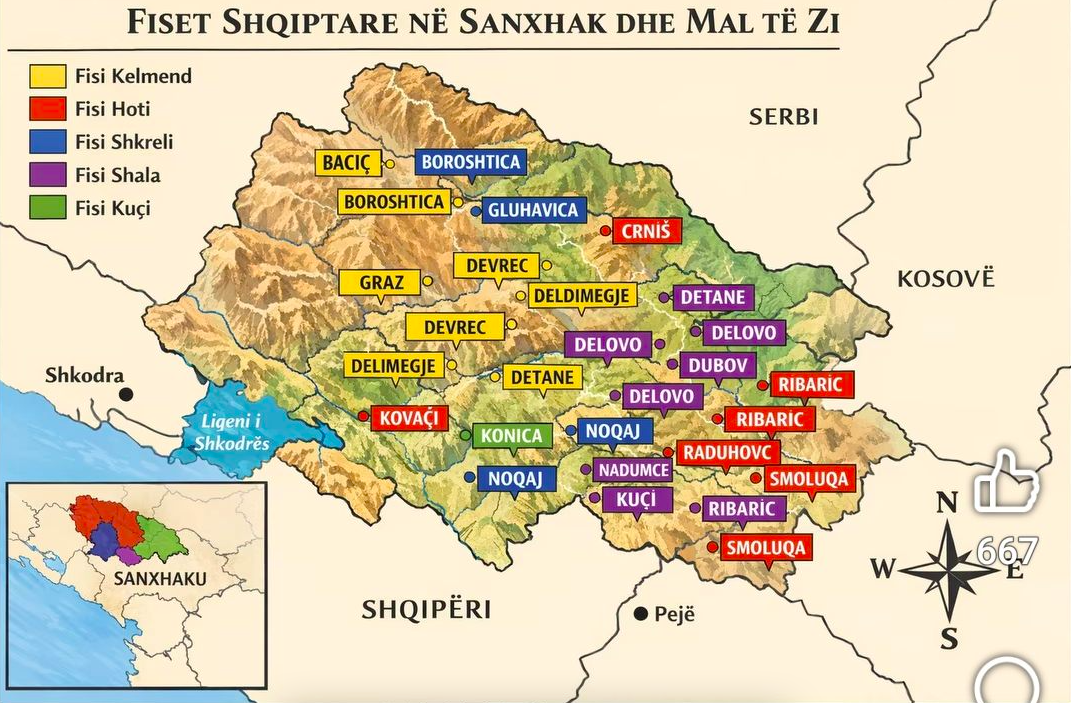
Through out the centuries, the Albanian tribes in Sandžak and Montenegro underwent slavization or bosniakfication (bosniakization). These tribes were:
- Kelmendi
- Hoti
- Shkreli
- Shala
- Kuçi
Toponyms and onomastics
- Baçiq
- Boroshtica
- Gluhavica
- Cërniš
- Devrec
- Delimegje
- Delovo
- Detane
- Dubov
- Ribaric
- Raduhovc
- Smoluqa
- Noqaj
- Nadumce
- Kuçi
- Konica
- Kovaçi
- Graz
Semantic and toponym restoration
Baçiq → Baçiq (already Albanian; from baç = shepherd hut) Cërniš → Cërnish / Cërnisht (likely from cërn < Slavic “black,” but Albanianized) Noqaj → Noqaj (Albanian clan-type name, -aj ending) Kuçi → Kuç / Kuçi (well-known Albanian tribe) Kovaçi → Kovaç / Kovaçi (from “blacksmith,” shared Balkan term)
Boroshtica → Borosht / Boroshtë
(remove -ica; Albanian definite form -ë possible) Gluhavica → Glluhavë / Gluhavë
(from Slavic gluh = “deaf/silent,” adapted into Albanian phonology) Devrec → Devër / Devrec
(-ec often maps to Albanian -ë/-ec; root unclear but preserved) Delovo → Delë / Delovë
(-ovo → -ovë; possibly from delë = sheep) Detane → Detan / Dëtanë
(likely nasal vowel shift; Albanian schwa possible) Dubov → Dub / Dubovë
(Slavic dub = oak; Albanianized with -ë) Ribaric → Ribar / Ribarë
(from Slavic ribar “fisherman,” Albanian definite -ë) Raduhovc → Raduh / Raduhë
(-ovc/-ovac → -ovë / -uhë) Smoluqa → Smollukë / Smoluqë
(cluster simplified into Albanian phonetics) Nadumce → Nadumc / Nadumë
(-ce simplified; vowel added) Konica → Konicë
(very typical Albanian ending already)
Delimegje → Delmegjë / Delmegj
(possibly from delmë “ewe” + suffix; uncertain) Raduhovc → alternative: Radovë / Raduhë
Introduction
Toponymy provides an important lens through which historical ethnolinguistic landscapes can be reconstructed. In regions such as Sandžak and Montenegro, place names often reflect multiple layers of linguistic influence shaped by migration, political transformation, and cultural assimilation. The interaction between Albanian and South Slavic languages is particularly evident in these areas.
Historically, northern Albania and neighboring regions in Montenegro and Sandžak were inhabited by Albanian tribal groups, including Kelmendi, Hoti, Shkreli, Shala, and Kuçi. Over time, many of these regions experienced processes of Slavicization that affected both linguistic expression and collective identity. Place names, however, often retain older strata, making them valuable evidence for earlier linguistic conditions.
Methodology
The reconstruction of Albanian toponyms from Slavicized forms is inherently interpretative. This study employs a comparative linguistic method based on phonological correspondences, morphological patterns, and known Albanian lexical roots. Particular attention is given to suffix substitution, such as the transformation of Slavic endings like -ica, -ovo, and -ac into Albanian forms such as -ë, -ovë, or -ec. Regional naming conventions, including clan-based suffixes like -aj, are also considered.
The toponyms are evaluated according to the degree to which their Albanian origin can be identified, ranging from relatively clear cases to more uncertain reconstructions.
Analysis
Several toponyms retain strong Albanian features or require minimal modification. Baçiq appears to derive from the Albanian word baç, referring to a shepherd’s hut, reflecting pastoral traditions typical of northern Albanian highlands. Noqaj follows a common Albanian clan-based naming pattern with the suffix -aj. Kuçi corresponds to a historically documented Albanian tribe, while Kovaçi reflects a shared Balkan term for “blacksmith” that has been preserved in Albanian phonological form. Cërniš, although influenced by Slavic vocabulary, has been adapted into Albanian phonetics.
A larger group of toponyms shows clear evidence of Slavic morphological influence while preserving identifiable roots that can be reconstructed into Albanian forms. Boroshtica can be reduced to Boroshtë by removing the Slavic suffix -ica. Gluhavica may be rendered as Gluhavë or Glluhavë, reflecting phonetic adaptation. Delovo likely corresponds to Delovë or possibly Delë, which may connect to the Albanian word for sheep.
Dubov can be reconstructed as Dubovë, while Ribaric may be rendered as Ribarë. Smoluqa is consistent with an Albanianized form such as Smollukë, demonstrating consonant cluster simplification. Konica corresponds closely to the Albanian form Konicë. In each of these cases, the primary transformation involves suffix substitution combined with phonological adjustment.
Other toponyms are more difficult to reconstruct with confidence. Delimegje may correspond to a form such as Delmegjë, potentially linked to pastoral terminology, though this remains uncertain. Raduhovc could be simplified to Raduhë or Radovë, depending on the interpretation of its suffix. Nadumce might be rendered as Nadumë through phonological simplification and vowel insertion. These examples illustrate the limits of reconstruction in the absence of corroborating historical sources.
Linguistic Patterns
The analysis reveals several consistent patterns in the transformation of toponyms. Slavic suffixes were frequently added to existing place names, replacing or modifying earlier Albanian endings. Phonological changes often involved adapting consonant clusters and vowel structures to fit Slavic linguistic norms. In some cases, original meanings were preserved, particularly in names related to pastoral life or occupations, while in others the semantic content shifted or became obscured. Many toponyms exhibit hybrid characteristics, reflecting prolonged contact between Albanian and Slavic-speaking populations.
Historical Context
The Slavicization of toponyms in Sandžak and Montenegro reflects broader historical processes, including medieval Slavic expansion, Ottoman administrative practices, and gradual cultural assimilation. While political authority and population structures changed over time, place names often retained elements of earlier linguistic layers. These names therefore serve as important indicators of historical continuity, even in regions where language shift and identity transformation have occurred.
Conclusion
The toponymy of Sandžak and Montenegro preserves significant evidence of earlier Albanian linguistic presence, despite later processes of Slavicization. Through comparative analysis, it is possible to identify patterns of transformation and to propose reconstructed forms that reflect earlier stages of linguistic development. These findings highlight the layered and dynamic nature of Balkan toponymy and underscore the importance of interdisciplinary approaches in reconstructing the region’s complex historical landscape.
Further research integrating linguistic, historical, and ethnographic data would allow for more precise reconstruction and a deeper understanding of the interactions between language and identity in the western Balkans.

