
Summary
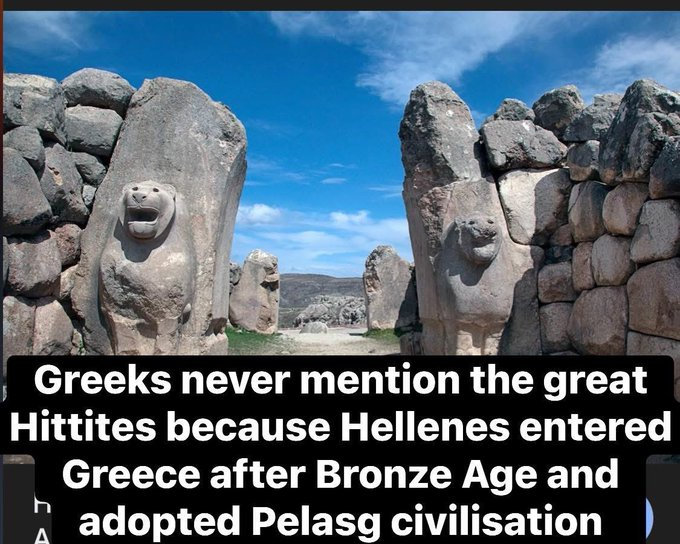
Greek civilization emerged after the Bronze Age collapse (~1200 BCE), inheriting rather than inventing much of its culture from earlier populations, including the Pelasgians. Ancient sources, like Herodotus, describe the Pelasgians as pre-Hellenic inhabitants of the Aegean whose material culture, myths, and traditions were absorbed by the emerging Greeks. Archaeological and genetic studies confirm continuity between Bronze Age and later Greek populations, showing assimilation of pre-Greek groups. Over time, Greeks reinterpreted this inherited legacy to construct their own identity and mythology, blending earlier cultural elements into the foundation of classical Greek civilization. Greek culture is thus both inherited and transformed.
The story of Greek civilization often begins in the aftermath of the Bronze Age collapse, around 1200 BCE.
This period marked the end of the palatial Mycenaean societies and a dramatic cultural transformation in the Aegean. Archaeological evidence indicates that Greek culture did not arise in isolation; rather, it inherited elements from earlier populations, including the so-called Pelasgians, pre-Hellenic peoples whose presence is attested in classical sources.
Ancient historians such as Herodotus reference the Pelasgians as indigenous inhabitants of the Aegean, gradually absorbed or displaced by emerging Greek communities. Their material culture, language influences, and mythological motifs were integrated into the developing Greek identity, forming a foundation upon which later mythology and civic traditions were built.
Modern scholarship confirms this cultural continuity. Genetic studies of Bronze Age and Iron Age populations in Greece show a complex mix of ancestries, consistent with the assimilation of pre-Greek groups into what became classical Greek society. Historians also note that later Greeks often claimed the cultural and mythological legacy of these earlier peoples, reshaping it into narratives that reinforced emerging notions of Greek identity.
In other words, the Greeks did not simply invent their culture after the Bronze Age; they inherited, adapted, and reinterpreted the traditions of those who lived in the region long before them, creating a civilization that combined continuity and innovation.
References
- Herodotus. The Histories. Translated by Robin Waterfield. Oxford: Oxford University Press, 1998.
- “Pelasgians.” Encyclopaedia Britannica. Accessed March 24, 2026. https://www.britannica.com/topic/Pelasgians.
- Papathanasiou, Anagnostis, et al. “Genetic Continuity and Population Change in the Aegean from the Bronze Age to the Iron Age.” PLOS ONE 12, no. 2 (2017): e0171126. https://doi.org/10.1371/journal.pone.0171126.
- Senior, Nassau William. Conversations with M. Thiers, M. Guizot, and Other Distinguished Persons During the Second Empire. Vol. 2. London: John Murray, 1878.
- Finkelberg, Margalit. “The Pelasgians and the Prehistory of Greece.” Journal of Hellenic Studies 118 (1998): 35–58. https://www.cambridge.org/core/journals/journal-of-hellenic-studies/article/history-of-the-pelasgian-theory/7CDF23004B984C3F2160187CC0FE7224.

