

by Gurakuç Kuçi
Now, 22 years after the unrest of March and in light of the review of the events of recent years, such as the terrorist attack in Banjska, the attack on Ibër-Lepenc and the dismantling of an espionage network linked to the BIA in Kosovo, the unrest of March take on a clearer political and strategic meaning. The events appear as part of a logic where the security crisis, infiltration and destabilization are used to keep the north of Kosovo contested and the statehood of Kosovo incomplete
Infrastructure and illegal control of the north (2000–2004)
After the war in Kosovo, the situation was not characterized only by institutional transition and the establishment of authority by international missions, but at the same time also by the establishment of a parallel reality by illegal Serbian structures in the Serbian enclaves, and especially in the north of Kosovo. Reports of international organizations, including the International Crisis Group (ICG), clearly described these phenomena and, for this reason, in 2002, they clarified the influence and financing by Serbia for the partition of Kosovo.
This group explicitly called for pressure on Belgrade to cease support for parallel structures in the north of Mitrovica. The report highlighted Belgrade’s infiltration in Kosovo and the financing of parallel structures, including at the center the group “Bridge Watchers”. The report emphasized that the financing was carried out directly by the Ministry of Internal Affairs of Serbia (MUP) and constituted a violation of UN Resolution 1244.
The same report also highlighted the fact that the United Nations Interim Administration Mission in Kosovo (UNMIK), at that time, had difficulty establishing its authority beyond the Ibar, due to the presence of Serbian parallel institutions financed by Belgrade.
The ICG called on the international community to condition financial assistance to Serbia on the cessation of support for parallel structures. Likewise, it was proposed that Serbia, due to these actions, be denied membership in the Council of Europe, in the Partnership for Peace with NATO, and in agreements with the EU. The analysts of the report argued that Belgrade would not cooperate in this direction without serious international pressure, equal to that used to secure cooperation with the Hague Tribunal, as political stability in Kosovo was at risk.
This report analyzed in detail, at that time, Serbia’s efforts for the partition and cantonization of Kosovo, identifying these as strategies of Belgrade to maintain control over the north and to dictate the final status of Kosovo. The report emphasized that Mitrovica was de facto divided and that the aim of Belgrade was the final partition of the province.
The cantonization plan, as a proposal of Belgrade, aimed at formal geographical division through a system of “self-governance”, where, according to this plan, Serbs would control 30% of the territory of Kosovo, divided into five cantons. There was even a proposal for division according to the Bosnia model and the creation of “entities”.
The Serbs who most strongly pushed this idea ranged from the government of Serbia to those holding positions in Kosovo. The list began with Vojislav Kostunica, prime minister at the time; Nebojsa Covic, deputy prime minister of Serbia and head of the Coordination Center for Kosovo; Branislav Krstic, deputy director of the Coordination Center and author of the writings on which Covic’s proposals for cantonization were based;
Oliver Ivanovic, at that time a member of the “POVRATAK” coalition; Marko Jaksic, vice president of the DSS party and a radical leader in the north; as well as Milan Ivanovic, chairman of the Serbian National Council of Northern Kosovo, who, together with Jaksic, avoided cooperation with UNMIK and called for partition, etc. The aim was always to present that multi-ethnicity does not function.
At that time, the ICG reported that Belgrade had poured into Kosovo over 50 million euros only in the first eight months of 2001. According to the reporters, the World Bank should have halted assistance to Serbia’s budget, as the money from this bank indirectly ended up financing parallel structures.
How powerful and untouchable these parallel structures were is shown by the fact that, in a clash of the group of Slavoljub Jovic “Pagi”, a member of the Bridge Watchers, with UNMIK police, 26 police officers from the latter were injured.
All of this constituted a structural provocation and a creation of situations that led toward the partition of Kosovo through parallel structures, systems of segregation, groups that kept the situation tense through clashes, road barricades, confrontations at the bridge, etc.
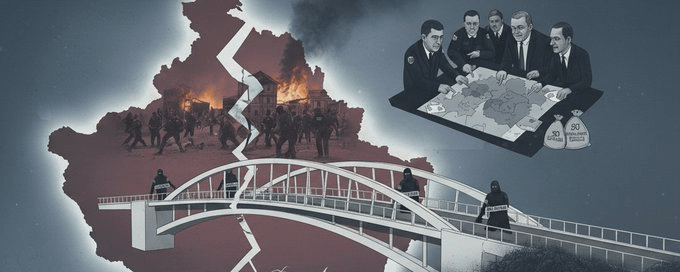
The unrest of March 2004 and indications of Serbia’s involvement
Other reports of that time also emphasized the element of Serbia’s tendencies for the cantonization of Kosovo or its partition. In the Human Rights Watch report on the March 2004 unrest, it was assessed that there were major concerns on the Albanian side regarding the establishment of “parallel institutions” by Belgrade. According to the report, fear was also increasing due to the failure of UNMIK to challenge these structures, and this allowed Belgrade to turn the cantonization of Kosovo into a fait accompli.
Likewise, the same report also mentioned the Bridge Watchers as a group where the starting point of violence occurred in every case, identifying their meeting place as the cafe “Dolce Vita”, located near the bridge.
Nebojsa Covic, in one of his interviews, spoke about a covert military operation carried out by Serbian forces in the name of protecting the Gracanica Monastery during the March unrest. He stated that, together with a group mainly composed of paratroopers and police officers, they had crossed the border in a civilian vehicle and had positioned themselves inside the church.
He further added that he had contacted the KFOR commander to arrange a meeting. The latter had replied that he could not meet him due to the distance, but when Covic informed him that he was already at the Monastery and had arrived around 09:00 in the morning, this caused surprise for the KFOR commander.
This statement by Covic indicates that Serbia knew in advance what was expected to happen in Kosovo.
The political exploitation of the unrest and the advancement of partition plans
In a report by Borut Grgic and Jana Urh, the presentation of Belgrade’s plan, introduced in April 2004, immediately after the March unrest, for ethnic partition is emphasized. The objective was an engineered division through the decentralization of power along ethnic lines, with autonomous regions leading toward partition.
Another report, which contains extensive analysis from several authors, explained the same issue: how Belgrade was aiming at the partition of Kosovo. Tim Judah argued that Belgrade’s plan foresaw the creation of five autonomous Serbian districts that would form the “Serbian Autonomous Community of Kosovo and Metohija”.
Janusz Bugajski also argued that the plan for “ethno-territorial decentralization” is an early attempt at the partition of Kosovo. At that time, Bugajski also warned that there is no third path for Kosovo between dependency and independence, and that delays in determining the status encourage radicals and plans for partition.
These unrests were strongly used by Belgrade against Kosovo’s movement toward final status, arguing that multi-ethnic governance is unstable and pushing forward their plans for the cantonization and partition of Kosovo, which had begun before the March unrest.
On 25 August 2005, Nebojsa Covic was dismissed from his duties due to his frequent clashes with Kostunica, who at that time held the position of prime minister. Covic accused the government of lacking a clear strategy for Kosovo and of blocking his initiatives.
Meanwhile, on the other hand, his dismissal was accompanied by serious accusations of misuse of state funds intended for Serbs in Kosovo, which publicly were mainly designated for the construction of houses that were never completed. These public accusations cast a shadow over their failed use during the March unrest.
Covic was then replaced by Sanda Raskovic-Ivic, who had a closer approach to Kostunica.
Continuity of a strategy: from March 2004 to today
Now, 22 years after the March unrest and in light of the review of the events of recent years, such as the terrorist attack in Banjska, the attack on Iber-Lepenc and the dismantling of an espionage network linked to the BIA in Kosovo, the March unrest take on a clearer political and strategic meaning.
The events appear as part of a logic where security crisis, infiltration and destabilization are used to keep the north of Kosovo contested, the statehood of Kosovo incomplete and to hinder its full consolidation. Therefore, March 2004 appears as a provocation and incitement aimed at creating an environment where it would be demonstrated that multi-ethnicity does not function and that the partition of Kosovo or its treatment as an unresolved issue remains a political option.
Seen from a chronological perspective, from the events before March 2004, those after and up to today, it is understood that there exists a consistent strategy aimed at realizing Serbia’s plans for the partition of Kosovo, which has changed in forms and modes of action over the years, but not in objectives.
Precisely in this sense, crises do not appear only as episodes of violence, but also as instruments to produce political consequences and to advance objectives that Serbia has not managed to achieve through direct means. Transdisciplinarity in analyzing these events offers a perspective that strips away propaganda and places the focus on facts.

