
Serbia Among Europe’s Most Affected by Organized Crime, New Index Shows
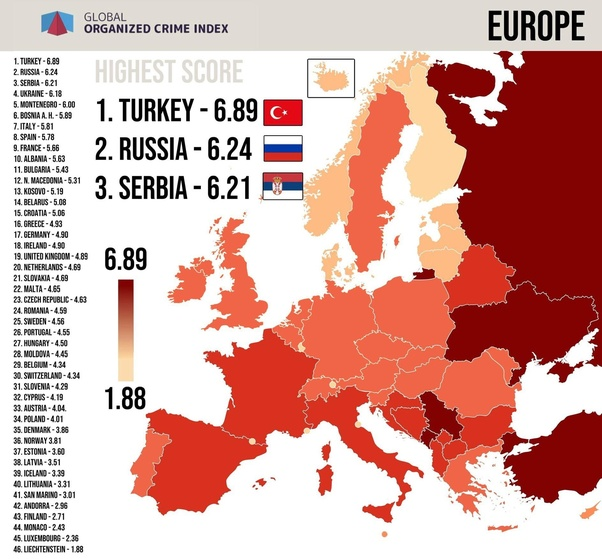
A recent map based on the Global Initiative Against Transnational Organized Crime’s Global Organized Crime Index places Serbia among the countries most impacted by organized crime in Europe, ranking third on the continent with a score of 6.21. Only Turkey (6.89) and Russia (6.24) score higher.
The index evaluates countries on the scale, structure, and impact of criminal markets and actors, alongside the resilience of state institutions. Serbia’s high ranking highlights persistent challenges in tackling organized crime networks that operate both domestically and across borders.
A Regional Hub
Located in the Western Balkans, Serbia occupies a strategic position along key transit routes between East and West. According to the index, this geography contributes to its role as a corridor for illicit flows, including drug trafficking, human smuggling, and arms trade. The broader Western Balkans has long been identified as vulnerable to such activities due to a combination of historical instability, economic disparities, and governance gaps.
Experts note that criminal groups in Serbia are often highly networked, maintaining links with organizations across Europe and beyond. These networks can adapt quickly, making law enforcement efforts more complex.
Institutional Challenges
While Serbia has made progress in reforming its legal and policing frameworks—particularly as part of its ongoing relationship with the European Union—the index suggests that institutional resilience still lags behind the scale of criminal activity.
Issues such as corruption, political influence, and limited judicial independence are frequently cited as factors that weaken the effectiveness of anti-crime measures. Transparency and accountability remain key areas where improvements are needed.
Comparisons Across Europe
The map shows a clear divide across Europe. Countries in Northern and Western Europe, such as Norway and Switzerland, score significantly lower, reflecting stronger institutions and lower levels of organized crime penetration. In contrast, parts of Eastern and Southeastern Europe, including Serbia, exhibit higher scores.
Neighboring countries like Bosnia and Herzegovina and Montenegro also rank relatively high, reinforcing the idea of a regional pattern rather than an isolated national issue.
Implications and Outlook
Serbia’s ranking underscores the importance of sustained reforms and international cooperation. Organized crime is inherently transnational, meaning that effective responses require coordination between governments, law enforcement agencies, and international bodies.
Analysts emphasize that improving judicial independence, strengthening anti-corruption frameworks, and enhancing cross-border intelligence sharing will be crucial steps forward. As Serbia continues its path toward closer European integration, addressing these challenges will likely remain a central priority.
Sources
- Global Organized Crime Index, published by the Global Initiative Against Transnational Organized Crime
- Global Initiative Against Transnational Organized Crime (GI-TOC), official data and methodology documentation
- European Commission reports on rule of law and governance in Serbia

