
Abstract
The Antikythera Mechanism is widely regarded as a product of Hellenistic Greek science, dated to the late 2nd or early 1st century BCE. This interpretation is supported by Greek inscriptions, stylistic dating, and correspondence with known Greek astronomical theories. However, the attribution is not beyond dispute. This paper examines a series of counterarguments that challenge the assumption of an exclusively Hellenistic origin. These include issues related to archaeological context, technological discontinuity, cross-cultural knowledge transmission, linguistic ambiguity, and the absence of a clear developmental lineage. The paper argues that the mechanism may be better understood as a product of a broader, interconnected Mediterranean and Near Eastern intellectual environment rather than a purely Greek invention.
1. Introduction
Since its discovery in 1901, the Antikythera Mechanism has been hailed as the earliest known analog computer, demonstrating a remarkable level of mechanical and astronomical sophistication. The prevailing scholarly consensus situates its origin firmly within the Hellenistic Greek world. Yet, this consensus rests on a set of interpretive assumptions that merit closer scrutiny. This paper does not seek to overturn the Hellenistic attribution outright but to critically examine its evidentiary basis and explore plausible alternative interpretations.
2. Archaeological Context and the Problem of Provenance
The mechanism was recovered from a shipwreck dated to approximately the 1st century BCE. While this provides a terminus ante quem, it does not conclusively establish the place of manufacture. Ancient Mediterranean trade networks were extensive and complex, facilitating the movement of goods, technologies, and ideas across cultural boundaries.
The cargo of the wreck itself appears heterogeneous, including artworks and artifacts of varying origins. It is therefore plausible that the mechanism was not produced by the same cultural group that operated the vessel. It may have been a traded item, diplomatic gift, or even war booty. Consequently, the findspot cannot be equated with the place of origin.
3. Technological Discontinuity and the “Outlier Problem”
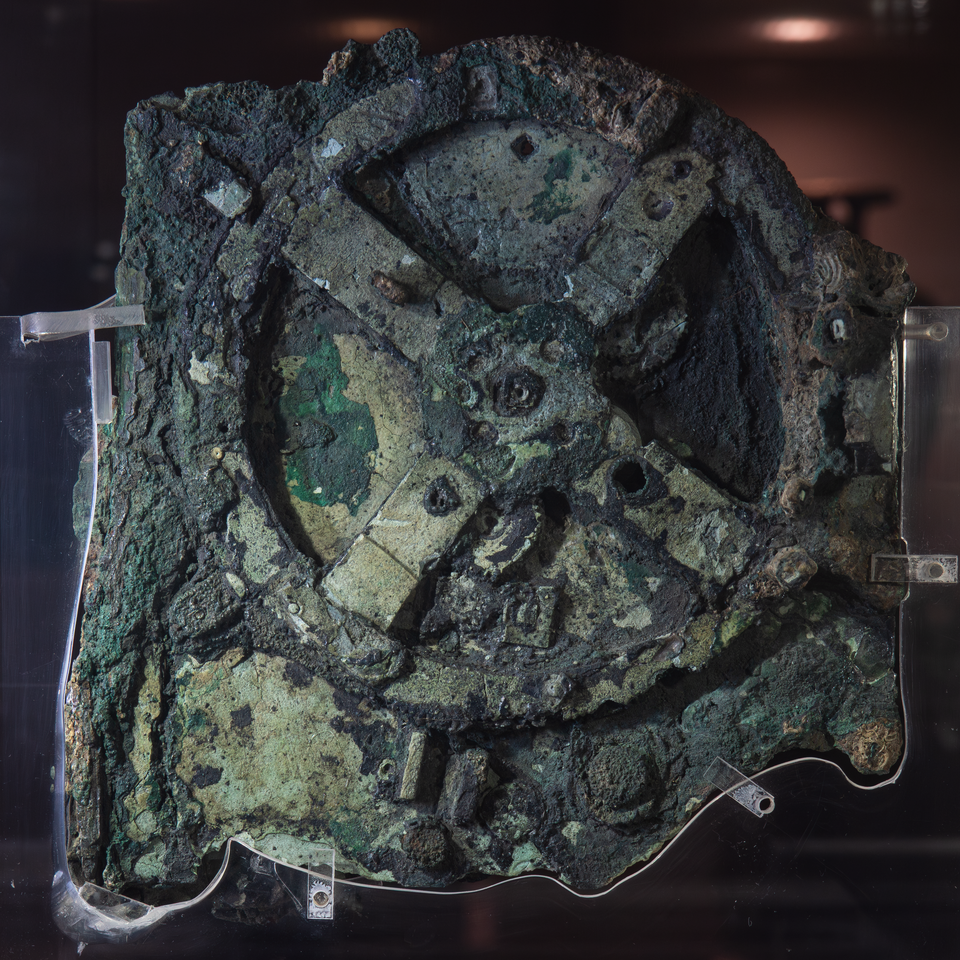
One of the most striking features of the Antikythera Mechanism is its technological sophistication. The system of interlocking bronze gears, capable of modeling complex astronomical cycles, has few parallels in the archaeological record of the period.
This raises a critical question: if such technology was developed within the Hellenistic world, why is there so little evidence of its evolution or replication?
The absence of intermediate forms or simpler prototypes suggests either a significant loss of material evidence or that the mechanism represents a technological tradition developed elsewhere and only incidentally preserved in a Greek context.
4. Cross-Cultural Transmission of Astronomical Knowledge
The astronomical principles embedded in the mechanism, such as the Saros cycle used for eclipse prediction, are well attested in earlier Mesopotamian (Babylonian) traditions. Greek astronomers are known to have incorporated and adapted this knowledge.
This raises the possibility that the mechanism is not purely a Greek invention but rather a synthesis of knowledge drawn from multiple cultures. Babylonian astronomy, Egyptian craftsmanship, and Greek mathematical formalism may all have contributed to its design. In this sense, attributing the mechanism solely to the Hellenistic world may obscure the extent of intellectual exchange in antiquity.
5. Linguistic Evidence and Its Limitations
The inscriptions on the mechanism are in Greek and have been central to arguments for its Hellenistic origin. However, language alone is not definitive evidence of manufacture. Greek functioned as a lingua franca in the eastern Mediterranean during the Hellenistic period, particularly in scientific and scholarly contexts.
It is therefore conceivable that a non-Greek craftsman or workshop produced the device for a Greek-speaking patron or market. Alternatively, the inscriptions could have been added after the mechanism’s construction. While these scenarios are speculative, they highlight the limitations of relying solely on linguistic evidence for cultural attribution.
6. Absence of a Developmental Lineage
Technological innovations typically exhibit a traceable developmental trajectory, with earlier and later examples providing context for their emergence and diffusion. In the case of the Antikythera Mechanism, such a lineage is conspicuously absent.
No comparable devices of similar complexity have been definitively identified from the same period. This absence complicates efforts to situate the mechanism within a continuous tradition of Greek mechanical engineering and opens the possibility that it originated from a now-lost or poorly documented technological culture.
7. Chronological Uncertainty
The dating of the mechanism is primarily based on the associated shipwreck and stylistic analysis of inscriptions. However, these methods provide only indirect evidence. The possibility remains that the device was already old at the time of the shipwreck, having been preserved as an heirloom or collected antiquity.
If so, its origin could predate the currently accepted timeframe and potentially belong to a different cultural or technological context.
8. Toward a Transcultural Interpretation
Rather than framing the debate in binary terms—Greek versus non-Greek—it may be more productive to adopt a transcultural perspective. The Mediterranean of the Hellenistic period was characterized by intense interaction among diverse cultures, including Greek, Egyptian, Persian, and Mesopotamian societies.
The Antikythera Mechanism may thus represent a hybrid artifact, embodying the cumulative knowledge of multiple traditions. Such an interpretation aligns with broader patterns of knowledge exchange in antiquity and avoids the pitfalls of attributing complex innovations to a single cultural source.
9. Conclusion
While the Hellenistic attribution of the Antikythera Mechanism is supported by substantial evidence, it is not definitive. The arguments presented in this paper highlight the need for caution in making exclusive cultural claims. The mechanism’s origin may be more accurately understood within a network of intercultural exchanges rather than as the product of a single civilization.
Future research, including comparative studies and new archaeological discoveries, may help clarify these issues. Until then, the Antikythera Mechanism should be regarded not only as a marvel of ancient engineering but also as a testament to the interconnectedness of ancient knowledge systems.
Keywords: Antikythera Mechanism, Hellenistic science, ancient technology, cross-cultural exchange, history of astronomy, archaeology
References
Freeth, Tony, Yanis Bitsakis, Xenophon Moussas, John H. Seiradakis, Alexander Tselikas, Helen Mangou, Mike Edmunds, et al. “Decoding the Ancient Greek Astronomical Calculator Known as the Antikythera Mechanism.” Nature 444 (2006): 587–591.
Freeth, Tony, Alexander Jones, John M. Steele, and Yanis Bitsakis. “Calendars with Olympiad Display and Eclipse Prediction on the Antikythera Mechanism.” Nature 454 (2008): 614–617.
Jones, Alexander. A Portable Cosmos: Revealing the Antikythera Mechanism, Scientific Wonder of the Ancient World. Oxford: Oxford University Press, 2017.
Marchant, Jo. Decoding the Heavens: A 2,000-Year-Old Computer—and the Century-Long Search to Discover Its Secrets. Cambridge, MA: Da Capo Press, 2009.
Price, Derek J. de Solla. “Gears from the Greeks: The Antikythera Mechanism—A Calendar Computer from ca. 80 B.C.” Transactions of the American Philosophical Society 64, no. 7 (1974): 1–70.
Steele, John M. Observations and Predictions of Eclipse Times by Early Astronomers. Dordrecht: Springer, 2000.
Neugebauer, Otto. The Exact Sciences in Antiquity. 2nd ed. New York: Dover Publications, 1969.
Rochberg, Francesca. The Heavenly Writing: Divination, Horoscopy, and Astronomy in Mesopotamian Culture. Cambridge: Cambridge University Press, 2004.
Evans, James. The History and Practice of Ancient Astronomy. Oxford: Oxford University Press, 1998.

