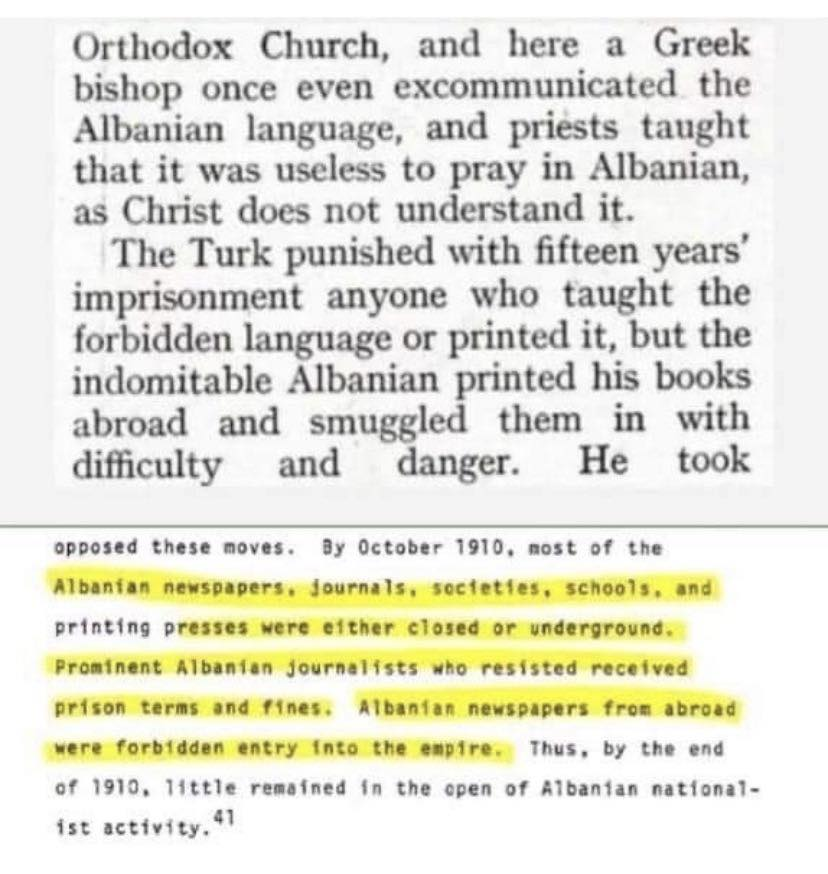

The excerpts describe the severe restrictions placed on the Albanian language and press in the late Ottoman period. They highlight how both religious and political authorities contributed to suppressing its use. According to the text, some clergy within the Orthodox Church discouraged or even condemned the use of Albanian in religious life, reflecting broader tensions over language, identity, and cultural authority.
At the same time, the Ottoman Empire enforced strict measures against Albanian-language education and publishing. Teaching or printing in Albanian could result in imprisonment, while newspapers, schools, and cultural societies were shut down or forced underground. Journalists who resisted faced penalties, and publications produced abroad were banned from entering the empire.
Despite these pressures, Albanian intellectuals and activists continued their efforts, often publishing materials abroad and smuggling them back into the country. The passage illustrates both the repression of Albanian cultural expression and the persistence of those who sought to preserve and develop the language under difficult conditions.
References
Unknown author. Excerpt on Albanian language suppression under Ottoman rule, excerpted image, undated. [Provide context if possible, e.g., from a historical text or archive.]
Albanian-Greek Frontier. LIT Verlag, 2010.
Fischer, Bernd J. Albania at War, 1939-1945. Purdue University Press, 1999.
Stavro Skendi, The Albanian National Awakening (Princeton University Press, 1967)
Miranda Vickers, The Albanians: A Modern History (I.B. Tauris, 1999)

