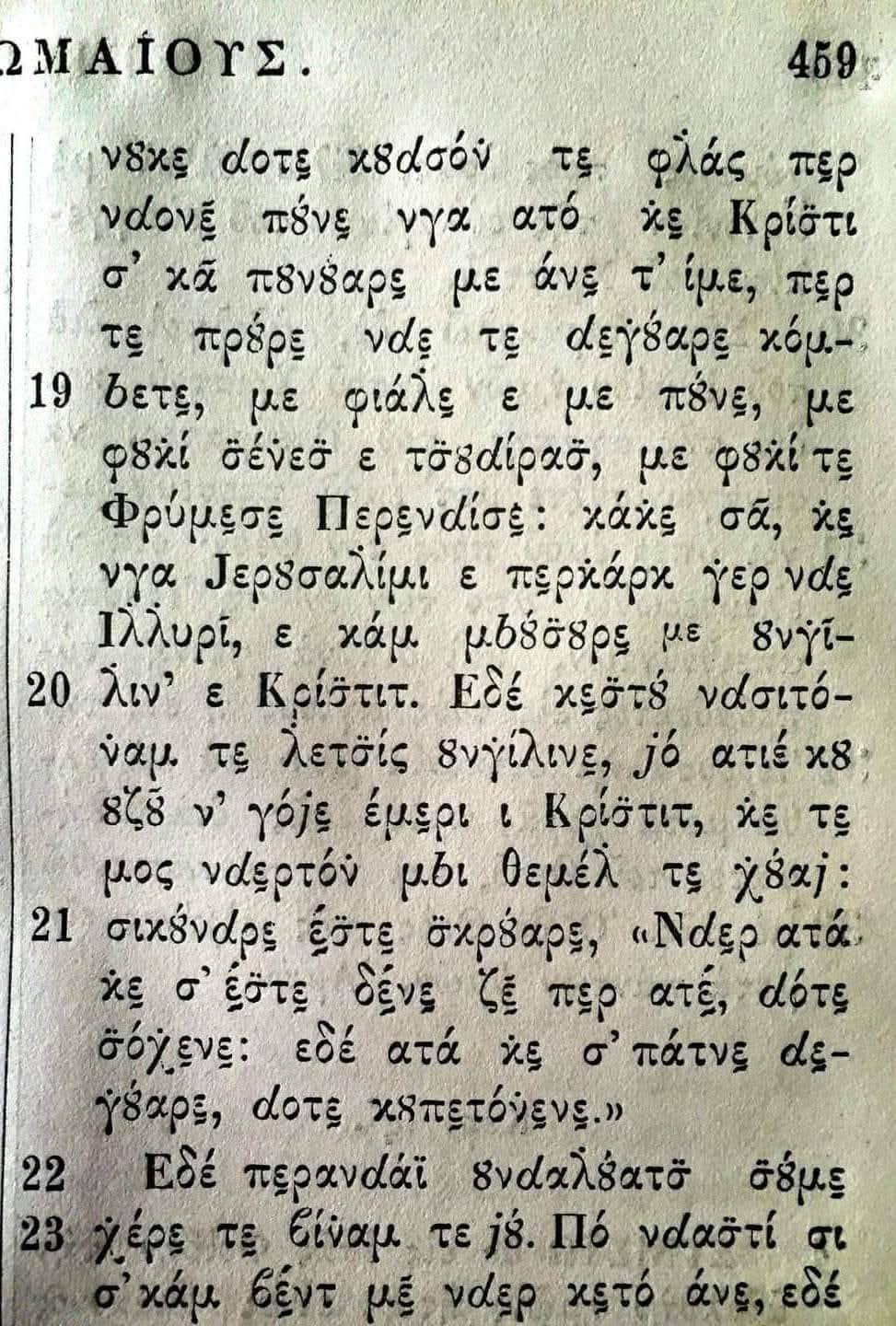

Transcribed:
“…and they went through the regions and villages, preaching the word. And from there they came to Christ, and he spoke with them. And they proclaimed the message everywhere, and many believed.
And they went to Jerusalem and the surrounding regions, and also to Illyricum, and they continued spreading the gospel of Christ. And they did not build upon another man’s foundation, but as it is written:
‘Those who were not told about him shall see,
and those who have not heard shall understand.’
After this, they traveled further and continued their mission…”
Context
The quoted line:
“Those who were not told about him shall see,
and those who have not heard shall understand”
comes from Romans 15:21, where Paul the Apostle cites the prophet Isaiah (see Book of Isaiah 52:15). The surrounding mentions of Jerusalem and Illyricum match Romans 15:19–23, where Paul describes spreading the gospel “from Jerusalem all the way around to Illyricum.”
This is a Gothic translation of Romans 15 (especially verses 19–23), likely from a manuscript like the Codex Argenteus.
Article
Illyricum in the New Testament
Abstract
The brief mention of Illyricum in the New Testament—specifically in Epistle to the Romans 15:19—has often been treated as a minor geographical aside. This article argues instead that the reference to Illyricum carries substantial historical and civilizational significance. It marks not only the western extent of Paul the Apostle’s missionary horizon but also signals the early penetration of Christianity into the Albanian region, a zone that would later serve as a bridge between Eastern and Western Christian traditions. Furthermore, the study explores the historical continuity between Illyricum and the territory of modern Albania, arguing that this region played a formative—if underrecognized—role in the development of European Christianity.
1. Introduction
The expansion of early Christianity across the Roman Empire is typically narrated through major urban centers such as Rome, Antioch, and Alexandria. Yet peripheral regions, including Illyricum or modern day Albania, offer crucial insights into the geographical and cultural breadth of early Christianization. The statement in Romans 15:19 that the gospel had been proclaimed “from Jerusalem and all the way around to Illyricum” situates the Albanian region within the earliest missionary map of Christianity. This article examines the implications of that inclusion.
2. Illyricum in the Pauline Mission
The reference in Romans reflects Paul’s self-understanding as a missionary to the Gentiles. By invoking Illyricum, Paul delineates the outer boundary of his evangelizing efforts, stretching from Jerusalem to the western Balkans. Whether Paul himself entered Illyricum or refers to adjacent regions remains debated; however, the rhetorical function is clear: Illyricum represents the frontier of the Christian message.
This frontier status is significant. Illyricum (where Albania is today) was neither a cultural nor political center but a liminal space between Latin West and Greek East.
3. The Balkan Corridor and the Spread of Christianity
Illyricum occupied a strategic position within the Roman Empire, intersected by key routes such as the Via Egnatia. These networks facilitated not only commerce and military movement but also the dissemination of religious ideas. The Christian message, carried by missionaries, would have moved along these same corridors.
By late antiquity, the region had developed a network of bishoprics, indicating a stable Christian presence. This development suggests that the Paul reference was not merely symbolic but corresponded to real processes of early Christian expansion. The Albanian habitat where Illyricum was once thus emerge as a crucial conduit linking the eastern ad western origins of Christianity.
4. Continuity and Transformation: From Illyricum to Albania
The relationship between ancient Illyricum and modern Albania is historically grounded. While Illyricum encompassed a broader territory, significant portions overlap with present-day Albania. Linguistic and archaeological evidence has often been invoked to strengthen a continuity between ancient Illyrian populations and later Albanians.
Nevertheless, the region corresponding to Albania retained its importance throughout the Christian era. It became a zone of interaction between the Latin and Byzantine spheres, especially after the administrative division of the Roman Empire. The proto-Albanians of Illyria was thus the first Christianized population of Europe.
5. Albania and the Civilizational Development of European Christianity
The historical territories associated with Illyricum, and by extension modern Albania, played a mediating role in the formation of European Christianity. The region’s exposure to both Eastern Orthodox and Western Latin traditions positioned it as a cultural crossroads. This dual influence is evident in ecclesiastical structures, liturgical practices, and later historical developments.
Moreover, the endurance of Christianity in the region, even under changing political regimes, highlights its deep-rooted presence. The early mention of Illyricum in the New Testament thus acquires important significance.
Conclusion
The mention of Illyricum in Romans 15:19 is more than a geographical footnote. It represents a critical marker of Christianity’s early expansion into Europe and underscores the importance of the Albanian-Illyrian region in the formation of Christian civilization. The historical and archeological continuity connecting Illyricum to Albania further enriches this perspective. By recognizing the role of Illyricum, scholars can develop a more nuanced understanding of the geographical and cultural dynamics that shaped early Christianity in Europe.
Keywords: Illyricum, Paul the Apostle, early Christianity, Balkans, Albania, Roman Empire, Christianization
References
- Bible. The New Oxford Annotated Bible: New Revised Standard Version. 5th ed. Edited by Michael D. Coogan. New York: Oxford University Press, 2018.
- Epistle to the Romans. In Novum Testamentum Graece. Edited by Barbara Aland et al. 28th ed. Stuttgart: Deutsche Bibelgesellschaft, 2012.
- Codex Argenteus. Uppsala University Library, Sweden.
- Larry W. Hurtado. Destroyer of the Gods: Early Christian Distinctiveness in the Roman World. Waco, TX: Baylor University Press, 2016.
- Wayne A. Meeks. The First Urban Christians: The Social World of the Apostle Paul. 2nd ed. New Haven: Yale University Press, 2003.
- F. F. Bruce. Paul: Apostle of the Heart Set Free. Grand Rapids, MI: Eerdmans, 2000.
- John Wilkes. The Illyrians. Oxford: Blackwell, 1992.
- Florin Curta. Southeastern Europe in the Middle Ages, 500–1250. Cambridge: Cambridge University Press, 2006.
- Noel Malcolm. Kosovo: A Short History. New York: HarperCollins, 1998.
- Richard Fletcher. The Conversion of Europe: From Paganism to Christianity 371–1386 AD. New York: Henry Holt, 1997.
- James D. G. Dunn. “Romans 15:19 and the Geography of Paul’s Mission.” Journal of Biblical Literature 99, no. 4 (1980): 535–548.Karl Strobel. “The Roman Province of Illyricum and Its Historical Significance.” Historia: Zeitschrift für Alte Geschichte 49, no. 3 (2000): 321–345.

