
by Anita Paga
Abstract
The text presents a study of Y-DNA haplogroup distributions in the Balkans, with a focus on Albanians. It states that populations in the region carry a mixture of very ancient genetic lineages, particularly G2a, E1b1b (EV13), R1b, and J2, and argues for long-term autochthonous continuity predating Indo-European expansions. It also compares haplogroup frequencies across Balkan populations before and after proposed Slavic migrations, suggesting shifts in genetic composition. The text further links these genetic patterns to broad prehistoric migrations and includes associations with ancient civilizations and historical figures, blending genetic data with non-mainstream historical interpretations.
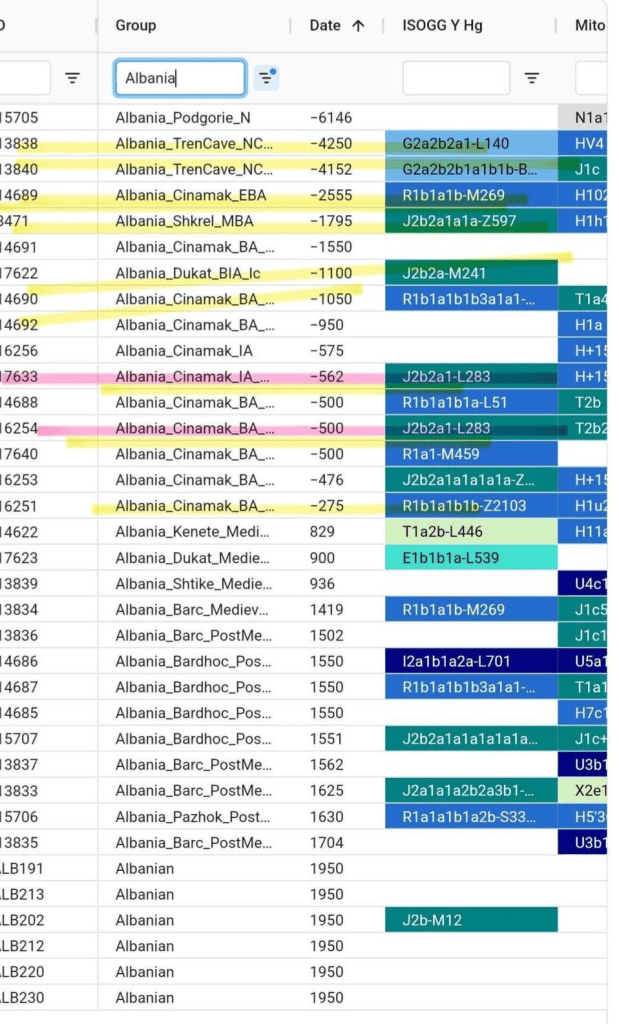
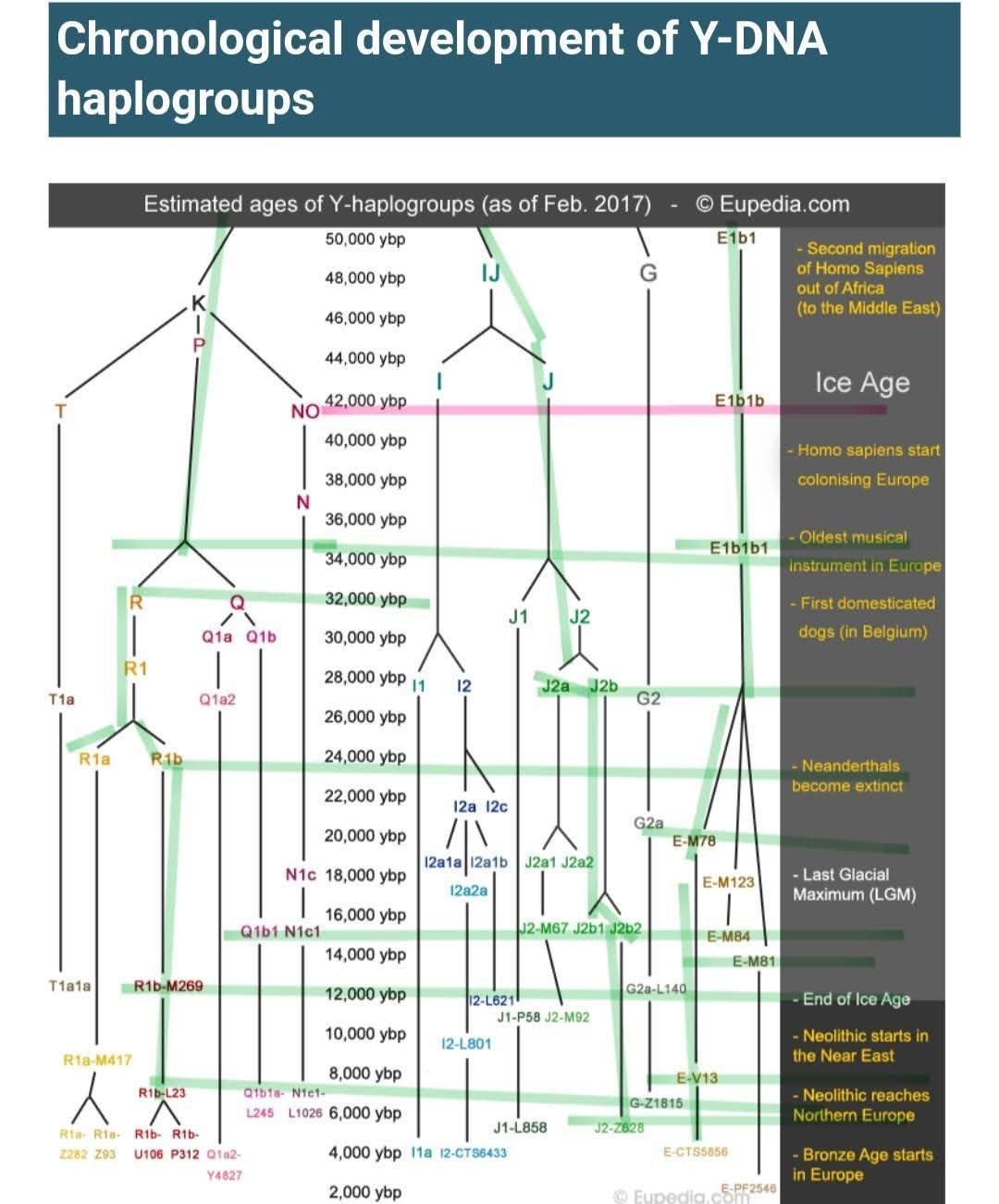
Chronological development of Y-DNA haplogroups, show that Albanians contain the mixture of the oldest identified haplogroups, and can be considered autochthonous before the thesis of the Indo-European theory of our origin
Note: One of the oldest haplogroups found in Albania is G2a2b2b…which dates back to 4250 BC in the Trenit Cave. This group is a subgroup of G2a which dates back to 21000 BC.
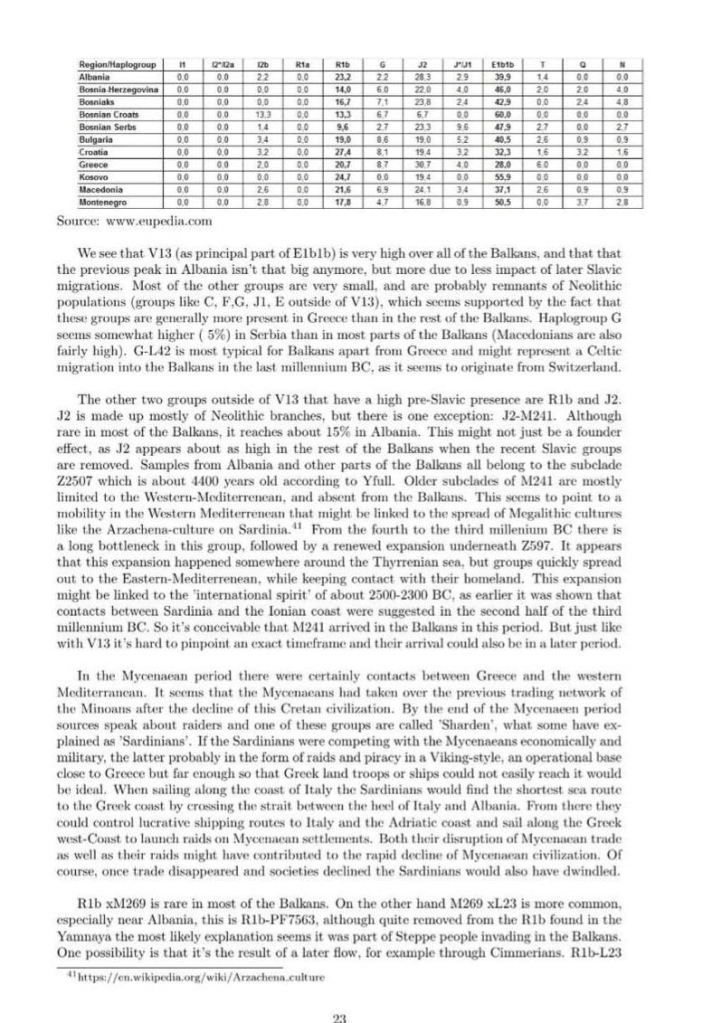
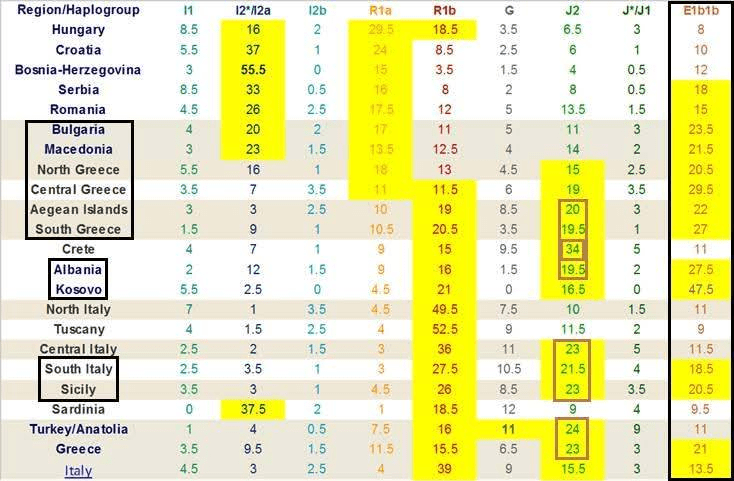
Before the Slavic migration in the Middle Ages, group G had the highest % in Bulgaria and Croatia (8.6-8.1), Macedonia 6.9% and Albania 2.2%.
E1b1(EV13), which dates to 50,000 BC and was identified in Europe 34,000 years ago, a cultural period that used musical instruments; the Neanderthal flute.
Also known as haplogroup E-M78, it is haplogroup E among Europeans and the Near East, which developed between 28,000 and 20,000 BC, and is considered to be the era before the European Ice Age.
Europe and the Southern Balkans experienced a prolonged and severe glacial period between 42,000 BC, ending in 12,000 BC, which caused population decline and migration to warmer climates.
From the Neolithic Period, around 8000 BC, the same haplogroup is identified as EV13:
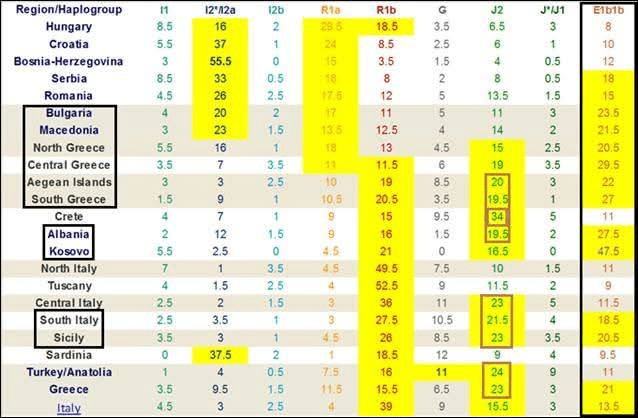
Currently, Albanians have the highest percentage of EV13 (E1b1b1a2).
The EV13 Eupedia database shows: On the European continent it has the highest concentration:
Kosovo (over 45%),
Albania and Montenegro (both 27%),
Bulgaria (23%),
Macedonia and Greece (both 21%),
Cyprus (20%),
Sicily (20%),
Southern Italy (18.5%),
Serbia (18%) and Romania (15%).

The tables reflecting comparative studies of EV13 before and after the Slavic influx show that the % decreased;
Kosovo from 55.9 to 47.5%
Montenegro from 50.5 to 27%
Bulgaria from 40.5 to 23.5%
Albania from 39.9 to 27.5%
Macedonia 37 to 21.5%
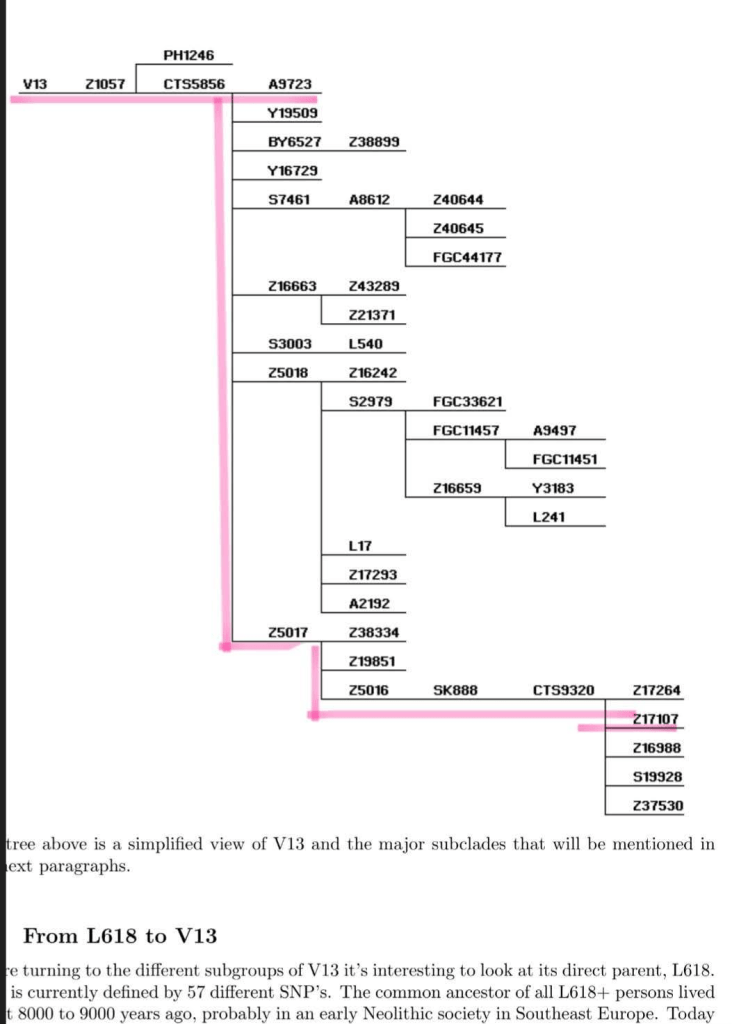
The dominant haplogroup of GEORGE KASTRIOTI was identified by a paternal descendant, belonging to haplogroup E-V13 > Z17107.
Hypothesis:
E-V13 emerged from E-M78, when Neolithic farmers were advancing in the Balkans and the Danubian basin and spread far beyond the borders of Europe to the eastern edge of the Mediterranean, the Caucasus, Kurdistan, Iran and even Siberia, since 6000 BC.
E-V13 is more common in Libya today than anywhere else in the Near East, which is consistent with North Central Africa as a potential source for European E-V13 (and other M78 subclades). In fact, the small presence of E-V13 in the Near East can best be explained by its exceptionally long presence in the eastern Mediterranean from the time of Alexander the Great until the end of Byzantine dominance of the region during the Middle Ages.
R1b split 25,000 BC,
The oldest sample was found in present-day Serbia in 8273 BC: the R1b1b-V88 subgroup.
On the other hand, in Albania, the unique R1b-M269 subgroup, dated to 2555 BC, has been identified as originating in 12,000 BC, the end of the Ice Age. In Serbia it dates from 200 AD as Serbia_Roman R1b1a1b-M269, and is rare in the rest of the Balkans.
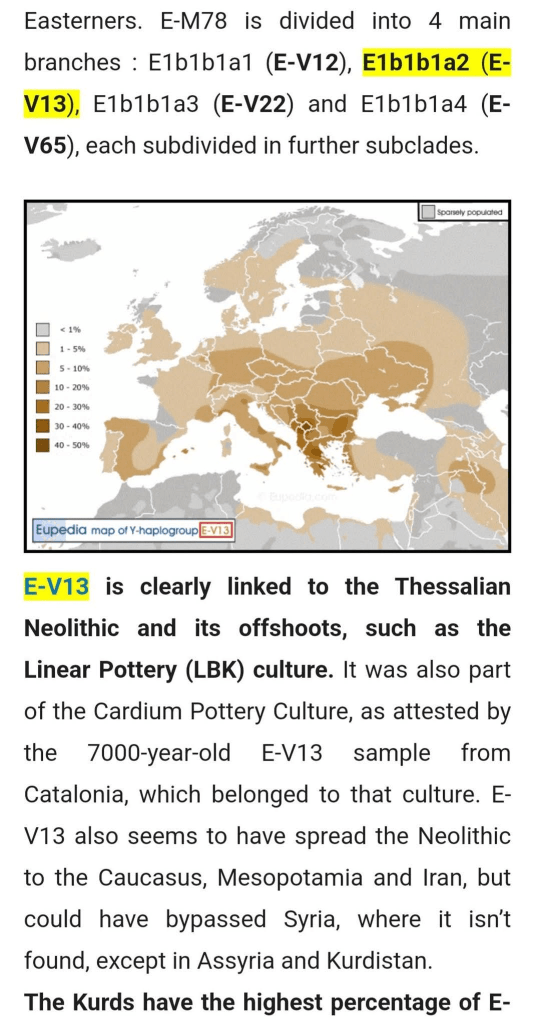
The tables reflecting comparative studies of R1b before and after the Slavic invasion show that the % decreased;
Kosovo from 24.7 to 21
Albania from 23.2 to 16
Macedonia from 21.6 to 12.5
Montenegro from 17.8 to 9.5
Bulgaria from 19 to 11
 Haplogroup IJ 50,000 BC, split into J during 40,000 BC and further into J2a & J2b during 28,000 BC, belong to the Neolithic branch.
The tables reflecting comparative studies of J2b before and after the Slavic invasion show that the % decreased;
Albania from 28 to 19.5
Macedonia 24.1 to 14
Bulgaria from 19 to 11
Kosovo from 19.4 to 16.5
Montenegro from 16.8 to 9

Rare Albanian groups:
*After the end of the last ice age approximately 12,000 years ago, European hunter-gatherers recolonized the continent from the Ice Age refuge of Southern Europe.
*J2-M241, although rare in the rest of the Balkans, reaches 15% in Albania. Between 4000-2300 BC, subclades of this haplogroup spread around the Tyrrhenian Sea and reached the Balkans around 2300 BC (not definitive).
Found in Albania 1100 BC, and also as a subclade in the Hunza people, discussed earlier.
https://www.facebook.com/share/p/1BTZfQj7WG/
*J2b2a1-L283 was first identified in 562 BC, with a concentration in Northern Albania and later spread towards the southern Balkans.

Some conclusions:
E-M78 was autochthonous in Southern Europe in the Mesolithic, and was assimilated by G2a farmers, then by R1b Indo-Europeans.
Analysis of the Egyptian dynasty; EV13
Contrary to the previous thesis of non-European origin, the Egyptian royal families, although from a mixture of genetic characteristics based on marriages, show non-African traits.
The genetic profile of Ramesses II determined that: “the hair of Ramesses II, surprisingly preserved, showed additional data on pigmentation: he was a person with light skin and red hair.
Cleopatra’s facial features originate from the Macedonian dynasty and she is portrayed as having red hair in a woodcut, in the 1st century AD.