
by Ερινα Ινα Ελμαζι
Summary
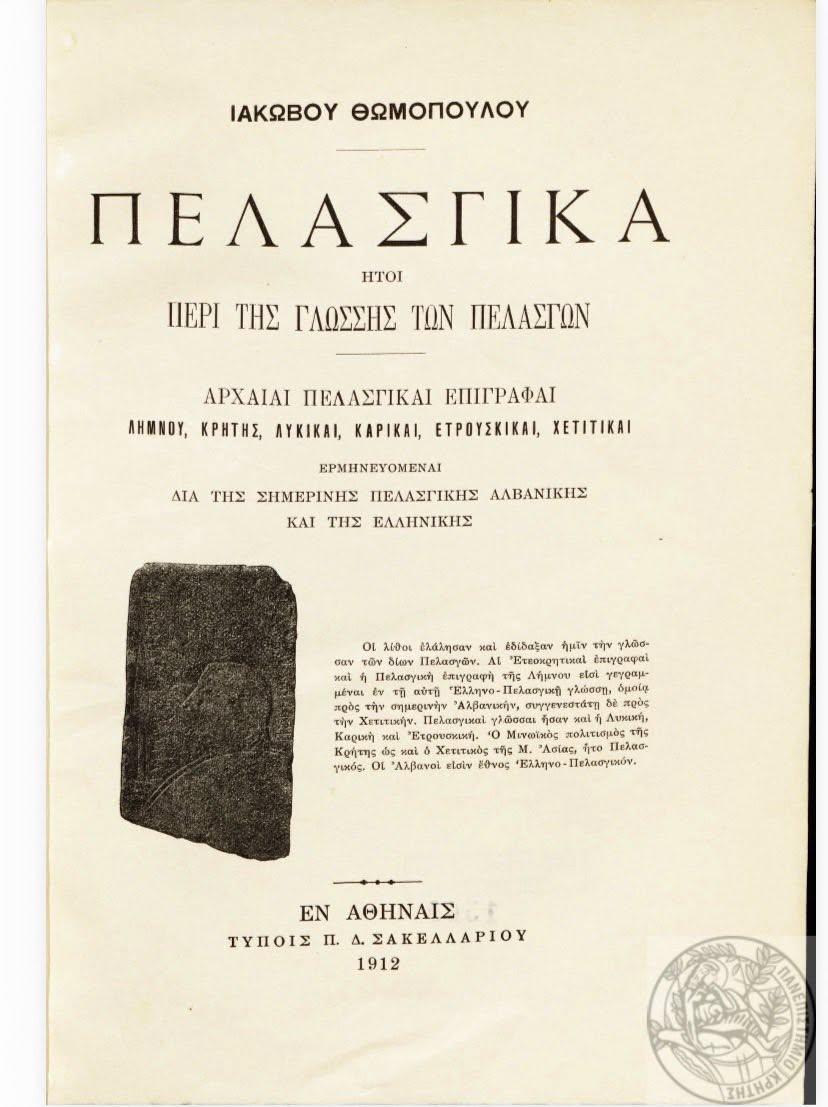
Iakovos Thomopoulos’ 1912 work proposes that various ancient inscriptions from regions such as Lemnos, Crete, and Etruria belong to a single “Pelasgian” language. He argues that this language survives today as Albanian and is closely related to Ancient Greek and other regional languages. Based on comparative analysis, he claims linguistic continuity between ancient Pelasgians, Illyrians, and modern Albanians. Thomopoulos classifies Pelasgian within a broader Greek language family, alongside Thraco-Phrygian. He further suggests that ancient populations, including the Minoans, belonged to a shared Greco-Pelasgian linguistic and cultural group, presenting Albanians as part of this enduring historical continuum.
Title: Pelasgian: The Language of the Pelasgians
Author: Iakovos Thomopoulos
Publisher: Typis P. D. Sakellariou
Year of publication: 1912
Content and Theory
The book deals with the decipherment of ancient inscriptions (from Lemnos, Crete, Lycia, Caria, Etruria, and the Hittites) based on a specific linguistic theory of the author.
According to the text, Thomopoulos argues that:
- These ancient languages are Pelasgian.
- “Modern Pelasgian” is Albanian.
- There is a close relationship between Ancient Greek, Albanian, and the other aforementioned languages.
- Albanians are a “Greco-Pelasgian nation.”

Preface (Page 13)
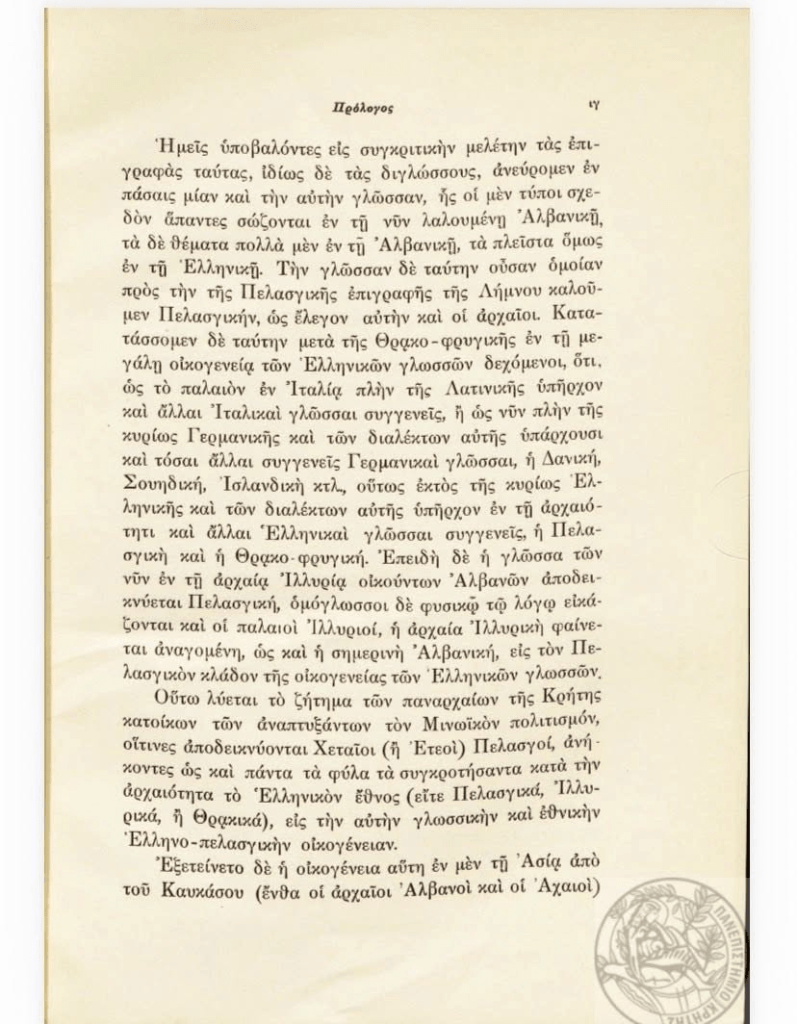
By subjecting these inscriptions, especially the bilingual ones, to a comparative study, we found in all of them the same language. The forms of this language are almost entirely preserved in modern spoken Albanian, while its themes (word roots) are found in many Albanian words, but most of them in Greek.
Since this language resembles that of the Pelasgian inscription of Lemnos, we call it Pelasgian, as the ancients did. We classify it together with Thraco-Phrygian within the great family of Greek languages, accepting that just as in the past in Italy there were other related Italic languages besides Latin, or as today there are many other related Germanic languages (Danish, Swedish, Icelandic, etc.) besides German and its dialects, so too in antiquity there were other related Greek languages besides the main Greek language, such as Pelasgian and Thraco-Phrygian.
Since the language of the Albanians who today live in ancient Illyria turns out to be Pelasgian, it is natural to conclude that the ancient Illyrians were of the same linguistic group. Thus, ancient Illyrian appears to be traced, like modern Albanian, to the Pelasgian branch of the Greek language family.
In this way, the issue of the ancient inhabitants of Crete—those who developed the Minoan civilization—is resolved, as they appear to have been Pelasgian-Hittite (or Eteocretan). They belonged, like all the tribes that formed the Greek nation in antiquity (whether Pelasgians, Illyrians, or Thracians), to the same Greco-Pelasgian linguistic and national family.
Source
Thomopoulos, Iakovos. Pelasgika: Hē glōssa tōn Pelasgōn [Pelasgian: The Language of the Pelasgians]. Athens: Typis P. D. Sakellariou, 1912.

