
Jesus of Nazareth preached a radical gospel of love, forgiveness, and peace. “Love your enemies,” he commanded in the Sermon on the Mount. “Bless those who curse you.” His message was one of universal compassion, not tribal hatred. Yet in contemporary Serbia, a disturbing trend persists: far-right Chetnik revivalists, nationalist ultras, and irredentist ideologues have hijacked Christian imagery—Orthodox icons, crosses, and invocations of faith—to cloak their extremist agendas in the language of piety.
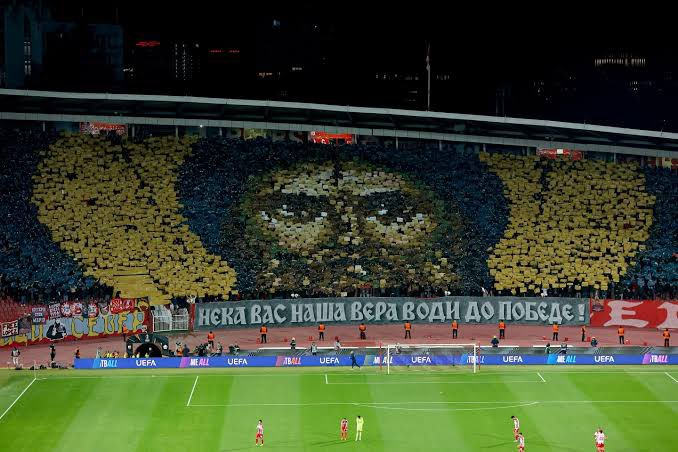
This is not devotion; it is desecration.Nowhere has this cynical exploitation been more visible than in the stands of Serbian football. In February 2026, during a UEFA Europa League knockout tie against Lille, the ultras of Crvena Zvezda (Red Star Belgrade)—the notorious Delije Sever group—unfurled a spectacular tifo featuring a towering Serbian Orthodox icon widely interpreted as Jesus Christ (or, alternatively, Saint Simeon the Myrrh-flowing).
Accompanying it was a banner reading “May our faith lead you to victory.” UEFA responded with a €95,500 fine on the club, including a €40,000 penalty specifically for “displaying a message deemed inappropriate for a sporting event” that allegedly undermined the “reputation and integrity of football and UEFA.”
While some defenders framed the fine as anti-Christian bias, the context tells a darker story. The Delije have never been mere football fans; they are the spiritual heirs of Serbia’s most violent nationalist currents.Historically, the Delije have served as a recruiting ground for paramilitary terror.
In 1990, members of the group formed the core of Željko “Arkan” Ražnatović’s Serb Volunteer Guard—better known as Arkan’s Tigers—one of the most brutal paramilitary units of the Yugoslav wars. Arkan himself was the de facto leader of the Delije before he became a warlord indicted for crimes against humanity. These same ultras openly aligned themselves with the revived Chetnik movement, the royalist-nationalist paramilitaries whose World War II legacy includes collaboration, ethnic cleansing, and massacres.
Today’s neo-Chetniks—right-wing extremists and Greater Serbia irredentists—march under the same banners, waving Orthodox icons while glorifying figures responsible for some of the worst atrocities in modern European history. Football terraces have long functioned as their ideological incubator, blending hooliganism, organized crime, and radical nationalism into a toxic brew.
This perversion runs deeper than aesthetics. Chetnik symbolism has always been drenched in religious imagery: the slogan “With faith in God—freedom or death,” four-S crosses, icons of saints repurposed as war totems. During the 1990s conflicts, paramilitaries adorned themselves and their weapons with Orthodox crosses and Serbian religious motifs, framing their campaigns of ethnic expulsion as a holy crusade.
The Serbian Orthodox Church’s official teachings emphasize peace, dialogue, and the universal love at the heart of Christ’s message. Jesus himself condemned violence and called for reconciliation. Yet these extremists have twisted that message into a tribal war cry, using icons of the suffering Christ not to evoke compassion but to justify aggression against perceived “enemies”—Albanians, Bosniaks, Croats, or anyone who stands in the way of their irredentist fantasies of a Greater Serbia.
The hypocrisy is staggering. While the Church preaches peace from its pulpits, its symbols are paraded in stadiums by groups with documented ties to criminal networks and political extremism. The Delije’s tifo was no innocent act of piety; it was a calculated assertion of nationalist identity wrapped in religious garb.
UEFA’s fine, whatever its bureaucratic justification, inadvertently highlighted a deeper truth: when religious symbolism becomes inseparable from hate, violence, and irredentism, it ceases to be faith and becomes propaganda.This is not unique to Serbia, but the Serbian case is particularly egregious because it perverts the very core of Christianity.
Jesus did not die on the cross so that his image could be used to incite hatred in football stands or on the battlefield. He taught that true faith is known by its fruits—love, not division; mercy, not vengeance. The Chetniks, Delije ultras, and their irredentist fellow travelers have produced bitter fruit indeed.
Until Serbian society confronts this co-optation of faith—until the Church more forcefully distances itself from those who twist the cross into a sword, and until football authorities and civil society reject the normalization of extremism in the stands—the perversion will continue. Jesus’ message of love deserves better than to be reduced to a prop for the politics of blood and soil. True Orthodoxy, like true Christianity anywhere, must reject those who would make the Prince of Peace into a mascot for war.
References
Greek City Times. 2026. “UEFA Fines FK Crvena Zvezda €95,500 Over Religious Tifo in Europa League Match.” March 28, 2026. https://greekcitytimes.com/2026/03/28/crvena-zvezda-uefa-fine-religious-tifo-europa-league/.
Berkley Center for Religion, Peace & World Affairs. 2023. “The Serbian Orthodox Church and Extreme-Right Groups: A Marriage of Convenience or Organic Partnership?” July 14, 2023. https://berkleycenter.georgetown.edu/posts/the-serbian-orthodox-church-and-extreme-right-groups-a-marriage-of-convenience-or-organic-partnership.
berkleycenter.georgetown.edu. Balkan Insight. 2021. “Serb Chetniks’ Links to War Criminals and Extremists Uncovered.” February 5, 2021. https://balkaninsight.com/2021/02/05/serb-chetniks-links-to-war-criminals-and-extremists-uncovered/btj/.
balkaninsight.com. Sells, Michael A. 1996. The Bridge Betrayed: Religion and Genocide in Bosnia. Berkeley: University of California Press. (Referenced in analyses of religious symbolism during the Yugoslav wars.)
ifimes.orgAdditional sources for historical context (Chetnik movement, Delije, and religious nationalism): Širka, Z. 2026. “Role of Resilience in Development of Religious Nationalism in Serbia.” International Journal for the Study of the Christian Church. https://doi.org/10.1007/s11212-026-09841-2.
link.springer.com. Al Jazeera. 2016. “The Chetnik Priest: ‘I’m Still in a Mood to Kill.’” May 21, 2016. https://www.aljazeera.com/features/2016/5/21/the-chetnik-priest-im-still-in-a-mood-to-kill.

