

by Lorena Tota.
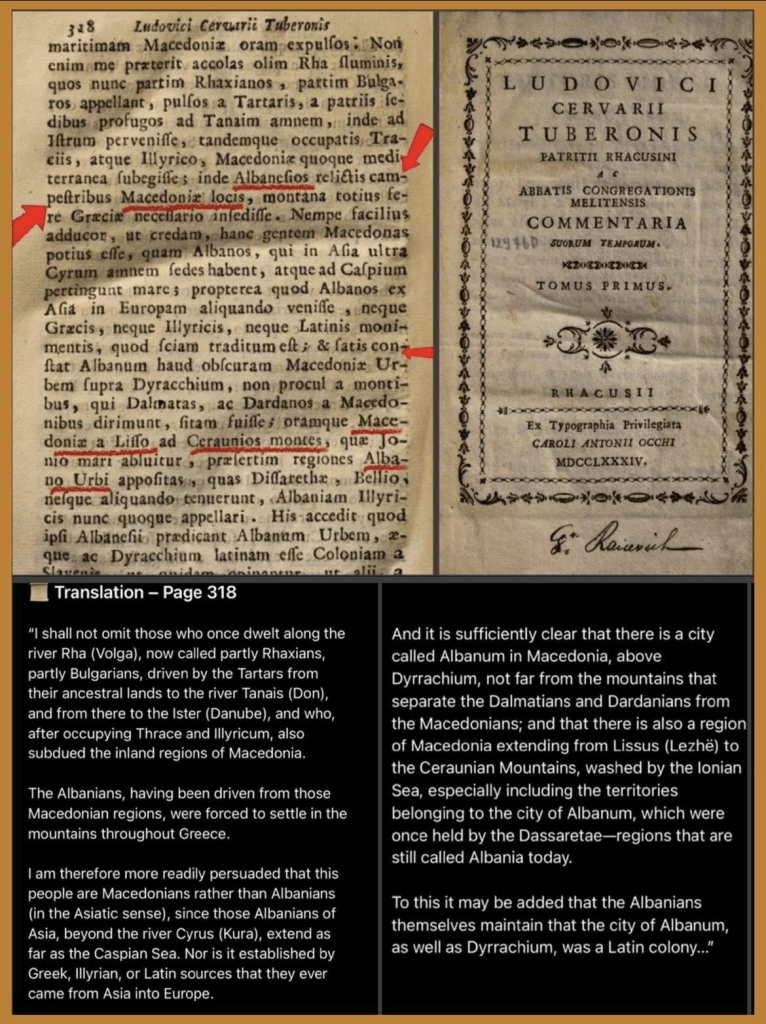
The testimony of Ludovik Crijević Tuberon (1459–1527), a Ragusan historian writing at the turn of the sixteenth century, is particularly significant for the study of Albanian origins.
In his Commentaria suorum temporum, Tuberon not only rejects but explicitly dismisses the notion that the Albanians of the Balkans derive from the so-called Caucasian Albanians beyond the river Cyrus (Kura), stressing that no Greek or Latin authority of antiquity records or even suggests such a migration, nor is it supported by later traditions.
This absence of evidence is central to his reasoning: for Tuberon, the Caucasian hypothesis is not merely improbable, but entirely unfounded within the historical record. Instead, he firmly situates the Albanians within the Balkan historical continuum, describing them as a population inhabiting Macedonia, Epirus, and the mountainous regions of Greece.
A central element of his argument lies in his observation that the Albanians use neither the Greek nor the Illyrian language ¹, thereby establishing their linguistic distinctiveness and precluding their identification with either group.
Crucially, Tuberon himself draws the connection between this linguistic autonomy and the ancient Macedonians, grounding his reasoning in the classical tradition of antiquity as preserved by Quintus Curtius Rufus, whose account of Alexander the Great emphasizes the distinct identity of the Macedonians in relation to other peoples. It is on this basis that he advances a clear identification between the Albanians and the ancient Macedonians, arguing that they represent the same people under a different name, displaced, but not replaced.
This identification is further supported, in his description, by their enduring reputation for martial vigor and warlike character, traits that he implicitly associates with the ancient Macedonians. He further explains their historical trajectory through later invasions, identifying the Bulgarians, originating from the regions of the Volga, as a force that contributed to the displacement of these populations toward the mountainous zones of the southern Balkans.
This interpretation is reinforced by his reference to Albanum, a locality within Macedonia near Dyrrhachium. By situating the Albanian ethnonym within the ancient Macedonian geographical framework, he reinforces the historical rootedness of the Albanians in the region. This toponymic argument complements his broader thesis, anchoring identity not only in language and character but also in place.
Tuberon’s account is thus doubly significant: it not only affirms continuity between Albanians and ancient Macedonians, but also categorically denies any eastern or Caucasian origin, presenting the Albanians as an indigenous Balkan population whose historical identity endured over time under shifting nomenclature.²
Footnotes
- It is important to clarify that the term “Illyrian” as used by Ludovik Crijević Tuberon does not correspond to the ancient Illyrians of classical antiquity. In the intellectual and geographical vocabulary of the late medieval and early modern Balkans, “Illyrian” was frequently employed as a broad and often imprecise designation for the Slavic-speaking populations of the western Balkans, particularly within Dalmatian and Ragusan humanist traditions. Consequently, Tuberon’s assertion that the Albanians speak neither Greek nor “Illyrian” should be understood as distinguishing them from the Slavic linguistic sphere rather than from the ancient Illyrians of antiquity.
2. A similar perception of continuity, particularly in terms of martial character, appears in the early eighteenth century in the writings of Lady Mary Wortley Montagu, who, describing the Albanians (Arnaouts) as inhabitants of “ancient Macedonia,” remarks that they retained the courage and hardiness traditionally associated with the Macedonians, even if the name itself had changed. This convergence between a sixteenth-century humanist account and an eighteenth-century eyewitness observation suggests the persistence of a broader European perception linking the Albanians to the historical legacy of Macedonia.

