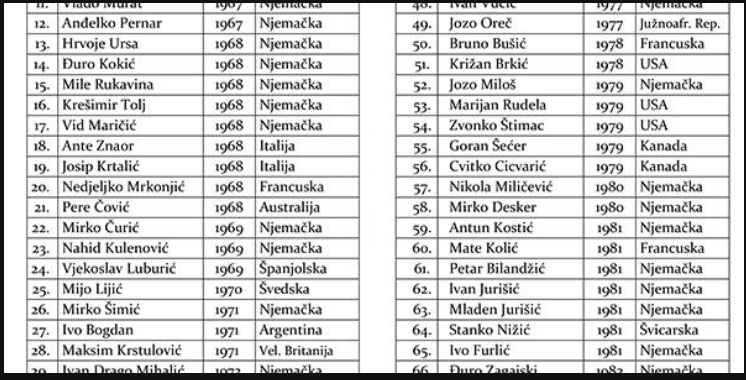

List of Croatian emigrants murdered by the Serbian Yugoslav UDBA.
1.) Dr. Ivan Protulipac 1946. in Italy
2.) Ilija Abramović in 1948 in Austria
3.) Dinka Domančinović 1960 in Argentina – 3 years old
4.) Mate Milićević 1966 in Canada
5.) Marijan Šimundić 1967 in Federal Republic of Germany
6.) Jozo Jelić 1967 in Federal Republic of Germany
7.) Mile Jelić 1967 in Federal Republic of Germany
8.) Petar Tominac 1967 in Federal Republic of Germany
9.) Vlado Murat 1967 in Federal Republic of Germany
10.) Anđelko Pernar 1967 in the Federal Republic of Germany
11.) Hrvoje Ursa 1968 in Federal Republic of Germany
12.) Đuro Kokić 1968 in Federal Republic of Germany
13.) Mile Rukavina 1968 in the Federal Republic of Germany
14.) Krešimir Tolj 1968 in Federal Republic of Germany
15.) Vid Maričić 1968 in the Federal Republic of Germany
16.) Ante Znaor 1968 in Italy
17.) Josip Krtalić in 1968 in Italy
18.) Nedjeljko Mrkonjić in 1968 in France
19.) Pere Čović in 1968 in Australia
20.) Mirko Čurić 1969 in Federal Republic of Germany
21.) Nahid Kulenović 1969 in Federal Republic of Germany
22.) Vjekoslav Luburić 1969 in Spain
23.) Mijo Lijić 1970 in Sweden
24.) Mirko Šimić 1971 in Federal Republic of Germany
25.) Ivo Bogdan 1971 in Argentina
26.) Maksim Krstulović 1971 in England
27.) Drago Mihalić 1972 in Federal Republic of Germany
28.) Josip Senić 1972 in Federal Republic of Germany
29.) Dr. Branko Jelić 1972 in the Federal Republic of Germany
30.) Stjepan Ševo 1972 in Italy
31.) Tatjana Ševo 1972 in Italy
32.) Rosemarie Bahorić 1972 in Italy – 9 years old
33.) Josip Buljan-Mikulić 1973 in the Federal Republic of Germany
34.) Mate Jozak 1974 in Federal Republic of Germany
35.) Ilija Vučić 1975 in the Federal Republic of Germany
36.) Ivica Milošević in 1975 in the Federal Republic of Germany
37.) Nikola Martinović 1975 in Austria
38.) Matko Bradarić 1975 in Belgium
39.) Vinko Eljuga 1975 in Denmark
40.) Stipe Mikulić 1975 in Sweden
41.) Nikola Penava 1975 in Federal Republic of Germany
42.) Ivan Tuksor 1976 in France
43.) Ivan Vučić 1977 in the Federal Republic of Germany
44.) Jozo Oreč in 1977 in South Africa
45.) Bruno Bušić 1978 in France
46.) Križan Brkić 1978 in the USA
47.) Marijan Rudela 1979 in the USA
48.) Zvonko Štimac 1979 in the USA
49.) Goran Šećer 1979 in Canada
50.) Cvitko Cicvarić 1979 in Canada
51.) Nikola Miličević 1980 in the Federal Republic of Germany
52.) Mirko Desker 1980 in Federal Republic of Germany
53.) Ante Kostić 1981 in the Federal Republic of Germany
54.) Mate Kolić 1981 in France
55.) Petar Bilandžić 1981 in the Federal Republic of Germany
56.) Ivan Jurišić 1981 in the Federal Republic of Germany
57.) Mladen Jurišić 1981 in the Federal Republic of Germany
58.) Stanko Nižić 1981 in Switzerland
59.) Ivo Furlić 1981 in the Federal Republic of Germany
60.) Đuro Zagajski 1983 in the Federal Republic of Germany
61.) Franjo Mikulić 1983 in the Federal Republic of Germany
62.) Milan Župan 1983 in the Federal Republic of Germany
63.) Stjepan Đureković 1983 in the Federal Republic of Germany
64.) Slavko Logarić 1984 in the Federal Republic of Germany
65.) Franjo Mašić 1986 in the USA
66.) Damir Đureković 1987 in Canada
67.) Ante Đapić 1989 in the Federal Republic of Germany
Attempted murders which failed
1.) Mate Frković 1948 in Austria
2.) Dr. Ante Pavelić in 1957 in Argentina
3.) Dr. Branko Jelić 1957 in the Federal Republic of Germany
4.) Deželić family in 1965 in Federal Republic of Germany
5.) Ante Vukić 1968 in Federal Republic of Germany
6.) Mirko Grabovac 1969 in Federal Republic of Germany
7.) Dr. Branko Jelić 1970 in the Federal Republic of Germany
8.) Vlado Damjanović 1970 in Federal Republic of Germany
9.) Dr. Branko Jelić 1971 in the Federal Republic of Germany
10.) Gojko Bošnjak 1972 in the Federal Republic of Germany
11.) Nikola Vidović 1972 in France
12.) Dane Šarac 1973 in Germany
13.) Gojko Bošnjak 1973 in the Federal Republic of Germany
14.) Dane Šarac in 1974 in France
15.) Stipe Bilandžić 1975 in Federal Republic of Germany
16.) Stipe Bilandžić 1977 in Federal Republic of Germany
17.) Franjo Goreta 1980 in Federal Republic of Germany
18.) Luka Kraljević 1982 in Germany
19.) Luka Kraljević 1983 in Germany
20.) Danica Glavaš 1986 in the USA
21.) Ante Tokić in 1988 in Australia
22.) Tomislav Naletilić 1988 in the Federal Republic of Germany
23.) Nikola Štedul 1988 in Scotland
Kidnappings:
1.) Drago Jelik 1949 from Italy
2.) Krunoslav Draganović 1967 from Italy
3.) Vjenceslav Čižek 1977 from Italy
4.) Ivica Novaković 1987 from the Federal Republic of Germany
1.) Dr. Branko Jelić 1950 from Federal Republic of Germany
2.) Franjo Mikulić 1979 from France
Missing:
1.) Zlatko Milković in 1949 in France
2.) Zvonimir Kučar in 1963 in France
3.) Geza Pašti in 1965 in France
4.) Stjepan Crnogorac 1972 in Austria
Mile Boban writes:
“(Today, Friday, November 8, 2013, it is known who and when killed and liquidated my cousin Stjepan Crnogorac on July 3, 1972. It was the Yugoslav UDBA, which did not have the courage to inform the grieving parents about the fate of their son. Rest in God’s peace, my dear cousin Stipe Crnogorac. Cousin Milan Boban, Gabrić.
Here we are only talking about some known murdered Croatian emigrants.
In the territory of the former Yugoslavia itself, there are thousands of mass graves, crimes committed by Yugoslav partisans. The UDBA liquidated thousands and thousands of Croats for whom no one was ever held accountable.
“Today’s Croatian left-wing authorities” of the Republic of Croatia have never prosecuted a single murderer from Udba or their principals.
Therefore, today, we must seize this opportunity that must not be missed. Now that Germany is seeking the extradition of Perković, and there are others waiting for their turn behind him, we, the state-building Croats, must doubly harness our mental strength and help Germany bring these villains and murderers of Croats to justice.
Mile Boban, Otporas.”
“My arrest in Paris
You resist, it’s hard to talk about yourself, but a person knows themselves best, so when that’s the case, it would be normal for them to say a few words about themselves sometimes.
This one story. I was in custody for nine (9) days, in a prison in Paris, whatever you want. I was not involved in the case, but I knew the details. I was among the first to be arrested. In nine days, I went through a sieve and a sieve. The investigators change every hour and go to rest. I am always the same, sleepless, tired, hungry, thirsty and a hundred other wonders. When I complain about something, the answer is that this is not a hotel for resting or a restaurant for enjoying. The moments came and went for the worst. That is what they say “Singed”, and the ball begins to unroll.
I was held and encouraged by the bravest people I knew who had gone through everything. They were the Ustaše. I would hold onto the table with my hands as if I were going to squeeze water out of it, and only think of those who had gone through the worst, how they would behave if they were here, in my place. I give myself the answer: HEROIC! That hardened me and I saw nothing else in front of me but Croatia.
So these 19 Croatian Heroes/Knights, including my cousin Stjepan Crnogorac, felt neither suffering nor pain nor torment. All they felt was boundless love for Croatia. Because of such people, everyone’s history is rich. It’s a shame that we don’t have a feuilleton about Eugen Kvaternik and his uprising in Rakovica in 1871.
These two cases are identical and I would say that the Bugojno Uprising –
Nationally/historically speaking – better for us Croats because all of this happened in a place that, to our great Croatian regret, is not part of the Croatian State today. In the long term, this can be considered Croatian Land.”
References
https://www.hrvatski-fokus.hr/2024/02/56008/
Klinger, William, and Denis Kuljiš. Tito’s Secret Empire: How the UDBA Controlled Yugoslavia. Zagreb: Naklada Ljevak, 2019.
Malić, Gordan. The Third Bullet: The Political Background of the Assassination of Stjepan Đureković. Zagreb: Večernji list, 2014.
Radeljić, Branislav. Europe and the Collapse of Yugoslavia: The Role of Non-State Actors and the Media. London: I.B. Tauris, 2012.
Cohen, Lenard J. “Yugoslavia’s Disintegration and the Politics of Assassination Abroad.” Journal of Cold War Studies 10, no. 2 (2008): 45–72.
Banac, Ivo. “Croatian Emigration and Political Violence, 1945–1990.” East European Politics and Societies 7, no. 2 (1993): 177–204.
Higher Regional Court of Munich (Oberlandesgericht München). Judgment in the Case of the Assassination of Stjepan Đureković. Munich, 2016.
Bundeskriminalamt. Investigative Files on Yugoslav State Security Activities in West Germany. Wiesbaden, various years.
Croatian State Archives. Documents on Yugoslav Secret Police Activities Abroad, 1945–1990. Zagreb.
BBC. “Tito’s Killers: Yugoslavia’s Cold War Assassinations.” BBC News, 2012.
Der Spiegel. “Mord im Exil: Jugoslawiens Geheimdienst und seine Opfer.” Der Spiegel, various issues.

