
Abstract
This study examines a traditional form of Kosovo Albanian folk music performed in domestic settings, focusing on ensembles centered around the çifteli and sharki. Drawing on frameworks from Ethnomusicology, the analysis situates musical performance within its broader social, cultural, and ritual context. Emphasis is placed on oral tradition, participatory performance, and the role of music as a medium of communal interaction.
The study explores how musical structure—particularly the use of asymmetrical meter (e.g., 9/8 subdivisions)—interacts with call-and-response vocal practices to produce a dynamic and collectively constructed performance. These musical features are inseparable from the embodied and social dimensions of the gathering, including shared seating arrangements, hospitality practices, and audience interjections such as verbal encouragements directed at performers.
Particular attention is given to the symbolic economy of the performance, notably the custom of placing money beneath the musician’s plis, interpreted through theories of gift exchange and symbolic capital (e.g., Marcel Mauss; Pierre Bourdieu). The study further considers the gendered nature of these gatherings as predominantly masculine social spaces, where music reinforces social bonds, identity, and hierarchy.
Ultimately, the paper argues that this musical practice constitutes more than entertainment; it is a form of “musicking” (Christopher Small) that sustains collective memory, articulates emotional expression, and reproduces cultural values. By integrating musical analysis with anthropological theory, the study contributes to a deeper understanding of how Kosovo Albanian folk traditions function as living systems of social meaning.

The fathers of Albanian folklore music; Salih and Feriz Krasniqi.
Introduction
This study examines a traditional form of Kosovo Albanian folk music performance centered around instruments such as the çifteli and sharki, analyzed through the framework of Ethnomusicology. The focus lies on the communal, domestic setting in which male participants gather, highlighting the interplay between oral tradition, performance practice, and social ritual.
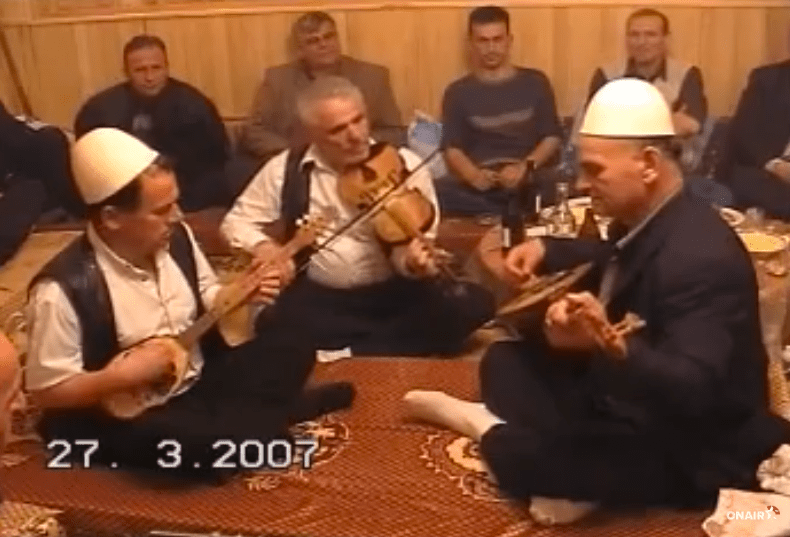
Halil Bytyqi (right) and Naim Salihu Krasniqi (left) playing and singing, together with a violinist in 2007.
Origin
Albanian folkloric music of Kosovo (Dardania) has its origins in the 1920s. Below is Salih and Feriz Krasniqi in 1966 playing and recording a song. Taken from RTK Arkivi Kënge Rapsodie.

The Communal Setting as Cultural Space
The performance unfolds within a communal setting, typically a traditional Albanian house characterized by white walls, sparse furnishing, and floor seating with cushions and mattresses. Participants sit cross-legged, forming a spatially intimate circle around the musicians. This spatial arrangement reinforces participatory music, where the boundary between performer and audience becomes fluid.
The host, referred to as “zoti i shpis”, embodies local hospitality codes, offering tea and sweets such as baklava. This act situates the musical event within a broader framework of ritual function, where music is inseparable from social bonding and ceremonial gathering.
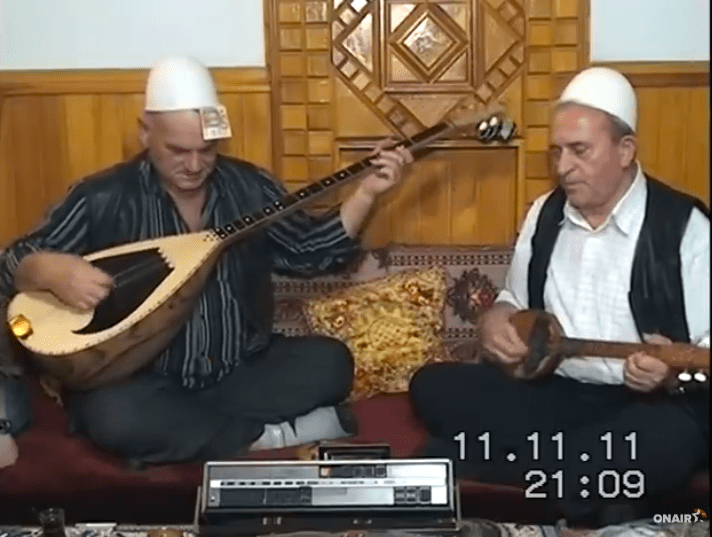
Halil Bytyqi (left) and Is Llapqeva playing the prim (mandoline).
Performance Practice and Interaction
The musical structure relies heavily on oral tradition and improvisation, with performers alternating vocal lines in a call-and-response pattern. Each singer contributes a phrase, creating a layered and evolving phrase structure that reflects both individuality and collective cohesion.
Audience interjections—phrases such as “may your heart sing” (zemra të knoft)—represent forms of participatory performance and affective expression. The performers’ replies, including expressions like “dugagji,” illustrate reciprocal acknowledgment embedded in tradition.
The presence of smoking and shared gestures—such as offering a cigarette to a musician mid-performance—constitutes an embodied practice, reinforcing intimacy and mutual dependence within the group.

Albanian gathering outside.
Musical Structure and Meter
The music often employs asymmetrical meter, characteristic of Balkan traditions. The rhythm described (e.g., “dun dun-dun dun-dun”) likely corresponds to a 9/8 pattern subdivided irregularly (e.g., 2+2+2+3 or 3+2+2+2), though variations such as 5/8 may also occur.
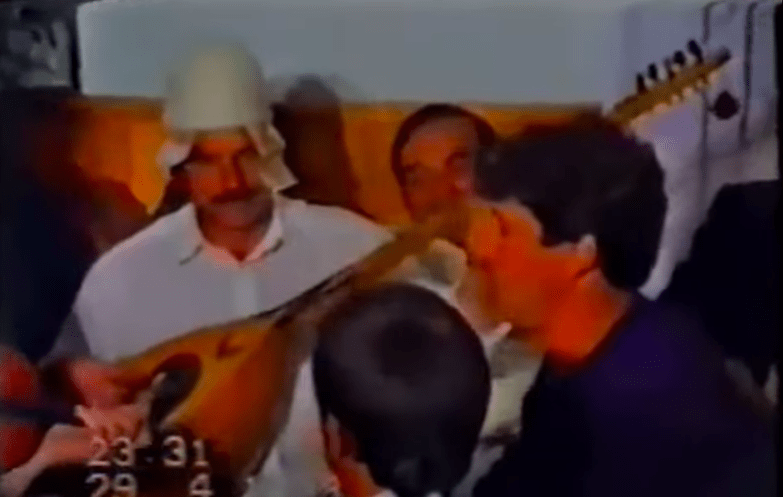
Albanian folklorist Halil Bytyqi (in the middle with the white cap), together with Naim Krasniqi (front) and others, in Prizren, 1993.
9/8=2+2+2+3
This asymmetry contributes to a distinctive rhythmic flow, central to the region’s folk repertoire. The melodic structure often reflects modal systems rather than Western tonal harmony, further reinforcing its cultural specificity.

Naim Krasniqi (middle) with a grop of folklorists.
Symbolic Economy and Social Meaning
A key feature of the performance is the placement of money beneath the musician’s plis (traditional white cap). This act represents a form of symbolic exchange, functioning both as economic support and as a visible sign of respect and admiration.
Unlike transactional tipping in commercial settings, this gesture is embedded in collective memory and tradition, transforming monetary exchange into a culturally meaningful act. The continued display of the money throughout the performance reinforces social recognition and honor.
Gender and Social Dynamics
The gathering is typically a masculine social space, where men engage in collective expression through music, conversation, and shared rituals. This environment reflects broader socio-cultural structures in which male bonding and identity are reinforced through participatory music and storytelling.
Ritual Function and Occasions
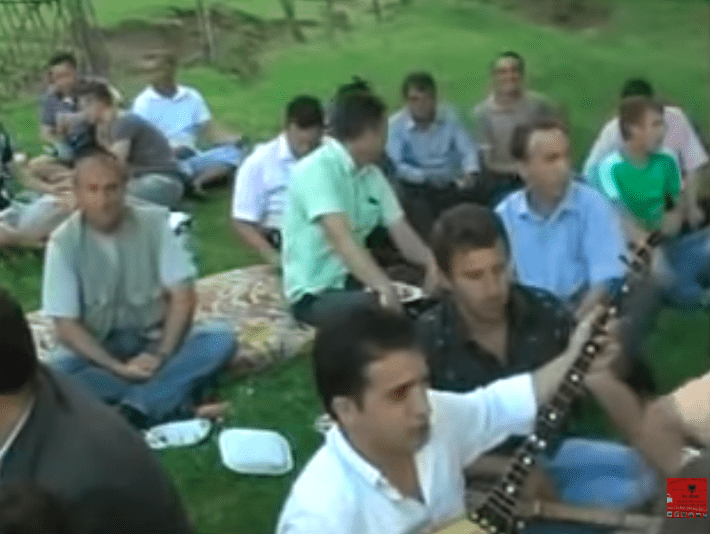
Albanian gathering outside with some individuals carrying guns preparing to fire in celebration.
These performances occur during significant social events—weddings, celebrations, or the release of an individual from prison—highlighting their ritual function. Music serves as a medium for processing collective experiences, expressing joy, resilience, and solidarity.
Media Technology and Circulation
An important yet often overlooked dimension of this tradition is the role of media technology in preservation and circulation. During the late 20th century, enthusiasts of Kosovo Albanian folk music developed a strong practice of recording live performances onto cassette tapes, reflecting a shift from purely oral tradition toward hybrid forms of transmission. High-quality cassette decks such as the Grundig C9000 and Grundig C8800 were particularly valued for their superior recording fidelity, and became associated with authenticity and prestige among listeners.

Grundig C9000, very famous among fans of Albanian folklore.
These recordings were often made in informal domestic settings, preserving not only the music itself but also the ambient social interactions—laughter, spoken interjections, and audience participation—thereby extending the concept of musicking (Christopher Small, 1998) into the realm of mediated sound. In this sense, cassette culture functioned as an archive of collective memory, capturing ephemeral performances and redistributing them across diasporic and local networks.
In contemporary contexts, this practice has evolved into a broader cultural industry surrounding Albanian folk music. Recordings—both analog and digital—along with specialized playback equipment, including radios and cassette players, are often sold at relatively high prices. This reflects not only market demand but also the transformation of tradition into a form of symbolic and economic capital (Pierre Bourdieu, 1986), where ownership and access to such media signify cultural belonging, nostalgia, and prestige.
Performative Masculinity and Sonic Displays of Power
Another significant dimension of these gatherings is the expression of performative masculinity through non-musical yet symbolically charged acts. In certain celebratory contexts, particularly during weddings or major social events, participants may discharge firearms into the air as a form of heightened emotional and social expression. This practice can be understood as a competitive display—what might be described as a form of “testosterone-driven signaling”—where individuals assert presence, honor, and vitality within the group.

Gun fire during an Albanian folkloric musical event.
Such acts often trigger a chain reaction, with others joining in, creating a layered soundscape that merges music, gunfire, and vocal exclamations. From an ethnomusicological perspective, this expands the definition of musical performance into a broader acoustic ritual environment, where non-musical sounds contribute to the overall affective intensity of the event.
This phenomenon can be interpreted through Victor Turner’s concept of ritualized expression and liminality, as well as Pierre Bourdieu’s notion of symbolic capital, where such displays function as markers of strength, status, and masculine identity. While potentially dangerous, the practice persists as part of a culturally embedded system of collective expression, reinforcing group cohesion through shared intensity and spectacle.
Note: Due to regulations from the Albanian government and authorities, these kind of activities involving fire arms have a seen a decrease over the last years.
Conclusion
The Kosovo Albanian folk music tradition centered on çifteli and sharki exemplifies the deep integration of music within social life. Through oral tradition, asymmetrical meter, participatory performance, and symbolic exchange, the practice sustains a rich cultural ecosystem.
Rather than functioning as mere entertainment, this musical form operates as a living expression of identity, community, and continuity—an embodiment of both historical memory and present social relations.
References
Alan P. Merriam (1964). The Anthropology of Music.
Christopher Small (1998). Musicking: The Meanings of Performing and Listening.
Thomas Turino (2008). Music as Social Life: The Politics of Participation.
Victor Turner (1969). The Ritual Process.
Marcel Mauss (1925). The Gift.
Pierre Bourdieu (1977/1986). Outline of a Theory of Practice; Forms of Capital.
Béla Bartók (1937). Studies on Balkan folk music.

