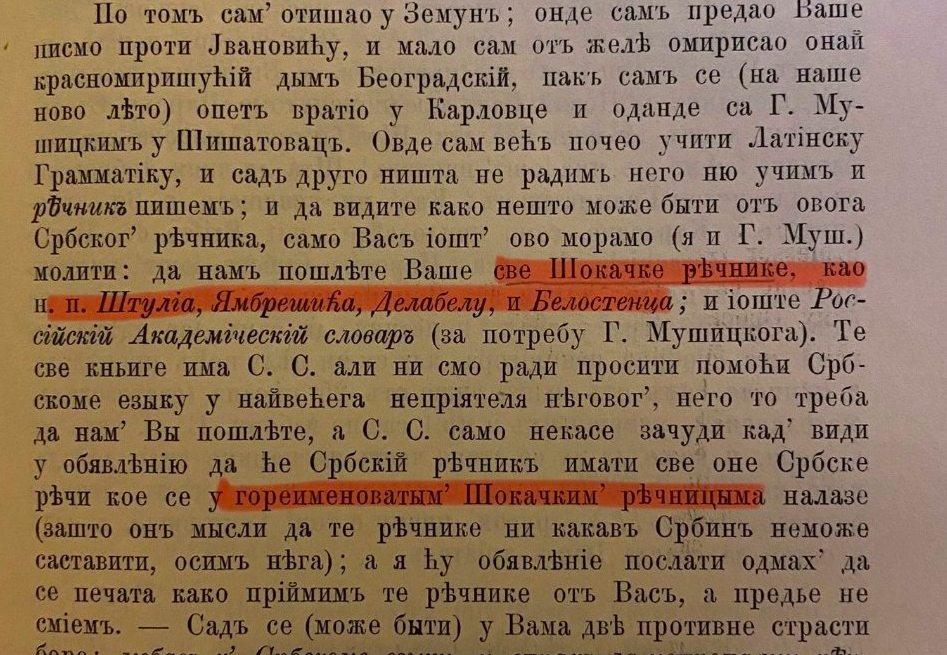

According to this passage, Vuk Karadžić mentions that when he studied Latin, he asked to be sent several dictionaries, as well as a Russian academic dictionary, most likely in order to begin the construction the Serbian language.
Transcribed:
“After that I went to Zemun; there I handed over your letter to Jvanović, and I smelled a little of that red-scented Belgrade smoke, then I returned (for our new summer) to Karlovci again and from there with G. Mušitski to Šišatovac.
Here I have already begun to study Latin Grammar, and now I do nothing else but study and write a dictionary; and so that you can see how something can come of this Serbian dictionary, only this much we (I and G. Mušitski) must ask of you: to send us all your Šokac dictionaries, such as, for example, Štulia, Jambrešić, Delabela, and Belostenac; and also the Russian Academic Dictionary (for the needs of G. Mušitski). S. S. has all those books, but we are not asking for help for the Serbian language from its greatest enemy, but you should send them to us, and S. S. is only somewhat surprised when he sees in the announcement that the Serbian Dictionary will have all those Serbian words that are in the aforementioned Šokac dictionaries.”
Quote from “Vuk Stefanović Karadžić” stating that if he had printed in Hercegovinian, the local Slavs would have asked “Why (what) is this Croatian language being imposing on us?”
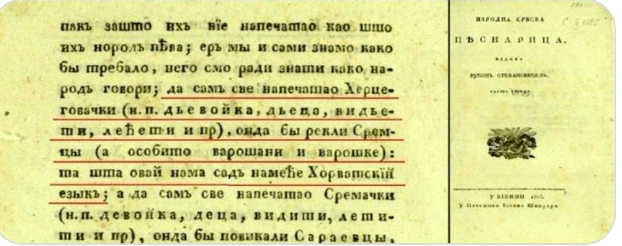
If I had printed everything in Herzegovinian (e.g. girl, children, see, honor, etc.), then the people of Srem, and especially the townspeople, would have said: so what is this Croatian language imposing on us now? ” (“Folk Serbian Songbook, Part Two, Vienna, 1815, collected by Vuk Stefanović Karadžić.”
Sources
“Народна српска пјеснарица” (Narodna srpska pjesnarica — Serbian Folk Songbook)
Narodna srbska pjesnarica, Vuk Stefanović Karadžić, Vienna, 1815.

