
by Anita Paga
Abstract
This text examines the origins, symbolism, and historical continuity of the double-headed eagle across the Balkans and Anatolia. It traces the symbol from ancient Hittite and Illyrian–Pelasgian contexts, where it represented divine authority and protection, through its integration into Greek mythological imagery associated with Zeus. Archaeological evidence demonstrates its early and widespread use prior to the Byzantine period. The study highlights its transformation into a key imperial emblem under the Byzantine Empire, particularly during the Palaiologos dynasty, symbolizing dual sovereignty. Furthermore, it explores the preservation and adaptation of the symbol in Albanian heraldry, especially through medieval noble families and the emblem of Skanderbeg.
Art & Myth
Zeus and the Eagle, krater (c. 560 BC, Louvre), reflects the geometric style of the Pelasgian cultural sphere where red and black dominate.
Ganymedes, wearing a Phrygian cap and red cloak, is seized by Zeus in eagle form — a scene symbolizing divine ascension and chosen favor.
Archaeological Record of the Double-Headed Eagle
Symbolism: Divine authority and protection
Earliest Appearances:
Hittites (Anatolia), 1600–1200 BCE
7th c. BC – Croatia
6th c. BC – Shkodra, Albania
6th–5th c. BC – Mat Tumulus (Albania)
6th c. BC – Korçë (Albania)
These findings attest to the eagle’s enduring sacred and royal connotations across Illyrian–Pelasgian territories.
Albanian Heraldry and the Byzantine Connection
Albanian heraldry descends from the ancient Constantinian Order of St. George.
During the Macedonian Dynasty, under Basil I the Macedonian, the Byzantine Empire re-entered its golden age.
Albanian noble families — forming the Arbanensis episcopal polity from Antibari to Ioannina — allied with Byzantine emperors by 900 AD in campaigns against the Arab fleets, Kievan Rus, and Bulgaria.
Notably, the Angeli (Engjëlli) of Drivasto (Drisht) and the Comneni of Macedonia and Thrace reintroduced the double-headed eagle to the Kingdom of Rascia through the coronation of Nemanjić in Duklja (Albania).
From there, the emblem spread via dynastic marriages into Trebizond and Russia through Sophia Palaiologina.
Skanderbeg and the Eagle of Freedom
Historian Marin Barleti records the Kastrioti family emblem as “a double-headed eagle on a red field.”
A 16th-century panel, Saint Helena and Emperor Constantine the Great (c. 1530), depicts Constantine with the same banner described by Barleti — linking the Albanian symbol directly to imperial Byzantine heritage.
The Byzantine Imperial Flag
According to Kleonikos Tsakiris (2005):
“The Byzantine Imperial flag was yellow with a black crowned double-headed eagle — emblem of the Palaiologos, the last Greek-speaking Roman dynasty of Constantinople.
Earlier versions bore no crowns, and the wings, beak, and talons were open in readiness — resembling today’s Albanian flag.
Later, the sword (romphaia) and the Globe of Orthodoxy were added.
The two crowns symbolized Nicaea (the dynasty’s original seat) and Constantinople (after its liberation from the Latins).”
Alexander the Great & the Eagle
Numismatics and Artifacts:
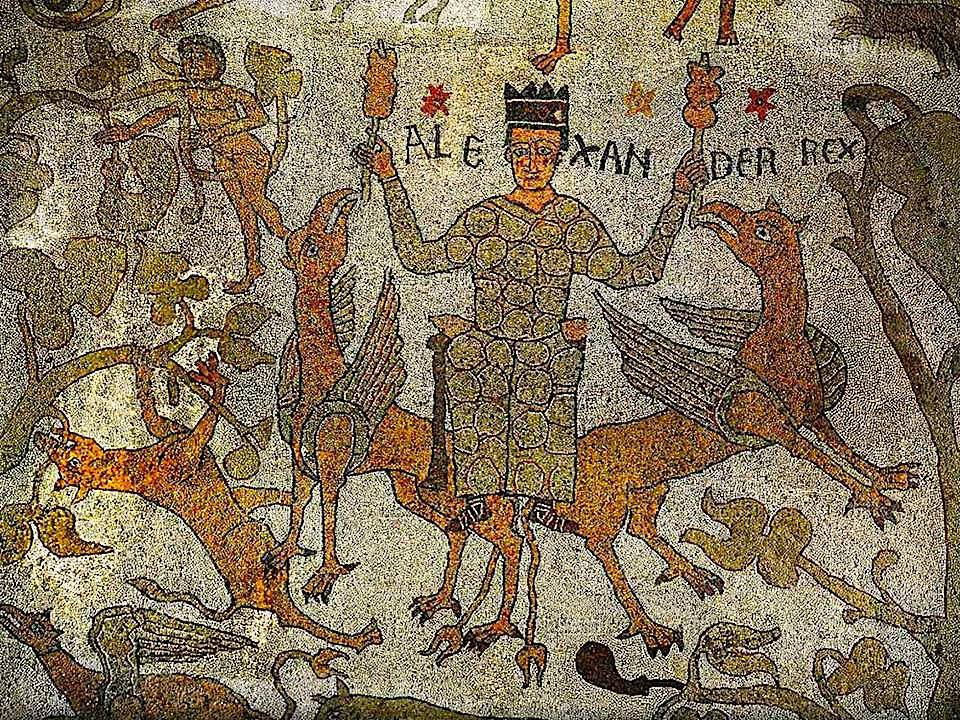
Coins and mosaics depict Alexander Rex accompanied by the eagle of Zeus, symbolizing divine kingship.
A 10th-century textile preserved in the Mainfränkisches Museum (Würzburg) continues this iconography, linking Macedonian sovereignty to the eagle motif across millennia.
Conclusion
The double-headed eagle is not an exclusively Byzantine or “Greek” emblem — it is a pan-Balkan and Anatolian symbol of divine and sovereign authority with deep roots in Illyrian–Pelasgian civilization.
Its survival in Albanian heraldry represents the continuity of imperial and spiritual identity from antiquity through Byzantium and into the national symbol of Albania today.

