
by Petro Prodani
Summary
The text describes how Ottoman general Hasan Tahsin Pasha, of Albanian origin, surrendered Thessaloniki to the Greek army in 1912, reportedly believing the city rightfully belonged to the Greeks. It highlights Thessaloniki’s long, multicultural history and its importance in both ancient and religious contexts. The author suggests Tahsin’s decision was influenced by his education, cultural awareness, and understanding of regional dynamics, including Greek influence on Balkan societies. Despite being condemned by the Ottoman authorities, he is remembered in Greece as a supporter of Hellenism, and his legacy is honored near the site where the city’s surrender was signed.
“We took it from the Greeks; to the Greeks we will return it.” This is how the high-ranking Ottoman general Hasan Tahsin Pasha expressed himself before signing the act of surrendering the city to the Greek Army on October 26, 1912.
Thessaloniki is an ancient city with origins in Hellenic antiquity. Over time, different cultures and civilizations have overlapped and intertwined, reflected today in the many museums of this coastal city. Naturally, Albanian traces are also present.
Moreover, Thessaloniki is mentioned in the best-selling book in the world—the Bible. The Apostle Paul lived in this city for a short time, and from there he wrote some of his teachings and experiences.
It is no exaggeration to say that the history of Thessaloniki resembles the history of the Balkans—or vice versa.
In this post, I will not dwell on the origin of the name “Thessaloniki,” nor repeat well-known historical accounts. Instead, I will focus on the moment when an Ottoman military officer of Albanian origin signed to affirm what he saw as a historical truth: that Thessaloniki had been Greek and should remain so.
Why did a pasha of Albanian origin take on such responsibility, for which the Sublime Porte sentenced him to death in absentia?
There may have been many reasons.
My imagination suggests that Hasan Tahsin was an intelligent and farsighted man. He understood the differences between the various cultures and traditions that existed in the few regions still under Ottoman control. As a military man, Tahsin was well aware of the prominence of Hellenism compared to other national movements that had emerged in the Balkans. He had studied at the Zosimea Gymnasium in Ioannina, and it can be said that he had become “Hellenized” to some extent.
The clearest evidence of this is the official protocol kept in the administrative offices where the general lived and worked until October 1912. The records were written in Greek, not Ottoman Turkish. This indicates that not only Hasan Tahsin himself, but also his family members and all his subordinates, were proficient in the Greek language.
Let us return to the decisive moments of October 1912. Two armies were approaching Thessaloniki: the Greek army on one side and the Bulgarian army on the other. Perhaps the Sublime Porte preferred a Bulgarian victory, but Hasan Tahsin had made his own calculations. He knew that the Bulgarians, and many other Slavic populations, had learned literacy from the Greco-Byzantines.
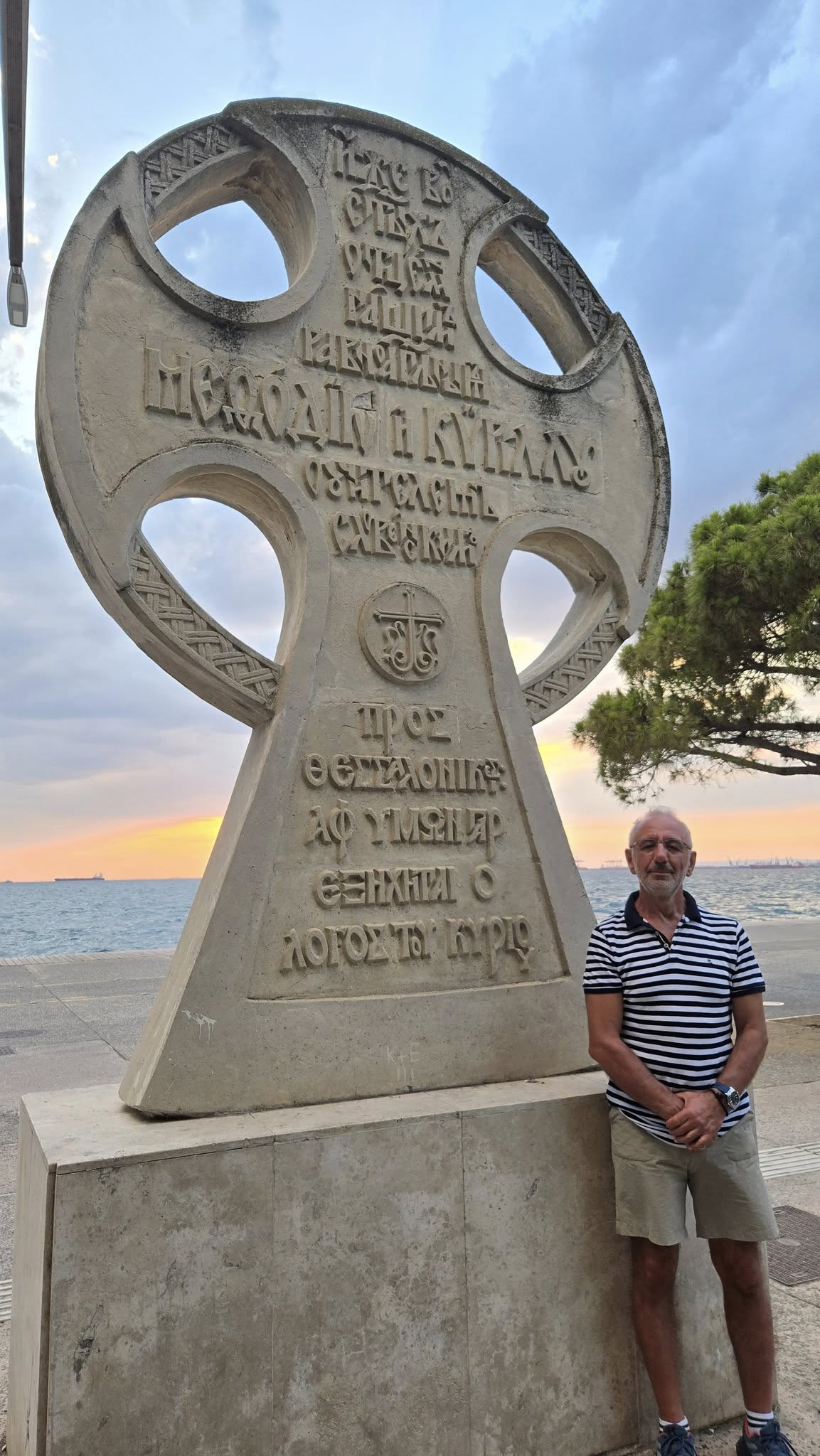
About 1,260 years earlier, two Greek brothers from Thessaloniki, Cyril and Michael, had embarked on an apostolic mission: the Christianization of the Slavic peoples. To spread the “Word of God,” they needed a unified alphabet through which religious texts could be translated and written—and Cyril succeeded in creating it.
Gradually, for both religious and political purposes, the Cyrillic alphabet became a tool for social and economic development.
This was enough for the learned Tahsin to place himself, as he saw it, on the right side of history. He had told himself: give the Greeks what belongs to the Greeks.
Perhaps he held some resentment toward the Slavo-Bulgarians. Or perhaps his ancestors had been Slavs who became Ottomanized and Albanianized, and as a sign of respect he himself became “Greek.” I say this because his surname “Mesare” in Slavic means “butcher.”
Whatever Hasan Tahsin Pasha may have been, the Greek state and ordinary citizens have regarded him as a great friend of Hellenism and Greece.
His remains, along with those of his son Kenan Mesare, rest near the historic building where the protocol surrendering Thessaloniki to the Greek state was signed.
Today, the complex of buildings has been turned into an interesting museum known as the “Museum of the Balkan Wars.”

