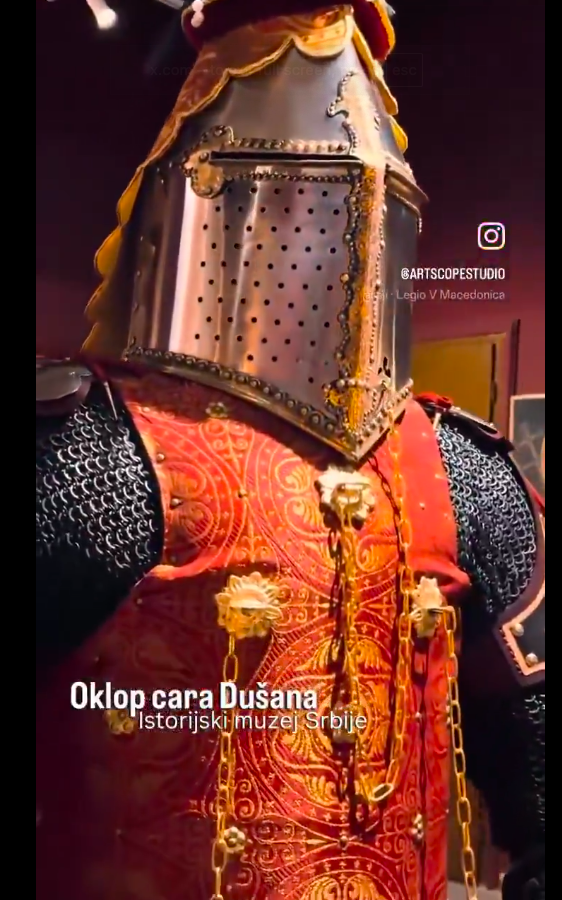

A recent X post from @GlobalDiss (posted April 5, 2026) has been circulating among history enthusiasts, proudly showcasing what it calls an “EPIC reconstruction of Emperor Dušan’s armor.” The video pans slowly over a gleaming, ornate suit of armor — complete with a helmet topped by dramatic black feathers, gilded details, red brocade fabric, chain accents, and lion-head motifs — displayed at the Historical Museum of Serbia. The caption hails 14th-century Serbian Emperor Stefan Uroš IV Dušan (Dušan the Mighty) as “no ordinary ruler” who “built one of the STRONGEST empires in the Balkans,” with the armor supposedly “crafted from a Dečani Monastery icon by architect Stevan Stevanović.”
It’s visually striking and taps into national pride, but the post (and similar viral content) heavily romanticizes history. There is no historical evidence that Dušan ever wore anything resembling this armor. Moreover, his “empire” was a fragile, short-lived expansion that crumbled almost immediately after his death. Let’s break it down with the facts.
The Armor: Modern Speculation Based on Religious Art, Not Historical Fact
The reconstruction is a modern creation (developed in recent years) by Serbian architect Stevan Stevanović. It draws inspiration from a hagiographic (saint’s life) icon of Dušan’s father, Stefan Dečanski (Stefan Uroš III), housed in Visoki Deqani Monastery in Kosovo.
A separate sword element references a fresco from the Monastery of Saint George in Polog (North Macedonia). The full suit is described in Serbian media as “ceremonial” and includes period-appropriate touches like brocade fabric and Old Church Slavonic inscriptions — but these are artistic choices.
Medieval icons and frescoes were not photographic records. They were stylized religious and symbolic art meant to convey piety, divine favor, and royal legitimacy, not accurate depictions of battlefield gear. Serbian rulers of the Nemanja dynasty blended Byzantine, Western European, and local influences in their military equipment.
Dušan’s forces did import some plate armor and helmets from Venice for mercenaries, and heavy cavalry used chainmail, coats of plates, and lances — typical for 14th-century Balkan warfare. But no contemporary chronicles, inventories, archaeological finds, or portraits describe or preserve Dušan’s personal armor.
- There are no surviving artifacts of Dušan’s equipment.
- No 14th-century sources (Serbian, Byzantine, or Western) mention him wearing this specific ornate style.
- The reconstruction itself is explicitly labeled as such in museum contexts: an artistic interpretation for display, not a replica of a discovered original.
In short, the “epic” armor in the video is 21st-century craftsmanship inspired by art history — impressive as a museum piece or costume prop, but not evidence that Dušan the Mighty suited up like a fantasy knight. Claiming it as “his armor” is like saying a painting of King Arthur proves Excalibur existed.
The Empire: A Brief, Opportunistic Peak — Not a Lasting “Strongest” Power
Dušan was undeniably a skilled and ambitious ruler. Crowned King of Serbia in 1331 after murdering his father, he expanded aggressively during the Byzantine Empire’s internal chaos (civil wars and regency struggles). By 1346 he proclaimed himself “Emperor of the Serbs, Greeks, Bulgarians, and Albanians,” controlling territory from the Danube to parts of Greece — a significant achievement that made Serbia the dominant Balkan power for a moment.
But the reality was far more precarious than the “mighty empire” narrative suggests:
Short reign and rapid collapse: Dušan ruled as king for 15 years (1331–1346) and as emperor for just 9 years (1346–1355). He died suddenly at age 47 in December 1355. His son, Stefan Uroš V (known as “Uroš the Weak”), could not hold the realm together. Within a few decades (by the 1370s), the empire fragmented into semi-independent principalities ruled by powerful nobles. By the end of the 14th century, much of the territory had fallen under Ottoman influence.
Fragile structure: The “Serbian Empire” was a loose feudal confederation held together by Dušan’s personal charisma, military success, and Dušan’s Code (a legal reform from 1349). It relied on opportunistic conquests during Byzantine weakness rather than sustainable institutions. Peripheral regions seceded quickly under local governors.
Scale in context: On the broader European stage, it was a regional power in the Balkans — impressive locally, but not comparable to the longevity or influence of the Holy Roman Empire, the Ottoman Empire, or even the earlier Byzantine realm it partially supplanted. It was never “one of the strongest empires” in any enduring sense; its peak lasted roughly one generation.
Contemporary Byzantine sources and later Serbian chronicles acknowledge Dušan’s conquests but also note the empire’s internal divisions and quick dissolution. The “mighty ruler” image is real in Serbian national historiography, but it often glosses over how quickly his achievements unraveled.
Why This Matters: Romanticization vs. History
Viral posts like this one blend legitimate pride in medieval Serbian achievements with modern myth-making. The armor video is beautiful — and the reconstruction deserves appreciation as cultural heritage craftsmanship — but presenting it as “Dušan’s armor” without context misleads viewers. Similarly, calling the empire “one of the STRONGEST” ignores its fragility and brevity.
Dušan was a not remarkable conqueror and lawgiver who elevated medieval Serbia. He was a capable opportunist whose realm rose fast and fell faster. True historical understanding comes from the sources and evidence, not stylized icons or dramatic reconstructions.

