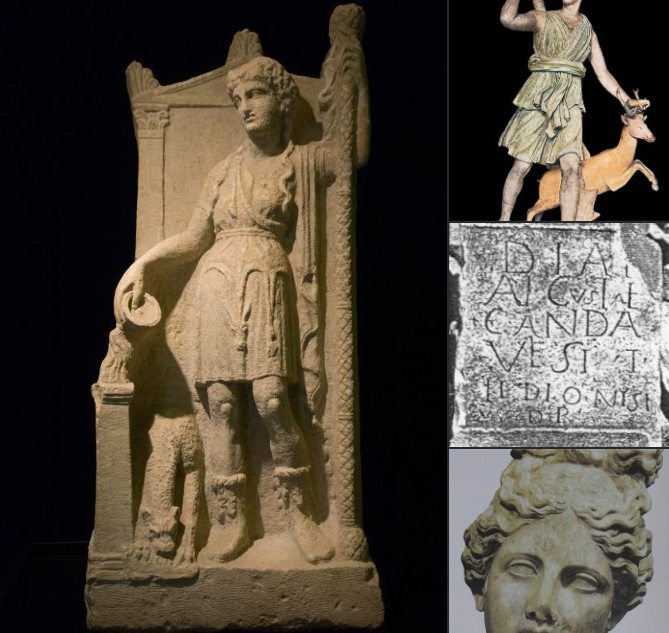

by Avni Alcani from Gazeta Dielli – Faqja Zyrtare.
Abstract:
This study examines the transmission of the name and attributes of the goddess Diana into the Albanian mythological figure Zana. Drawing upon classical, Roman, and Illyrian sources, as well as linguistic and ethnographic evidence, the research demonstrates how the figure of Zana inherits the characteristics of Diana, including her association with mountains, forests, hunting, and natural landscapes. It traces the transformation of Diana through Illyrian religious practices, highlighting votive inscriptions and archaeological finds, and explores linguistic continuity linking the names Diana and Zana. The analysis underscores the integration of pre-Roman, Illyrian, Greek, and Roman elements in shaping the Albanian folk tradition, emphasizing the persistence of this goddess figure in the Balkans.
Diana and Zana: From Illyrians to Albanians
How was the name of the goddess Zana transmitted among Albanians?
Zana is one of the most prominent figures in Albanian mythology. Scholars note that she inherited many characteristics of Diana, who, like Zana, lived in mountains, forests, meadows, and other natural landscapes. Diana has been compared to the Albanian mythological figure Zana, who, like Diana, inhabits deep forests, remote mountainsides, caves, shrines, and meadows.
After the Roman conquest of Illyria, Romans discovered local deities resembling some of their own gods, such as the “Diana of the Kandavi,” goddess of forests and hunting in the Kandavi mountains in the upper Shkumbin valley. Diana of the Kandavi, like the Roman Diana, was the goddess of forests, wild animals, and hunting. Some sculptures discovered in Illyrian urban settlements depict Diana of the Illyrians, armed with bow and arrow, accompanied by a deer (ALBANIEN – Schätze aus dem Land der Skipetaren, Mainz am Rhein 1988, p. 415).
Eqrem Çabej observed that the Albanian folk figure Zana retained features of the ancient Greek goddess Artemis. He writes: “Like Artemis, Zana is a goddess of nature, war, and healing; a savior from every danger; a goddess of dance and music; a goddess of the moon; a goddess of fate like the Fates.
Both figures are virgins. The influence of ancient Greek Artemis in Illyrian lands is not surprising, as the Polyphemus story survives in southern and northern Albania, similarly to the Morlachs near Risan, and the motifs of Perseus and Andromeda, Circe, and even Odysseus persist in Albanian popular belief” (Çabej, Diana dhe Zana, 2011, p. 88).
How was the name Zana transmitted? In his study of Diana and Zana, Çabej notes the transformation from Diana to Zana: “The Roman Diana… spread in Illyria over a local goddess, resembling her, and gradually took on her name” (Çabej, 2011, p. 92). During the spread of Christianity, most pagan beliefs disappeared, causing the loss of many Illyrian deity names in popular belief and language, including Diana (Çabej, 2011, p. 81).
Ledi Shamku-Shkreli, in the preface to Çabej’s book, offers an interpretation of the pre-Roman Illyrian name of the goddess. Referring to archaeological discoveries in Bosnia and Croatia, she notes votive altars inscribed with “Thana patron” or “Thana et Vidaso” (Shamku-Shkreli, 2011, preface, p. 8).
Drawing on Stipčević (Ilirët, 2002), she observes that the depiction of the Illyrian Thana matches the profile of Roman Diana (Shamku-Shkreli, 2011, p. 8). The cult also appears across the Adriatic, evidenced by a 6th-century BCE terracotta vase fragment found in Scala di Furno (Lecce), dedicated to the goddess Thana, worshiped by Mesapians and Illyrians (Shamku-Shkreli, 2011, p. 9).
Shamku-Shkreli emphasizes the connection of the name Thana to Zana: “Çabej links Thana on one side to Diana and on the other to Zana, suggesting the presence of a specific Illyrian phonetic feature, possibly related to the sound preceding the ‘z’ in the Albanian Zana” (Shamku-Shkreli, 2011, p. 9).
Searching for the Illyrian name of the pre-Roman goddess, Çabej examines Indo-European linguistics. He notes: “In Romanian, Diana appears as ‘Zina’… In Albania, the Romanian ‘zina-s’ corresponds phonetically and semantically to northern Albanian Zana, which Jokli derives from the word ‘za’ or from Diana cross-referenced with ‘za’” (Çabej, 2011, pp. 82–83).
In conclusion, Çabej states: “The Roman Diana spread in Illyria over a local goddess, resembling her, gradually taking on her name. Her cult combines pre-Roman Illyrian, Greek, and Roman elements, preserved in these regions to this day. This preservation is dual: linguistically covering Albania and Romania (p. 92).
Folk traditions suggest that Zina-Zëra derives from Diana, connecting it to Romanian Zina. The contemporary spread of this name in Albanian aligns fundamentally with the strong cult of this goddess among ancient Illyrians and Thracians. Beyond language, Diana and her attributes, like Silvanus, survive as popular belief across the western Dinaric Balkans to this day” (Çabej, 2011, p. 93).
References
ALBANIEN – Schätze aus dem Land der Skipetaren. Mainz am Rhein: 1988.
Çabej, Eqrem. Diana dhe Zana. Tirana: 2011.
Shamku-Shkreli, Ledi. Preface to Diana dhe Zana, by Eqrem Çabej. Tirana: 2011.
Stipčević, Aleksandar. Ilirët. Zagreb: 2002.

