
by Ερινα Ινα Ελμαζι.
Abstract
This study explores the material culture of the Illyrians and their enduring spiritual legacy in the Balkans, from the Roman period to the Middle Ages. Archaeological evidence, including altars, reliefs, and intaglios, illustrates the worship of gods such as Vidasus, Thana, and Bindus, as well as symbolic motifs like intertwined serpents and archers aligned with celestial bodies. These artifacts, found across Croatia, Bosnia, and Herzegovina, reveal the persistence of Illyrian religious and artistic traditions, their integration with Roman and Celtic influences, and their transmission into folklore and popular belief. The evidence underscores a continuous Illyrian identity, reflecting both indigenous spiritual practices and adaptation under successive cultural dominions.
Altar of Vidas and Thana
Found in Topusko, Croatia. Today it is in the Archaeological Museum of Zagreb.
Dating: 2nd–3rd century CE (Roman Period).
Inscription: VIDASO ET THANA SACRUM (Sacred to Vidas and Thana).
Historical context: This is the divine pair of the Illyrians. The name Thana is the ancient root of our Zana, the protector of the mountains, who still lives on in Albanian folklore.
Relief with Intertwined Dragons/Serpents
Found in detail on a Stećak (medieval tombstone) in Bosnia and Herzegovina.
Dating: 12th–16th century CE (Medieval).
No inscription. The meaning is entirely symbolic.
Historical context: This is a pure Illyrian symbol. The serpent was the sacred animal of the Illyrians, the protector of home and land. This art shows the continuity of the Illyrian and Celtic spirit that survived into the Middle Ages, preserving the symbols of our ancestors in stone.
Relief of Thana (Diana) with Nymphs
Found in Opačići, near Glamoč (Western Bosnia). Today it is in the National Museum in Sarajevo.
Dating: 2nd–3rd century CE (Roman Period).
No inscription.
Historical context: This is a local Illyrian interpretation of the goddess of the forests. Thana is the supreme Illyrian goddess, who still exists in popular beliefs as Zana of the Mountains. Pure Illyrian art showing our authentic spirit in the Roman era.
Vidas (Silvanus)
Intaglio stones like this have been found in many Roman areas in Dalmatia and Pannonia.
Dating: 1st–3rd century CE (Roman Period).
No inscription.
Historical context: Represents the Illyrian god Vidasus. Characterized by goat legs and horns, he holds a flute (syrinx) in his hand. He is the god of shepherds and music, linking Illyrian belief with Celtic and Mediterranean traditions.
Altar of the God Bindus (Bindus Neptunus)
Found at the sacred spring of Privilica, near Bihać (northwestern Bosnia). Today it is in the National Museum in Sarajevo.
Dating: 2nd–3rd century CE (Roman Period).
Inscription: BINDO NEPTUNO SACRUM (Sacred to Bindus Neptune).
Bindus was the Illyrian god of springs and waters, especially for the Japodes tribe. Worship of him was connected to the healing properties of water. The Illyrians did not lose their god but equated him with the Roman Neptune to continue honoring him officially.
Relief of Vidas (Silvanus)
Found in Opačići, near Glamoč (Western Bosnia). Today it is in the National Museum in Sarajevo.
Dating: 2nd–3rd century CE (Roman Period).
No inscription.
Historical context: Depicts the Illyrian god Vidasus, protector of forests and livestock. He is shown with goat legs, horns, and surrounded by natural symbols: a flute, a tree, and an animal (dog or sheep). This is pure Illyrian art, showing that our ancestors preserved their spiritual identity even under Roman rule.
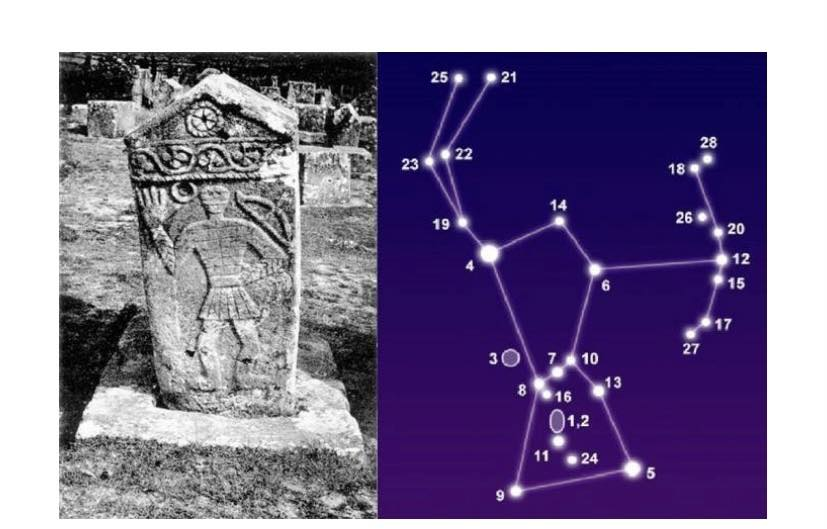
Archer of Radimlja and Orion
Found in the Radimlja necropolis, near Stolac (Bosnia and Herzegovina). One of the most iconic Stećci.
Dating: 14th–15th century CE (Medieval).
No inscription on this relief.
Historical context: Although the stone was carved in the Middle Ages, the figure of the archer with raised hand is considered a pure legacy of the Illyrian warrior spirit.
Connection to Orion: The theory seen in the image suggests that the figure’s position corresponds to the constellation Orion. This indicates that the descendants of the Illyrians and Dardanians preserved ancient Pelasgian astronomical knowledge, engraving it in stone as a message for future centuries.

