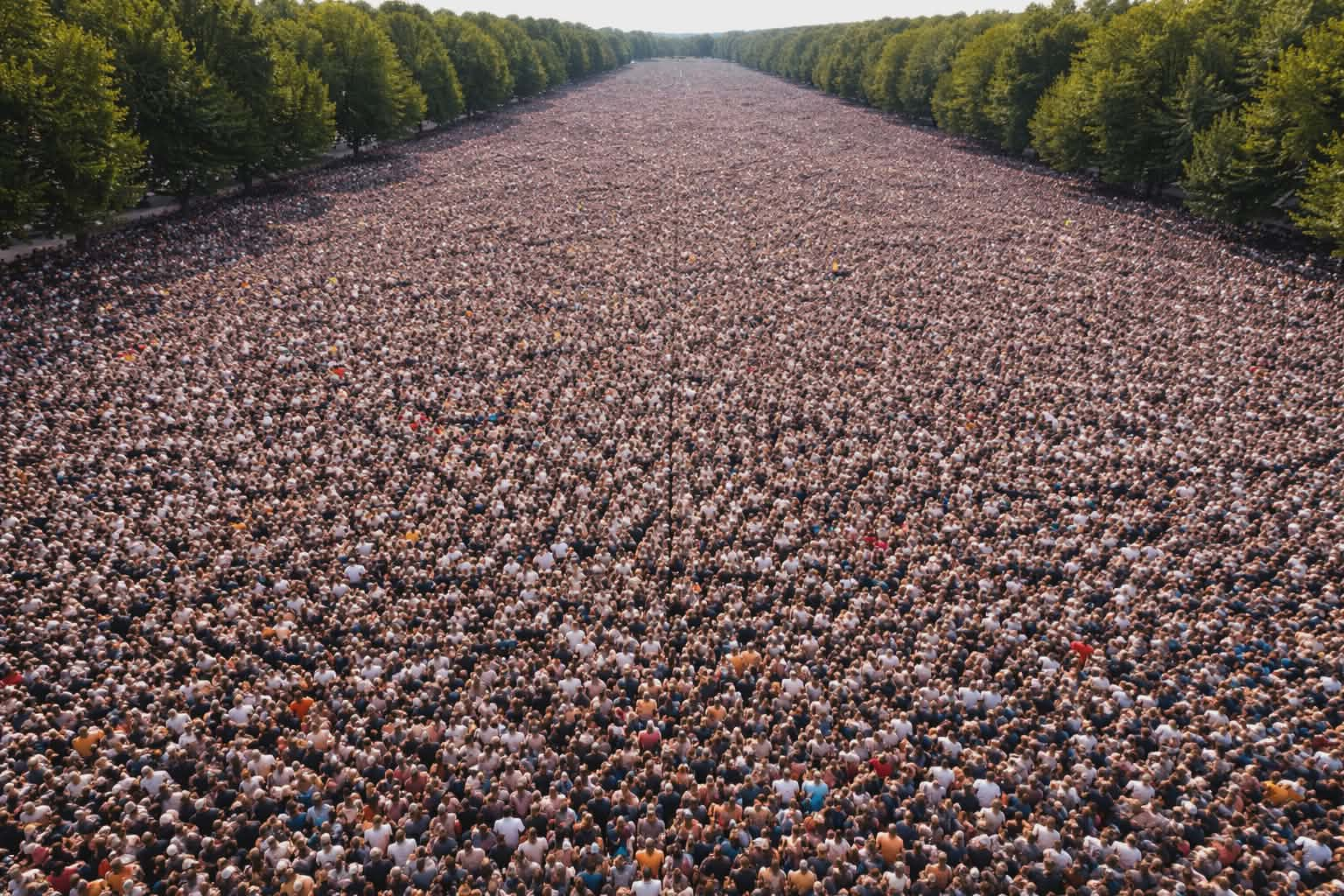

Imagine standing at the edge of a living sea — not water, but 150,000 people stretching shoulder-to-shoulder across a vast open landscape, bordered by endless rows of trees that fade into the distance. The photograph above captures exactly that: an immense crowd of 150,000 individuals, each one a beating heart, a story, a future. Every person visible in this sweeping aerial view represents one human life. Now picture all of them suddenly silenced, their bodies strewn across that same endless field in the aftermath of slaughter. This is the scale of the systematic killing of approximately 150,000 Albanian civilians carried out by Serbian forces during the First Balkan War in late 1912 and early 1913.
This image comes from our own time, showing a peaceful gathering. Yet it offers a powerful, unflinching lens through which to view the atrocities committed over a century ago in Kosovo Vilayet and neighboring Albanian lands.
As Ottoman rule crumbled, Serbian troops advanced into the region with clear instructions to secure the territory for the expanding Serbian state. What followed was not random violence born of battle, but a methodical campaign of terror: villages encircled and burned, civilians dragged from their homes and executed, women and children among the victims, and entire communities erased in a drive to reshape the demographic reality of the area.
Contemporary sources — including the detailed 1914 investigation by the Carnegie Endowment for International Peace, reports from European consuls, and accounts by journalists like Leon Trotsky — paint a consistent picture of organized ethnic cleansing. The Serbian army targeted the predominantly Albanian Muslim population of Kosovo Vilayet with the goal of reducing their numbers dramatically before new borders were drawn.
While narrower estimates for the core Kosovo area often cite around 50,000 deaths in the first wave, wider assessments covering Albanian-inhabited zones under Serbian and Montenegrin occupation (including parts of today’s Kosovo, northern Macedonia, and border districts) place the total civilian death toll as high as 120,000 to 150,000. These figures include direct mass executions, summary killings, rapes, forced displacements leading to death from exposure and starvation, and the destruction of livelihoods that left survivors with nothing.
The photograph forces us to confront what 150,000 murdered people actually look like in human terms:
- It equals the complete annihilation of a mid-to-large modern city — comparable to wiping out the entire population of a place the size of Örebro in Sweden or similar European regional centers, leaving not a single survivor.
- It would overflow two major football stadiums the size of Wembley (around 90,000 capacity each), with thousands more victims crowded onto the playing field and surrounding areas.
- It matches precisely the living multitude shown in the image: 150,000 souls gathered together in one unbroken expanse, but reimagined as a silent, lifeless plain covered in the dead from foreground to far horizon.
- It represents the combined populations of 30 to 40 ordinary small or medium-sized towns, each with 4,000–5,000 residents, every inhabitant slaughtered without exception.
Zoom into any portion of the photo and you see clusters of people — families standing close, friends talking, strangers sharing the same space. Then multiply that single intimate snapshot across the entire breathtaking width and depth of the crowd until the weight of the loss hits with full force.
Serbian commanders and soldiers at the time spoke openly of the need to “cleanse” or “exterminate” the Albanian element to make the land truly Serbian. Eyewitnesses described blood-soaked streets in towns like Pristina and Prizren, piles of corpses in public squares, and rural areas reduced to smoking ruins — a landscape some called “a kingdom of death.”
It is a bitter truth that this chapter of history has been largely airbrushed from mainstream narratives. Serbian official histories frequently reframe the killings as necessary military actions against “rebels” or “irregulars,” downplaying or denying the systematic targeting of unarmed civilians. Even many Western accounts of the Balkan Wars have treated the Albanian victims as footnotes rather than the victims of a calculated demographic purge. The Carnegie report, based on direct fieldwork, left little room for doubt: the violence was deliberate, widespread, and aimed at permanent ethnic reconfiguration ahead of the London Conference.
More than 110 years on, the estimated 150,000 Albanian civilian deaths of 1912 remain shamefully under-acknowledged. No major international monuments commemorate them. No formal reckoning has come from Belgrade. The vast living crowd in the photograph stands as a deliberate challenge to that silence: if we can visualize 150,000 lives gathered in one place, we cannot look away from the reality of 150,000 lives deliberately taken in a campaign of state terror.
The massacre of up to 150,000 Albanian civilians by Serbian forces in 1912 was never simple “wartime excess.” It was a premeditated act of ethnic cleansing, executed to redraw the map of the Balkans in blood. The image above — that boundless sea of humanity reaching toward the horizon — provides the clearest possible measure of the tragedy. Until this history is faced honestly, without denial or selective amnesia, the wounds of 1912 will continue to fester, reminding us how easily mass slaughter can be buried beneath layers of national myth-making.

