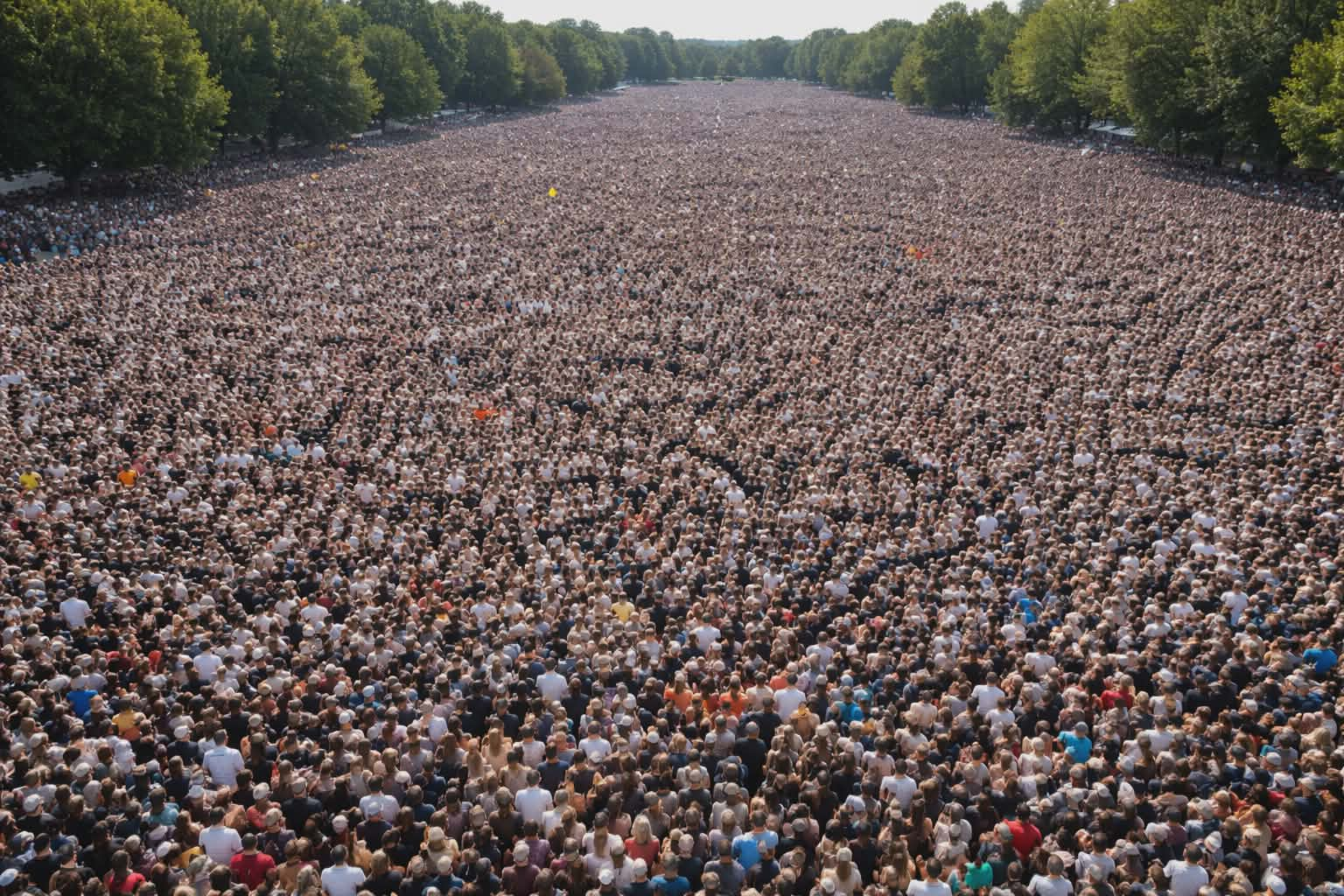

Look at the photograph above. It captures a single, sprawling crowd of 50,000 people — a sea of humanity packed into an open field, stretching from the foreground all the way to the distant tree line. Every individual you see here represents one human life. Now imagine every single one of them lying dead on the ground, slaughtered in cold blood. That is the scale of what happened in Kosovo Vilayet in late 1912, when the Serbian army marched in during the First Balkan War and systematically massacred an estimated 50,000 Albanian civilians.
The image is not from 1912 — it is a modern snapshot of a peaceful gathering — yet it serves as a haunting visual proxy for the horror that unfolded over a century ago. Stand in that crowd mentally. Feel the press of bodies around you. Now picture Serbian troops, acting on explicit orders to “pacify” the region, moving methodically through villages and towns, bayoneting men, women, and children, burning homes, and leaving entire communities in ashes.
Contemporary reports from the Carnegie Endowment for International Peace, Austrian consular dispatches, and even Serbian soldiers and journalists like Leon Trotsky documented the same pattern: not collateral damage from battle, but deliberate, organized extermination.
In the autumn of 1912, as Ottoman forces withdrew, the Serbian army entered Kosovo Vilayet — then home to a majority Albanian Muslim population — with a clear strategic goal. The violence was not random. Villages were razed, unarmed civilians were rounded up and executed, and mass graves were left behind.
Estimates from the period, including those later corroborated by University of Belgrade research, place the death toll in present-day Kosovo at around 50,000 Albanian civilians in the first months alone. Broader figures for Albanian areas under Serbian and Montenegrin occupation reach as high as 120,000 when including expulsions and deaths across Kosovo, Macedonia, and beyond.
But even the conservative contemporary tallies — 20,000–25,000 in Kosovo Vilayet in the opening phase — are staggering. The higher 50,000 figure for the core Kosovo region reflects the full scope of the campaign once the occupation solidified.
To grasp what 50,000 murdered civilians actually means, consider these comparisons:
- It is the entire population of a mid-sized city like modern-day Prizren or Ferizaj wiped out in a matter of weeks.
- It would fill an entire major football stadium — think Wembley Stadium in London (capacity ~90,000) or many NFL stadiums in the U.S. (often 50,000–70,000 seats) — with every seat occupied by a victim, and still leave thousands standing on the pitch.
- It equals the combined population of a dozen small towns, each with 4,000 residents, every man, woman, and child slaughtered.
- It is roughly the number of spectators at a sold-out concert in a large arena, except in 1912 those 50,000 were not cheering — they were civilians targeted because they were Albanian and stood in the way of Serbia’s demographic engineering.
The photograph forces us to confront the intimacy of that number. Zoom in on any cluster of people in the image: families, friends, strangers shoulder-to-shoulder. Multiply that micro-scene across the entire frame until the horror becomes visceral. This was not “war.” This was ethnic cleansing by design, intended to alter the population balance before international borders were finalized at the London Conference.
Serbian officers openly spoke of the “total extermination” of Muslim Albanians as the most effective form of pacification. Eyewitness accounts describe streets littered with corpses in Pristina (5,000 killed), Prizren (another 5,000), and Ferizaj (over 1,200). Entire regions were turned into “the Kingdom of Death,” as one survivor called it.
Critically, this massacre has been minimized, denied, or simply forgotten in mainstream Western narratives of the Balkan Wars. Serbian official histories often frame the killings as “combat casualties” or reprisals against “insurgents,” ignoring the documented targeting of non-combatants — women, children, the elderly.
Albanian sources, understandably, emphasize the genocide-like character of the campaign. Independent international observers at the time (the Carnegie Commission chief among them) left no doubt: houses reduced to ashes, populations massacred en masse, villages emptied through terror. The goal was clear — create a Serbia “cleansed” of Albanians to justify annexation.
Yet today, more than 110 years later, the 50,000 dead remain largely invisible in global memory. No major memorials stand in Belgrade acknowledging the crime. No international tribunals have delivered justice for 1912 the way they did (imperfectly) for later Balkan atrocities. The photograph of 50,000 living souls above is a deliberate provocation: if we can see the scale of life, we must also confront the scale of its deliberate destruction.
The systematic slaughter of 50,000 Albanian civilians in Kosovo Vilayet in 1912 was not an unfortunate side-effect of war. It was state policy. It was ethnic cleansing. And the image before you — that vast, living crowd — is the only honest way to begin remembering what was lost. Until we acknowledge the full horror of that autumn, the ghosts of Kosovo 1912 will continue to haunt the Balkans, demanding recognition that history has too long withheld.

