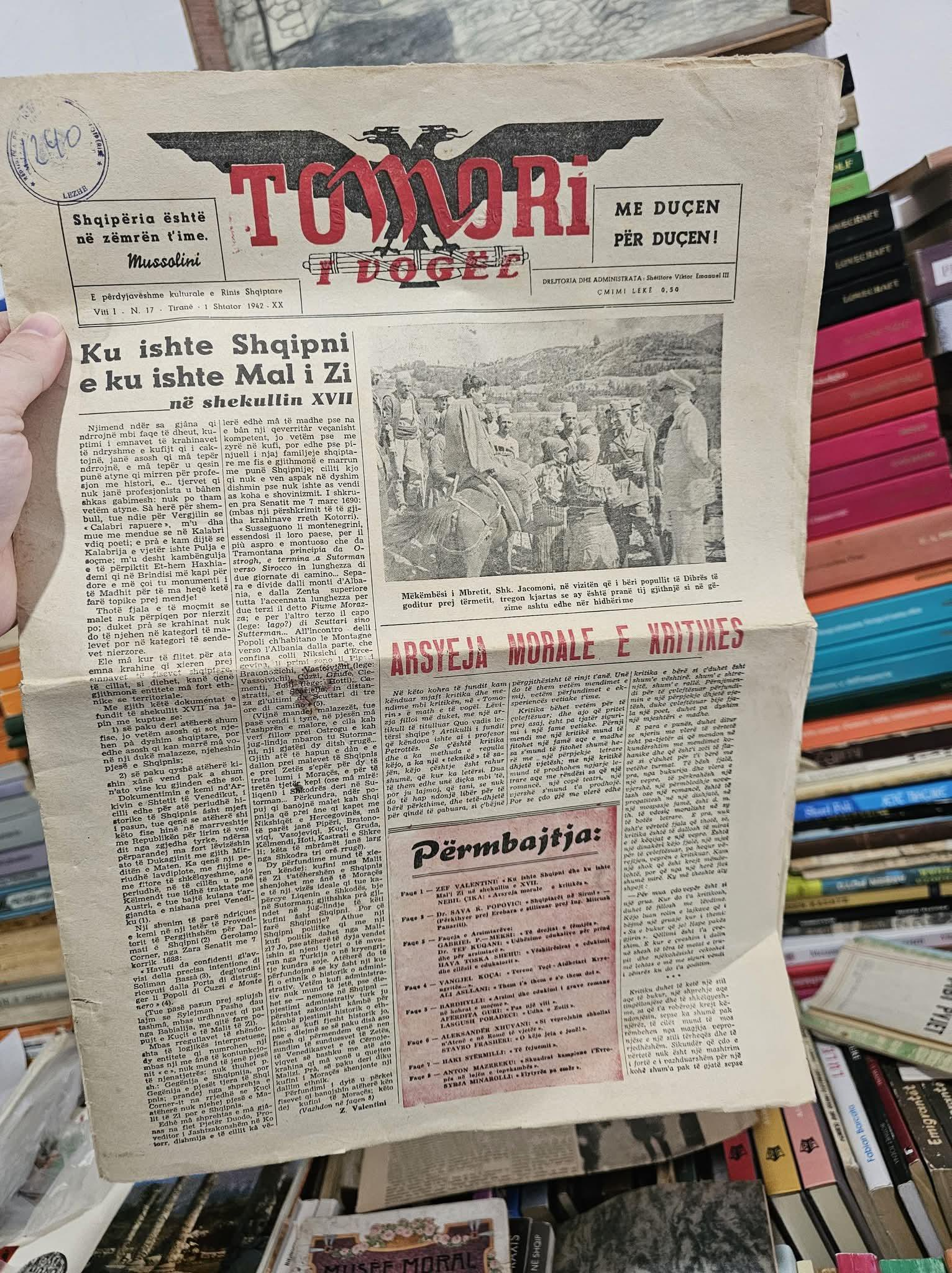

Discovery by Shefqet Fejzo.
Transcribed:
TOMORI I DOGE – with Duce! For Duce!
- “Shqipëria është në zemrën time. Mussolini” → “Albania is in my heart. Mussolini”
- Cultural weekly of Albanian youth
- Issue: Year 1, No. 17 – Tirana, 1 September 1942 – XX
- Price: 0.50 Lekë
Article 1: Where Albania was and where Montenegro was in the 17th century
First paragraph:
Indeed, among the many things that concern the pages of history, the memory of the names of different regions and the borders they have had is one of the most important, especially for those who work professionally in history. For others who are not professionals, I write not to confuse them but to explain clearly. The purpose of this article is to give historical context regarding the borders and territories of Albania and Montenegro in the 17th century.
Second paragraph:
To understand this, one must first consult historical documents. One of the most important sources is the works of Italian geographers and travelers, such as the famous report of the priest Frane Erizzo from the 17th century. In his writings, Erizzo describes the landscape, the settlements, and the organization of communities in what is today northern Albania and Montenegro. He emphasizes the division of lands according to local clans and the influence of larger regional powers.
Third paragraph:
The area of northern Albania was characterized by strong tribal organization. Villages were small, often scattered in mountainous regions, and under the leadership of local elders. Montenegro, in contrast, had a different system, influenced by Venetian and Ottoman control, with its own network of fortresses and a separate political structure. These differences were noted by travelers and chroniclers of the time, who recorded both the customs and the boundaries of the regions.
Fourth paragraph:
The political situation was complex. Albania and Montenegro were not unified states, but collections of tribes, each with its own leaders. Allegiances shifted frequently due to military campaigns, economic pressures, and family alliances. Historical documents from the 1600s show that while the Montenegrins had some contact with Venetian officials, the Albanian tribes maintained more autonomous local governance.
Fifth paragraph:
Geography played a crucial role. The mountains, rivers, and valleys naturally divided territories. Erizzo describes, for example, the flow of the river Buna and its role as a boundary marker, as well as the Diber valley, where communities lived close together but maintained distinct cultural identities. These geographical features strongly influenced settlement patterns, trade routes, and even conflicts.
Sixth paragraph:
In conclusion, the historical records of the 17th century reveal a complex mosaic of communities in northern Albania and Montenegro. Albania’s territories were organized by clans with localized leadership, whereas Montenegro had fortifications and ties to external powers. Understanding these divisions is essential for studying the history, culture, and identity of the region, as well as the interactions between neighboring peoples.
Photo Caption:
The King’s envoy, Shk. Jacomini, during his visit to the people of Dibra affected by the earthquake, shows care and reminds them that he is always close, both in joy and in grief.
Article 2: Red Subheading: ARSYEJA MORALE E KRITIKËS → The Moral Reason for Criticism
In our time, it is important to understand what moral criticism truly means. Criticism is not merely pointing out mistakes or weaknesses; it is a constructive force that guides improvement. A true critic observes, judges, and directs with fairness, always keeping the greater good in mind.
Criticism must have purpose and method. It is not enough to complain or to speak harshly. The critic must study, understand the subject, and communicate insights that lead to improvement, both for individuals and for society. When criticism is moral, it strengthens culture, ethics, and the sense of responsibility among people.
Criticism should also be timely. Offering guidance after an action has caused harm or failure has limited impact. The most effective criticism is proactive, aiming to prevent mistakes and encourage correct behavior before errors take root.
Finally, moral criticism requires courage and integrity. It is easy to avoid responsibility or to flatter others, but a true critic speaks the truth respectfully, balancing honesty with empathy. In this way, criticism is not an attack but a tool for education, growth, and the betterment of the community.
Contents Section:
Anton Mazreku – Youth Campaigns and the Role of Criticism in Society
Zef Valentini – How Albanian Youth Sees Moral Criticism
Neni Cika – Moral Criticism and Youth
Dr. Savë Griliqi – Criticism Before the Elders: How to Use It Wisely
Fagjati & Arnauti – Miscellaneous Commentaries and Youth Responses
Gabriel Kuqani – Cultural and Literary Criticism Among Youth
Vançell Koci – Youth, Literature, and Critical Thinking
Malësllani – Critique in Arts and Culture
Haki Stremelli – Criticism in Social Life
Source
Newspaper Tomori i Vogel, 1942.

