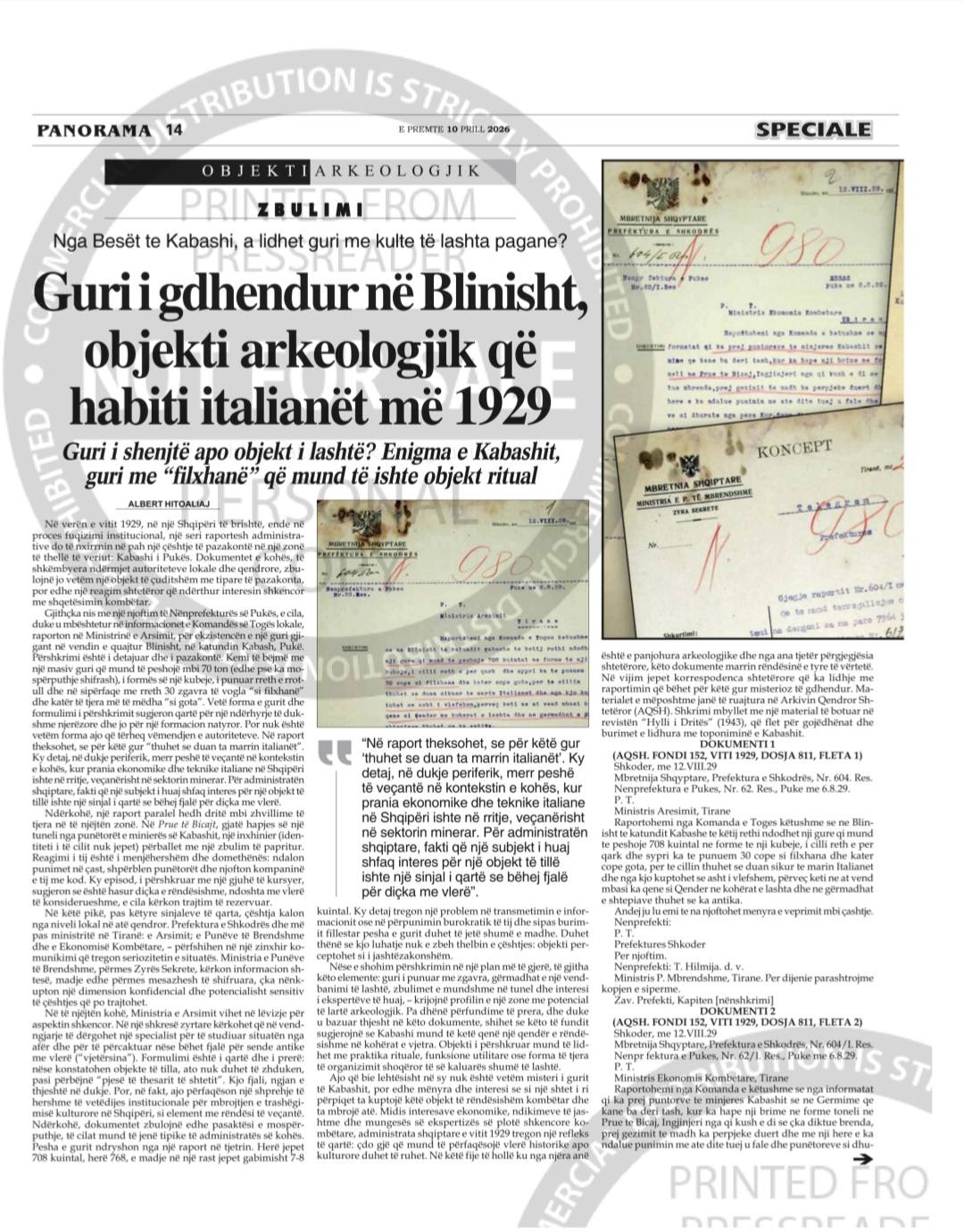

Abstract
The 1929 discovery of a massive carved stone in Blinisht, Kabash, Pukë, weighing around 70 tons, captured Albanian authorities’ attention and astonished Italian engineers. Reports describe a cube-shaped stone with small cup-like cavities, suggesting human modification and possible ritual significance. Administrative correspondence shows the state’s simultaneous concern for national security, foreign interest, and scientific study. The stone’s location amidst ancient settlement ruins highlights Kabash as a potentially significant archaeological site. Legends link the area to sacred stones and Thracian heritage. Archival materials reveal early institutional awareness of Albania’s cultural heritage and the strategic handling of valuable ancient objects.
The carved stone in Blinisht, the archaeological object that amazed the Italians in 1929. Holy stone or ancient artifact? The Kabash enigma, the stone with “cups” that could have been a ritual object. The mystery of the stone that mobilized official Tirana: “The Italians wanted to take it,” a 70-ton object in Pukë, how the Albanian state was alarmed in 1929.
by ALBERT HITOALIAJ. (PANORAMA NEWSPAPER, 10.4.2026)

In the summer of 1929, in a fragile Albania, still in the process of institutional strengthening, a series of administrative reports highlighted an unusual issue in a remote northern area: Kabashi in Pukë. Contemporary documents, exchanged between local and central authorities, reveal not only a strange object with unusual features but also a state response combining scientific interest with national concern.
It all begins with a notice from the Subprefecture of Pukë, which, relying on information from the local Togë Command, reports to the Ministry of Education about the existence of a giant stone in a place called Blinisht, in the village of Kabash, Pukë. The description is detailed and unusual.
The stone is a massive block that may weigh over 70 tons (although there are inconsistencies in the figures), cube-shaped, worked all around, with about 30 small cup-like cavities and four larger “glass-like” ones on its surface. The stone’s shape and the description suggest clear human intervention rather than a natural formation.

But it is not only the shape that draws the authorities’ attention. The report notes that “it is said that the Italians want to take it.” This detail, seemingly peripheral, gains special weight in the context of the time, when Italian economic and technical presence in Albania was increasing, especially in the mining sector. For the Albanian administration, the fact that a foreign entity showed interest in such an object was a clear signal of its value.
Meanwhile, a parallel report sheds light on other developments in the same area. In Prue of Bicaj, during the opening of a tunnel by Kabash mine workers, an engineer (identity not disclosed) encounters an unexpected discovery. His reaction is immediate and significant: he stops work instantly, rewards the workers, and informs his company using a code. This episode, described tersely, suggests that something important, possibly of considerable value, had been found, requiring discreet handling.
At this point, following these clear signals, the matter moves from the local to the central level. The Prefecture of Shkodër and later ministries in Tirana—the Ministries of Education, Internal Affairs, and National Economy—become involved in a communication chain that demonstrates the seriousness of the situation. The Ministry of Internal Affairs, through its Secret Office, requests additional information, even via coded messages, indicating a confidential and potentially sensitive dimension.
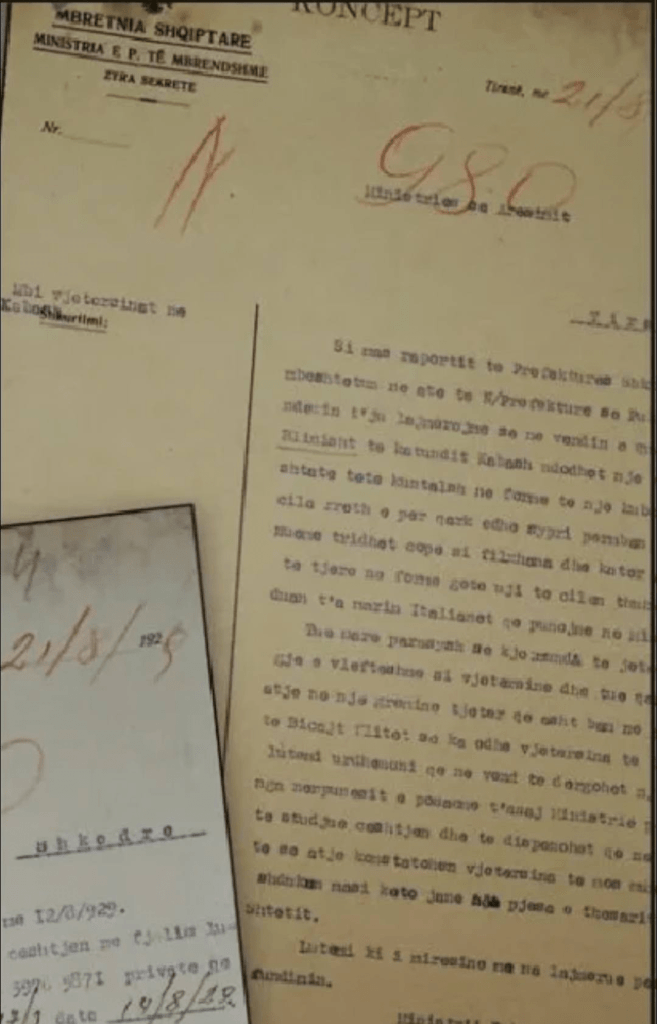
At the same time, the Ministry of Education acts on the scientific aspect. An official document requests that a specialist be sent to the site to study the situation closely and determine whether these are ancient valuable objects.
The wording is clear: if such objects are found, they must not disappear, as they are part of the “state’s treasure.” This phrase, seemingly simple, represents an early expression of institutional awareness for protecting Albania’s cultural heritage.
Meanwhile, the documents reveal inaccuracies and inconsistencies typical of the administration at the time. The weight of the stone varies from one report to another: sometimes 708 quintals, sometimes 768, and in one case erroneously 7–8 quintals.
This reflects either errors in information transmission or bureaucratic processing, yet all sources indicate the stone is very large. These fluctuations do not diminish the significance of the matter: the object is perceived as extraordinary.
Viewed more broadly, all these elements—the carved stone with cavities, the ruins of an ancient settlement, potential tunnel discoveries, and foreign expert interest—paint a profile of an area with high archaeological potential. Based solely on these documents, Kabashi may have been an important center in ancient times. The described object could be related to ritual practices, utilitarian functions, or other forms of social organization in the distant past.
What stands out is not only the mystery of the Kabash stone but also how a new state seeks to understand and protect this nationally significant object. Amid economic interests, foreign influences, and limited national scientific expertise, Albania’s 1929 administration demonstrates a clear reflex: anything of historical or cultural value must be preserved. Between the archaeological unknown and state responsibility, these documents gain their full importance.
The following sections provide state correspondence regarding the reporting of this mysterious carved stone. These materials are preserved in the Central State Archive (AQSH). The text closes with a 1943 article in the magazine “Hylli i Dritës” discussing legends and sources related to Kabash’s toponymy.
DOCUMENT 1
(AQSH. FUND 152, YEAR 1929, FILE 811, PAGE 1)
Shkodër, 12.VIII.29
Albanian Kingdom, Shkodër Prefecture, No. 604. Res. Subprefecture of Pukë, No. 62. Res., Pukë, 6.8.29
To the Ministry of Education, Tirana
We report from the local Togë Command that in Blinisht, village of Kabash in this district, there is a stone that may weigh 708 quintals in the form of a cube, with around 30 cup-like cavities and four glass-like ones, said to be desired by the Italians, which indicates its value. Additionally, the place has been a center in ancient times, and ancient objects are said to exist among the ruins of the houses.
Instructions on how to act regarding this matter are requested.
Subprefect: T. Hilmija
DOCUMENT 2
(AQSH. FUND 152, YEAR 1929, FILE 811, PAGE 2)
Shkodër, 12.VIII.29
To the Ministry of National Economy, Tirana
We report that according to information from Kabash mine workers, during excavation in a tunnel in Prue of Bicaj, an engineer discovered something unexpected. He immediately stopped work, rewarded the workers, and informed his company via code.
Subprefect: T. Hilmija
DOCUMENT 3
(AQSH. FUND 152, YEAR 1929, FILE 811, PAGE 3)
Tirana, 20.8.29
To the Ministry of Internal Affairs, Tirana
The stone in Blinisht of Kabash may weigh 768 quintals in a cube shape, with 30 cup-like cavities and 4 glass-like ones. It is said the Italians want it, indicating its probable ancient value. The stone should be handled appropriately.
Commander: R. Çela
DOCUMENT 4 & 5
Tirana, 21.8.29
Secret Office, Ministry of Internal Affairs
Follow-up instructions for securing the stone and sending a specialist to study it and ensure that ancient objects are not removed.
ORIGIN OF THE NAME KABASH IN LEGENDS AND SOURCES
The Kabash tribe in Pukë and the Gazullorët (Lushaj family) are mentioned. Kabash’s name may derive from the Thracian city Kabesos. Kabashi’s history and legends suggest links to ancient Thracian tribes and continuity of ritual practices.
According to Mark Tirta (Mythology among Albanians, 2004), Kabashi contains sites that preserve the pagan tradition of worshiping sacred stones, such as Guri i Shenjtë in Zogaj, Kabash, and other local sacred sites. These legends indicate ancient sanctity, pilgrimages, and dedicated offerings. The stone in question may be one of these ancient worship objects.
The disclosure of these archival materials (nearly 100 years old) aims to awaken scientific, state, and national interest in the ancient objects of Kabash, which today may be hidden by vegetation and forgotten over time. Albania awaits discovery.
Source:
Article Name: The carved stone in Blinisht, the archaeological object that amazed the Italians in 1929. Publication: Panorama (Albania). Author: Albert Hitoaliaj. Pages: 14–15. PressReader

