
Venetians identified the Gjuraš family by their ancestral name, even the Slavic-sounding Crnojević identity was set. This dynastic branding was a political move to claim the legacy of Lower Zeta and exert authority over strategic highland territories: Junk Hoth, Lugina e Hotit.
Abstract
In 1199, during the second year of his pontificate, Pope Innocent III issued a synodal decree through his legates in the Archdiocese of Bar (Antivari). The document reinforced the protection of clergy from violence and secular judgment, regulated church property and marriage, and established minimum standards for priestly ordination. Signed by the Archbishop of Dioclea and Antivari along with bishops from key Albanian and Dalmatian sees—including Arbanensis (Arbanon), Scutari (Scuarinensis), Polatinensis, Aruastinensis, Soacinensis, Dulcinensis (Ulqinj), and Sarcanensis—this decree illustrates the Latin Church’s efforts to consolidate authority in the Southwestern Balkans amid competing political influences.
The document also reflects broader dynamics of dynastic legitimacy in the region. Venetian sources identified emerging local families, such as the Gjuraš (later associated with the Crnojević identity), by their ancestral names as a political strategy to claim the legacy of Lower Zeta and assert control over strategically important highland territories like Hoti (Junk Hoth / Lugina e Hotit). Together, the 1199 synod and contemporary cartographic evidence highlight how papal ecclesiastical structures intersected with local power networks in what would become medieval Albania and Montenegro.
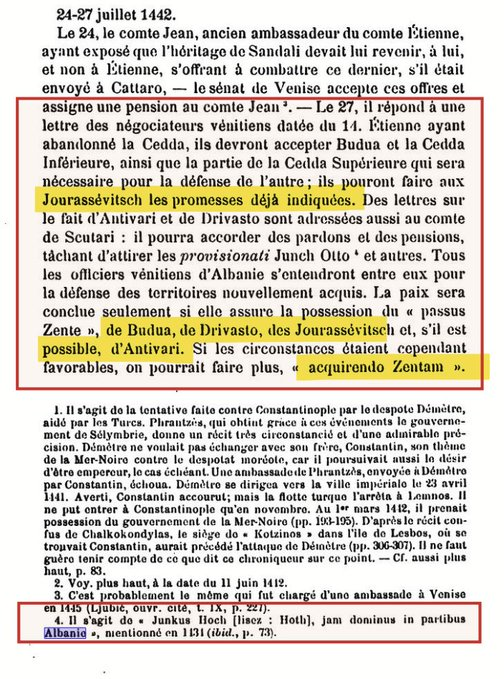
The Albanian origin of the Crnojević (Gjuraš) family according to Venetian archives

A remarkable map and a 1199 document that it gives us a synodal document with their proper diocesan identifications and named bishops for several Albanian dioceses (Antibari, Arbanensis (Arbanon), Scutari, Drivasto, Sarda, Pulati, Shas, Dulcigno (Ulqinj).

Transcribed:
“INNOCENT III PP. III. ANNO II. CHRISTI 1199.
Since honor is shown by all to the envoys or ministers of earthly powers, much more should the honor due to God be shown to the laity, from whom not only the divine offices are celebrated, but also the sacred baptism, the Body of the Lord, and penance, and the other ecclesiastical sacraments are constantly administered.
Therefore, according to the decree of the Lord Pope Innocent II, we strictly forbid that anyone should presume to lay violent hands on the person of a bishop or priest, or of any cleric or religious man whatsoever. Whoever shall have attempted this shall remain excommunicated until he presents himself before the Apostolic See, or before its legate, and makes due satisfaction, and obtains the benefit of absolution.
Likewise, under pain of excommunication, we forbid that any layman should presume to drag a cleric before a secular court by means of the hot iron, or water, or any other secular judgment; for it does not belong to a layman to judge a cleric. But if a cleric has committed an offense, he shall be judged by his archbishop or bishop, or even by his own prelate, or, if necessary, by the Roman Pontiff.
We excommunicate all those who unjustly detain the treasures of churches until they restore them, and those who hold Latins in servitude, unless, having received the money which they gave, they restore them to their former liberty.
Likewise, we excommunicate all those who have dismissed their own wives, or who have dismissed them without the judgment of the Church, until they return to them.
We also forbid that the sons of priests, and those who are not born of legitimate marriage, should advance to holy orders.
Likewise, we forbid that anyone should be ordained to the priesthood unless he has completed his thirtieth year.
Signatures:
Brother Johannes, chaplain of the Lord Pope, legate of the Apostolic See, have written and subscribed.
Brother Symon, subdeacon of the Lord Pope, legate of the Apostolic See, have subscribed.
Johannes Diocliensis et Antibarensis Archiepiscopus, have subscribed.
Dominicus Archpresbyter Arbaneusis, have subscribed.
Petrus Scuarinensis episcopus, have subscribed.
Iohannes Polatinensis episcopus, have subscribed.
Petrus Aruastinensis episcopus, have subscribed.
Dominicus Soacinensis episcopus, have subscribed.
Natalis Dulcinensis episcopus, have subscribed.
Theodorus Sarcanensis episcopus, have subscribed.
This is a decree issued in the second year of the pontificate of Pope Innocent III (1199), dealing with the protection of clergy from violence, the prohibition of trial by ordeal for clerics, the return of church treasures and freed Latin captives, rules on marriage and clerical discipline, and minimum age for priestly ordination. The document was likely issued in the context of the Latin Church’s activities in the Balkans (Dalmatia/Albania region), judging by the bishoprics mentioned (Dioclea/Antivari, Arbanum/Arbana, etc.).”
References
- Primary Source: Synodal decree of Pope Innocent III, Year 2 (1199), preserved in ecclesiastical archives and referenced in Balkan historical collections (original Latin text as transcribed above).
- Lala, Etleva. Regnum Albaniae and the Papal Curia (Central European University, 2008). Detailed study of papal legates and ecclesiastical organization in the Southwestern Balkans in the late 12th and early 13th centuries.
- Vargová, D., Vranešević, B., & Popović, M. “A Combined Approach to the Reconstruction of the Sacred Landscape of Duklja and Raška…” Zbornik Radova Vizantološkog Instituta 60/2 (2023). Discusses the 1199 context and the role of the Archbishop of Bar/Dioclea.
- Jireček, Konstantin. “Scutari and the Surrounding Region in the Middle Ages” (1916). Classic study on medieval dioceses including Scutari, Drivasto, and Dulcigno.
- Venetian archival references to the Gjuraš/Crnojević family and territorial claims in Lower Zeta and Hoti (various 14th–15th century documents cited in modern Balkan historiography).
- Additional context on the Diocese of Arbanum/Arbanensis: Transition to suffragan status under Bar by 1199.

