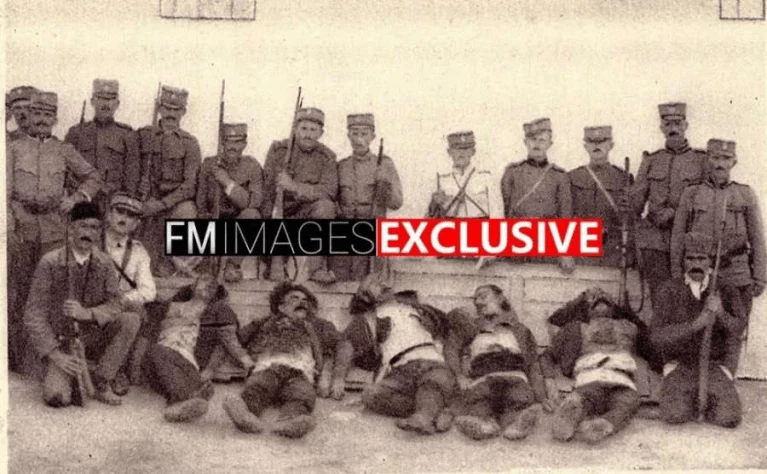

Serbian Soldiers Posing with the Corpses of Five Murdered Albanians in Prizren, 1925
In the grainy black-and-white photograph taken in Prizren in 1925, the horror is clinical, almost casual. A line of Serbian soldiers and gendarmes—some standing upright with rifles slung over their shoulders, others kneeling in the foreground—stare directly at the camera with the bored satisfaction of men who have just completed routine work.
At their feet lie the bodies of five Albanians, sprawled lifeless on the ground like hunting trophies. The corpses are stripped or partially clothed, limbs twisted, faces contorted in the final agony of execution. No battle damage mars the scene; these are not fallen combatants but executed civilians or captured resisters, their bodies deliberately arranged and displayed for the photograph.
One soldier rests a hand on his rifle as if posing beside game. The image, preserved by FMimages and published by Balkanweb, is not propaganda staged for outsiders. It is a private souvenir of the everyday sadism that defined Serbian rule in occupied Albanian territories.
This is not an isolated atrocity photograph from a distant war. It is the visual distillation of a thirteen-year continuum of nihilistic violence—1912 to 1925—during which Serbian military and police forces treated Albanian life as something to be extinguished, mutilated, and publicly humiliated without remorse.
The pattern did not begin in 1912. It was already systematized after the 1878 Congress of Berlin, when the newly independent Serbian state began the ethnic cleansing of Albanian-majority districts such as Toplica and Kosanica. Entire villages were emptied, lands confiscated under agrarian laws, and Albanian populations driven out or exterminated to make room for Serb settlers. By the early 20th century, this had become state doctrine: Albanian presence was not merely inconvenient; it was ontologically unacceptable.
The Balkan Wars of 1912–1913 escalated the campaign into open extermination. Serbian and Montenegrin armies, advancing into Kosovo and northern Albania as the Ottoman Empire collapsed, did not wage war so much as conduct a demographic purge. Villages were burned to the ground. Unarmed civilians—men, women, children—were massacred en masse.
The neutral Carnegie Endowment for International Peace commission, investigating in 1913–1914, documented the systematic nature of the terror: “Houses and whole villages reduced to ashes, unarmed and innocent populations massacred en masse, incredible acts of violence, robbery and brutality of every kind—such were the means employed… with a view to the entire transformation of the ethnic character of regions inhabited exclusively by Albanians.”
In Prizren alone, Serbian forces killed hundreds in the first days of occupation; bodies were left rotting in the streets, foreign journalists barred from witnessing the scale of the slaughter. Estimates for the period place Albanian deaths in the tens of thousands, with hundreds of villages destroyed.
The violence did not pause with the creation of the Kingdom of Serbs, Croats and Slovenes. Between 1918 and 1925 the colonial project intensified under the cover of “agrarian reform.” Albanian land was seized and redistributed to Serb and Montenegrin settlers, often including Russian White émigrés.
Resistance—whether armed Kaçak fighters or passive civilians—was met with scorched-earth reprisals. Prizren, the very city in the 1925 photograph, had already seen thousands killed or displaced in the preceding years. Detailed contemporary records list specific murders: eyes gouged out while victims were still alive, noses and ears severed, bodies bayoneted for sport before being left to die. The soldiers in the 1925 image were not anomalies; they were the logical product of a military culture that had spent over a decade treating Albanian corpses as props for morale-boosting photographs.
What makes the image profoundly disturbing is the absolute absence of shame. These men do not look haunted. They do not look victorious in any noble sense. They look bored—as if posing with dead Albanians was simply another day’s bureaucratic task, no different from posing beside a felled tree or a slaughtered pig.
There is a demonic nihilism here: a complete void where human empathy, international law, or even basic military honor should reside. Human rights, dignity, the sanctity of the dead—none of these concepts registered. The bodies are not hidden or buried with haste; they are arranged, displayed, immortalized on film. One can imagine the soldiers later passing the print around barracks, laughing, perhaps sending copies home as proof of patriotic service.
Imagine, for a moment, the European reaction had this been any other perpetrator. Suppose French colonial troops in Algeria in 1925 had posed grinning beside the mutilated corpses of five Arab villagers. Or British soldiers in Ireland displaying executed Irish rebels like game. The outcry would have shaken the League of Nations. Editorials in The Times and Le Figaro would have thundered about barbarism.
Diplomatic cables would have flown. Yet when Serb forces did precisely this—again and again, for years, in the heart of Europe—the response was largely silence or polite diplomatic hedging. The Albanian dead were simply inconvenient statistics in the narrative of South Slavic “liberation.”
This photograph is not an aberration. It is the face of Serbian expansionism rendered literal: a boot on the neck of Albanian life, a rifle butt to the skull of a culture, and a camera flash to celebrate the emptiness left behind.
From 1878 through the interwar colonization programs and beyond, the Serbian military elite, backed by the Orthodox clergy and nationalist politicians, waged a war not merely against territory but against life itself—Albanian life, Muslim life, any life that refused to submit to the Greater Serbian myth. The grass, as Albanian folklore warned, does not grow where that boot has trod. In Prizren, 1925, the soldiers proved the proverb with five fresh corpses and a smile for the lens.
The image endures as evidence, not of a single crime, but of a sustained ideological project: the sadistic, methodical erasure of an entire people. Thirteen years of nonstop slaughter, from the fires of 1912 to the posed trophies of 1925, and the men in the photograph felt nothing—except, perhaps, the quiet pride of a job well done.
Sources
Balkanweb (2019), “1925 / Serbs massacre 5 Albanians and expose their bodies.”
Carnegie Endowment for International Peace, Report of the International Commission to Inquire into the Causes and Conduct of the Balkan Wars (1914).
Contemporary records of Prizren massacres and interwar colonization programs, as documented in Albanian and international historical scholarship.

