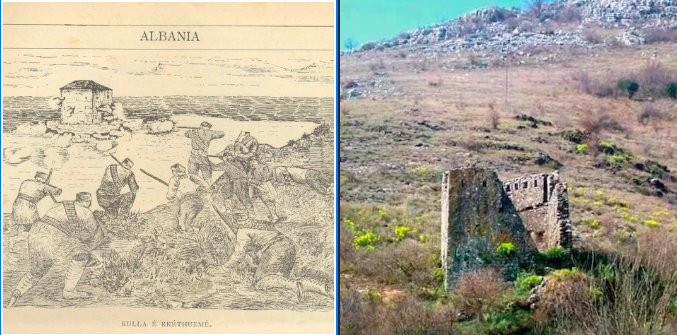

The heroic stand of Oso Kuka in 1862 remains one of the most powerful symbols of Albanian resistance and sacrifice. In June of that year, near the northern shores of Lake Shkodra (Liqeni i Shkodrës) in the region of Vranina, a small group of Albanian border guards faced overwhelming odds against Montenegrin forces. At the center of this drama stood a strategic tower filled with gunpowder — the site where Oso Kuka and his men chose death over surrender.
The Battle and the Legend
Oso Kuka (Osman Bejtullah Kuka, c. 1812/1820–1862), a Shkodra-born captain of the Ottoman-Montenegrin border guards, led a small çeta of about 24–30 men. When thousands of Montenegrin soldiers attacked Vranina, the defenders resisted fiercely from the tower (often called the “gunpowder tower” or xhebehane). As ammunition ran low and the enemy closed in, Oso Kuka made a fateful decision: he set fire to the powder stores. The resulting explosion killed him, his remaining comrades, and hundreds of attacking soldiers who had entered or surrounded the tower.
This act of self-sacrifice turned a military defeat into a lasting moral victory. It inspired epic songs, poetry (including passages in Gjergj Fishta’s Lahuta e Malcis), and generations of Albanians who saw in Oso Kuka the embodiment of the principle: better to die free than live in chains.

From Faik Konicas drawing.
A Century-Old Drawing and a Modern Revelation
In 1899, the prominent Albanian intellectual Faik Konica (1875–1942) published a detailed drawing of this very tower in his periodical Albania. The sketch showed a distinctive stone tower positioned right beside the water of Lake Shkodra, with architectural features that matched the scene of the 1862 battle.
For decades, many Albanians associated the battle with the medieval Lesendro Castle (Kështjella e Lesendros) on the island of Vranina. Tourists and visitors would head there, believing it was the site of Oso Kuka’s last stand. However, historical clarification in recent years has corrected this: the actual tower where the explosion occurred still stands today. It is known locally as Kulla e Dabanoviçëve (Dabanović Tower), located near the lake’s edge — not inside the medieval fortifications but closer to the water, in a position consistent with border guard outposts of the era.
When the 1899 drawing by Faik Konica is placed side by side with modern photographs of the Dabanović Tower, the resemblance is striking: the shape, the placement directly by the water, the overall structure, and key details align almost perfectly.
How Did Faik Konica Know?
This raises a fascinating question: How could Faik Konica, writing nearly 40 years after the event and while living abroad, depict the tower with such accuracy? Several explanations are possible:
- Oral tradition and eyewitness accounts: Stories of Oso Kuka’s heroism spread quickly across Shkodra and the Albanian lands. Survivors, local residents, and travelers who had seen the tower could have described it in detail to Konica or his sources.
- Written or illustrated records: Konica, as a meticulous researcher and publisher dedicated to Albanian national awakening, likely drew on contemporary reports, Ottoman documents, or sketches circulating among intellectuals.
- Personal or family connections: Though Konica was young at the time of the battle, networks of Albanian patriots preserved visual and narrative memory of key sites.
It seems unlikely that he simply “imagined” it. The precision — especially the tower’s proximity to the lake water rather than a more inland or elevated medieval castle position — suggests access to reliable information. Konica’s work in Albania magazine was part of a broader effort to document and promote Albanian history and culture at a time when such knowledge was vital for the national movement.

The actual tower today
Why This Matters Today
The correction of the battle’s location from Lesendro Castle to the Dabanović Tower highlights how collective memory can sometimes shift over time, especially when dramatic legends attach themselves to more prominent landmarks. Yet the core truth remains unchanged: a handful of brave men defended a strategic point on Lake Shkodra against vastly superior forces and chose a fiery end over dishonor.
Faik Konica’s 1899 drawing serves as a remarkable historical bridge. It demonstrates how early nationalist intellectuals worked to preserve accurate (or at least highly faithful) representations of key events, even decades later. Today, with clearer identification of the actual site, visitors and historians can better honor the memory of Oso Kuka at the correct location — a modest but resilient tower still standing beside the waters where history unfolded.
The story of Oso Kuka and the tower continues to inspire because it is not just about one explosion in 1862. It is about the enduring Albanian spirit of resistance, the power of memory, and the careful work of figures like Faik Konica who helped ensure that memory would not fade.
Whether viewed through Konica’s precise sketch or a contemporary photo, the tower stands as quiet testimony: some structures may crumble or be misremembered, but the courage they witnessed lives on.

