
by Dr. Nikollë Loka. Translated.
In the final years of Ottoman rule, the Albanian press became a key instrument for national awakening and for spreading the idea of unity and independence. During a period when the Ottoman Empire exercised strict control over publications and public opinion, Albanians used newspapers and magazines to preserve and affirm their national identity.
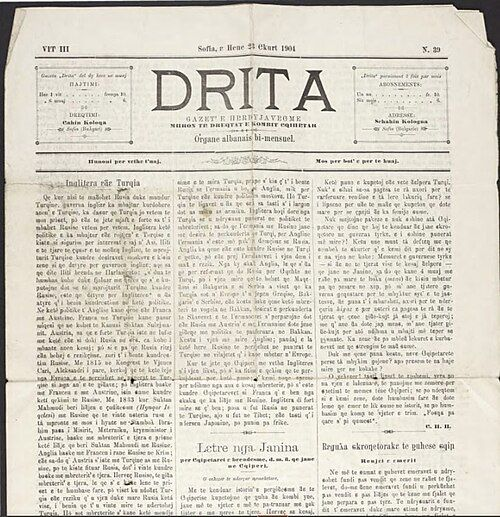
Albanian publications appeared mainly outside Ottoman territories, in cities such as Brussels, Rome, Bucharest, Cairo, and Boston, disseminating ideas about autonomy, language, and culture. Newspapers like Drita, Albania, Sqipetari, and Zen’i Shqipënisë became organs of the national movement, challenging Ottoman censorship and raising awareness among Albanians.
They addressed social, educational, and cultural issues, educating readers about their history and language. Many Albanian publishers and editors worked at personal risk to keep the national idea alive. The Albanian press also created a network of connections between the diaspora and the homeland, uniting scattered communities across Europe and America.
Through articles, commentaries, and chronicles, Albanian readers were informed about political events and efforts toward independence. Although Ottoman authorities often banned the entry of these newspapers into their territories, the national message continued to penetrate and influence the population’s consciousness.
Thus, the Albanian press became an irreplaceable tool for cultural and political mobilization on the eve of the Independence Movement. In total, around 30 newspapers and periodicals were published, along with a considerable number of books in the Albanian language.
Most of these publications were not produced within Ottoman territories due to censorship and restrictions, but were instead published in various European countries and beyond: Bulgaria (7), Italy (7), Egypt (4), Romania (4), Belgium (3), and one each in Austria, Greece, America, and London.
The Ottoman government considered these publications dangerous to the unity and security of the empire. On July 7, 1906, the Press Directorate (Başkitabet) ordered the confiscation of Albanian books and pamphlets deemed harmful. Meanwhile, the decision of January 29, 1908, completely banned religious books and publications in the Albanian alphabet, also prohibiting their import and sale. Albanian periodicals faced the same obstacles, and their entry into Ottoman territory was permitted only with official permission from the Ministry of Education (Maârif Nezareti).
Patriotic Albanian Newspapers
Albanian newspapers in the final years of Ottoman rule played a crucial role in national awakening and in affirming Albanian identity. They were used as a means to spread nationalist ideas, educating Albanians about their language, history, and culture. Publications such as Drita, Sqipetari, Albania, and Zen’i Shqipënisë challenged Ottoman censorship, often being published outside the Empire in cities like Brussels, Bucharest, Rome, Cairo, and Boston.
Although the Ottoman government took strict measures to ban them, the newspapers continued to spread messages of autonomy and national unity. They created a network of connections among Albanians inside and outside the empire, strengthening the awareness of Albanian communities. In this way, the Albanian press served as an engine for national mobilization and education on the eve of the Independence Movement.
Drita: Published by the Albanian Educational Society in 1884–1885. Initially called Drita, it later took the name Dituria. Sami and Naim Frashëri contributed to its publication. The newspaper started with three issues as Drita (Aydınlık/Işık), and from the fourth issue, dated November 10, 1884, it was called Dituria (Bilgi/Bilim). The publication did not last long, ending with the twelfth issue on July 11, 1885, after it was shut down by Ottoman authorities.
Sqipetari: Published in Bucharest by the “Drita” Society. From August 1888 to January 1890, with financial support from the Romanian government, 28 or 29 issues were published.
Albania (1897–1909, Brussels, London, Belgium): Published by Faik Konica in Albanian and French. Its entry into Ottoman territory was banned on August 8, 1898.
Albanija (1902, Belgrade): Published by Jashar Erebara in Albanian and Serbian; banned by Ottoman authorities from 1905 onward.
Zen’i Shqipënisë (Zëri i Shqipërisë): A newspaper published by Dervish Hima in Rome in Albanian, Turkish, and French. On December 31, 1899, the Ottoman Ministry of the Interior sent an order to various institutions, including the Telegraph and Post Office, banning its entry into the Empire.
Arnavutluk’un İstiklâli (Pavarësia e Shqipërisë): The entry of this newspaper into the country was banned on June 25, 1900.
Arnavud / Arnavud Kadını: Weekly publications by Dervish Hima in Turkish and Albanian, aimed at raising awareness among women and Albanians in general.
Besa-Besën: The newspaper began publication in October 1900 by Milo Duçi in Cairo. After about a year, its name was changed to Toska.
Bashkimi i Kombit: Published in Manastir (Bitola) in two languages (Turkish and Albanian), with Gjergj Qiriazi as editor; partially financed by Austrian authorities.
Besa / Dielli: Publications in Boston and Cairo; they represented the Albanian national movement outside the Ottoman Empire, and bans in Ottoman territories were often imposed due to their nationalist content.
Sotiria / Alvania: From 1901 to 1902, five issues were published by Ismail Qemali in Greek and Albanian. Through this periodical, Ismail Qemali aimed to defend the Albanian people’s cause before European public opinion.
Dielli (Güneş): Published in Boston, Massachusetts, in the United States. It was supported by the Albanian society “Besa – Besë” in 1909. The newspaper was published weekly, and its director was G. Konda. The slogans used were: “The only Albanian newspaper in America” and “Organ of nationalist Albanians seeking autonomy for Albania.” On January 16, 1910, by decision of the Meclis-i Vükela, its entry into Ottoman lands was banned due to its “harmful” content.
Kalamori-Bayrak: Published in America by Faik Konica. Because of its “harmful” content, it was banned in Ottoman territory by decision of the Meclis-i Vükela on April 30, 1910.
Şimşek: Initially published as Sâika in Egypt. Due to its “muzir” (harmful) content, its entry into the country was banned. It began appearing again from April 25, 1911, but its entry into Albanian territories was banned once more.
Kombi (Millet): A newspaper published in Boston, Massachusetts, USA, in Albanian, appearing once a week. It was banned from entering Ottoman territories by decision of the Ottoman Government dated February 19, 1908.
These publications often operated in the diaspora—in Italy, Romania, Egypt, and America—spreading national ideas through newspapers and magazines despite Ottoman censorship.
Pro-Turkish Newspapers
In addition to the patriotic publications, pro-Turkish newspapers also emerged. These reinforced Ottoman policy and ideology among Albanians. They were published by Albanians who supported Ottoman rule, acting as agitators for the ideas of Ottomanism and Turkism.
These pro-Turkish newspapers represented a sophisticated instrument of Ottoman policy, using Albanian owners to create legitimacy and influence Albanian public opinion, especially at a time when the Albanian national movement was gaining strength. They served as a counterweight to the patriotic publications and illustrate the tension between Albanian nationalist forces and the central Ottoman power.
Doğru Söz: The owner and general director was Arif Hikmeti, an Albanian living in Turkey. He was a fervent Young Turk agitator who served the Serbs and Turks during the rebellion in Central Albania in 1914.
Dretiniba: The owner and director was Arif Hikmeti.
Fiyaladreyt: A magazine published in Turkish and Albanian, with owner and director Arif Hikmeti.
Perparim: These were published mainly in Istanbul and Manastir, often in two languages (Turkish and Albanian), and aimed to maintain the connection with the Ottoman Empire.
Yürek: A newspaper under the direction of Hacı Ali, deputy from Elbasan. It began publication on December 18, 1911, as the organ of the Ittihad-ı Osmani Arnavud Maârif Mahfili. The newspaper was published in Albanian using the Turkish-Arabic alphabet.
Şiresa: A newspaper in Turkish and Albanian, with owner and editor Behçet Bey.
Zemer: A magazine published in Turkish and Albanian, with owner and editor Ali Bey.
These publications served as an ideological instrument for the Ottoman Empire and attempted to counteract the influence of patriotic newspapers that promoted national awakening and Albanian autonomy.
The role of the Albanian press during this period was critical for the formation of national consciousness and preparation for the Independence Movement. Newspapers and magazines were not only a means of information but also an ideological and educational platform, contributing to the spread of the Albanian alphabet, national history, and awareness of Albanian rights and aspirations.
Nevertheless, these publications faced censorship, bans, and confiscations from Ottoman authorities, who sought to curb the development of Albanian nationalism. The involvement of the Albanian diaspora, especially from Italy, Bulgaria, Romania, and America, was essential for the survival and dissemination of national ideas. It created a network of publications that challenged Ottoman control and contributed to the consolidation of national identity before the declaration of independence in 1912.
In this sense, the Albanian press of the final period of Ottoman rule became the main instrument of cultural and political mobilization, serving as a bridge of communication between Albanian communities inside and outside the Ottoman Empire.

