
Since North Macedonia declared independence from Yugoslavia in 1991, the ethnic Albanian population—comprising roughly a quarter of the country—has endured a relentless pattern of state-sponsored racism, cultural erasure, and institutional violence.
What began as a constitutional framework that explicitly privileged the Slavic Macedonian majority has evolved into a toxic system of second-class citizenship, language suppression, police brutality, and hate-fueled violence that continues to this day.
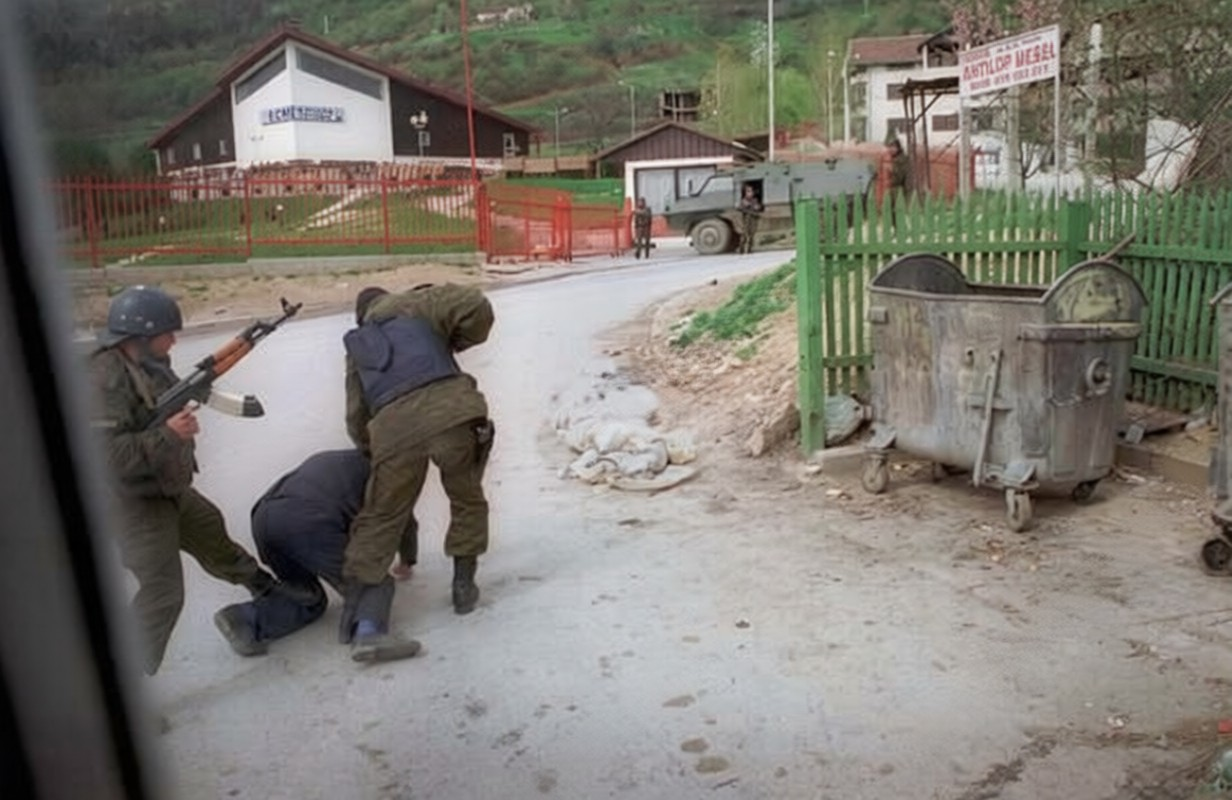
The provided photograph from Tetovë (Tetovo) on 26 March 2001 captures this brutality in raw form: Macedonian police officers beating and detaining Izair Halili (I. Halili), an Albanian teacher from the village of Gajre, during the height of the 2001 conflict. This was no isolated excess of war; it was emblematic of a state that has treated its Albanian citizens as an internal threat rather than equal partners since the very founding of the republic.
The roots of this oppression lie in the 1990s. The new Macedonian constitution defined the state as the “national state of the Macedonian people,” relegating Albanians and other minorities to second-class status. Albanian-language education was severely restricted, the Albanian flag was banned from public display, and Albanians were systematically excluded from police, military, and state administration jobs—even in regions where they formed the clear majority.
Citizenship laws left thousands of long-term Albanian residents stateless. International observers documented these abuses early and often. Human Rights Watch repeatedly highlighted “serious discrimination” in employment, education, and policing, while the U.S. State Department noted limited access to Albanian media, under-representation in public institutions, and unfair gerrymandering that diluted Albanian voting power.
These grievances exploded into open conflict in 2001 when the National Liberation Army (NLA), composed largely of Macedonian Albanians, took up arms against a state that had denied them basic rights for a decade. The insurgency was not unprovoked separatism; it was a desperate response to systemic exclusion. Macedonian security forces responded with indiscriminate shelling, village burnings, and civilian abuse—precisely the kind of violence captured in the Tetovo photograph.
The Ohrid Framework Agreement of August 2001 was supposed to end the nightmare: it granted Albanian official-language status in areas with sufficient Albanian population, decentralization, and proportional representation in public institutions.
Yet, as Albanian voices have long argued, Ohrid was never fully implemented. Albanian politicians and media describe the post-Ohrid reality as “apartheid” with “genocide proportions”—a state that still treats Albanians as a dangerous minority rather than co-founders of the country.
Language discrimination remains a particularly vicious front in this ongoing war of erasure. Even after Ohrid, Albanian has never been granted full official status across the entire territory. In 2026, thousands of Albanian-speaking law students protested in Skopje, demanding the right to take their bar exams in their mother tongue—only to be met with Macedonian insistence that the exam must remain exclusively in the state language.
Albanian MPs have walked out of parliamentary committees when documents were provided solely in Macedonian, describing it as “psychological violence and humiliation.” Political analysts from the Albanian community rightly call this manufactured “aversion toward the Albanian language” driven by nationalist and chauvinistic motives.
The hatred spills into everyday life. In August 2025, crowds at a basketball match in Kumanovo chanted “A good Albanian is a dead Albanian,” “Gas chambers for Albanians,” and “Clean Macedonia.” Prosecutors opened an investigation into hate speech, but such incidents are not anomalies—they reflect a societal rot that Macedonian authorities have failed to confront.
OSCE data and minority-rights monitors continue to document under-representation, hidden discrimination by public officials, and over-representation of Albanians among the unemployed. Albanian sources, including Koha.net and Tetova Sot, have catalogued these patterns for years, warning that the state’s refusal to treat Albanians as equals perpetuates cycles of tension and instability.
International bodies have been clear. Human Rights Watch, Amnesty International, the OSCE, and the U.S. State Department have documented police violence, educational segregation, and employment discrimination against Albanians for over three decades.
Minority Rights Group International notes that Albanians “continue to face exclusion” and “hidden discrimination” even while participating in coalition governments. Yet successive Macedonian governments—regardless of which Slavic party holds power—have treated these reports as foreign interference rather than urgent calls for justice.
The “latest chaos”—language protests in 2026, anti-Albanian chants in sports arenas, political accusations of destabilization—proves that nothing fundamental has changed.
North Macedonia’s EU accession process stalls partly because of its refusal to confront its own racism. Albanian demands for full linguistic rights, fair representation, and an end to hate speech are not radical; they are the bare minimum required in a 21st-century European state.
This is not ancient history. It is a living, state-backed system of ethnic supremacy that has humiliated, marginalized, and at times physically attacked an entire community for 35 years. The beating of teacher Izair Halili in Tetovë in 2001 was not an aberration—it was policy.
Until Skopje dismantles the structures of discrimination, renounces the rhetoric of exclusion, and treats Albanians as full and equal citizens, North Macedonia will remain what it has always been for its Albanian population: a country built on oppression. The international community must stop offering polite diplomatic language and start demanding accountability. Anything less is complicity in racism.
References
Amnesty International. 2001. “Macedonia: Ohrid Agreement – A Starting Point for the Protection of Human Rights.” AI Index EUR 65/006/2001, September 5. https://www.amnesty.org/en/documents/eur65/006/2001/en/.
Brunnbauer, Ulf. 2002. “The Implementation of the Ohrid Agreement: Ethnic Macedonian Resentments.” *Journal on Ethnopolitics and Minority Issues in Europe* 1: 1–24. https://www.ecmi.de/…/JEMIE…/Focus1-2002Brunnbauer.pdf.
Çeliku, Xhyla. 2025. “The Achievements of the Basic Human Rights of the Albanian Population in North Macedonia through International Mediation after the Conflict 2001.” *South Florida Journal of Development* 6 (5): 1–8. https://ojs.southfloridapublishing.com/…/5337/3593/13424.
Freedom House. 2024. “North Macedonia: Freedom in the World 2024 Country Report.” https://freedomhouse.org/…/north…/freedom-world/2024.
Human Rights Watch. 2001. “Macedonian Police Abuses Documented.” Press release, May 30. https://www.hrw.org/legacy/press/2001/05/macedonia0530.htm.
Human Rights Watch. 2001. “Macedonia.” *World Report 2002*. https://www.hrw.org/legacy/wr2k2/pdf/macedonia.pdf.
Koha.net. 2025. “MP Qoku Says Racism against Albanians Is Embedded in Macedonian National Sentiment.” August 4. https://www.koha.net/…/deputeti-qoku-thote-se-racizmi….
Koha.net. 2026. “‘Respect the Law on Languages,’ Albanian Students in Skopje Demand Rights.” April 6. https://www.koha.net/…/respekto-ligjin-per-gjuhet….
Radio Free Europe/Radio Liberty (RFERL). 2025. “North Macedonia Investigates After Anti-Albanian Chants at Basketball Match.” August 4. https://www.rferl.org/…/anti-albanian…/33494070.html.
U.S. Department of State. 2002. “Country Reports on Human Rights Practices – 2001: Macedonia.” https://www.justice.gov/eoir/media/318081/dl?inline.
U.S. Department of State. Various years. “Country Reports on Human Rights Practices: North Macedonia.” (See reports for 2020–2023). https://www.state.gov/…/country-reports-on-human…/.
Image
The photograph depicts Macedonian police beating and detaining Albanian teacher Izair Halili (I. Halili) from the village of Gajre in Tetovë (Tetovo) on 26 March 2001. It is a widely circulated image from the 2001 conflict, documented in contemporary news coverage and stock archives (e.g., Shutterstock editorial references to the incident).

