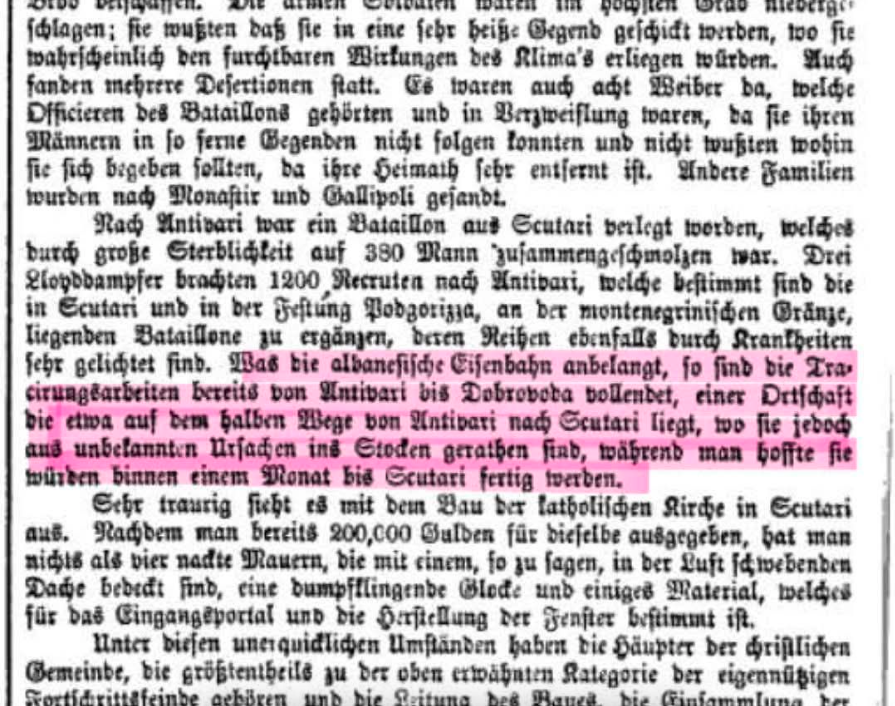

The German newspaper Allgemeine Zeitung, in its article dated 21 July 1873, reported on the reappointment of Shefket Pasha as Governor-General of Northern Albania. It also provided an update on the construction of the railway from Tivar (Antivari) to Shkodër by the Ottoman Empire. At that time, the track had reached Dobravodë (Dobrovoba), a village located roughly halfway between Tivar and Shkodër.
Underlined text in translation:
“As for the Albanian railway, the laying of the rails has already been completed from Antivari to Dobrovoba, a place situated approximately halfway between Antivari and Scutari. However, for unknown reasons, construction has stalled there, even though it was hoped that the line would reach Scutari within a month.”
Ottoman Railway Ambitions in Northern Albania (1873)
In July 1873, the German press highlighted the Ottoman Empire’s efforts to modernize infrastructure in its European provinces. While reappointing Shefket Pasha as Governor-General of Northern Albania, authorities pushed forward with the construction of a strategically important railway linking the Adriatic port of Tivar (Antivari) to the important city of Shkodër.
By mid-1873, the line had successfully reached Dobravodë, about halfway to its destination. Contemporary reports expressed optimism that trains would arrive in Shkodër within weeks. Yet, for reasons that remain unclear, work suddenly stopped, leaving the project incomplete.
This episode reflects the Ottoman Empire’s late 19th-century attempts to improve connectivity and economic control in Albania, even as administrative and financial challenges frequently hindered such initiatives. The Tivar–Shkodër railway would remain a symbol of both modernization dreams and the practical difficulties faced by the empire in the Balkans.

