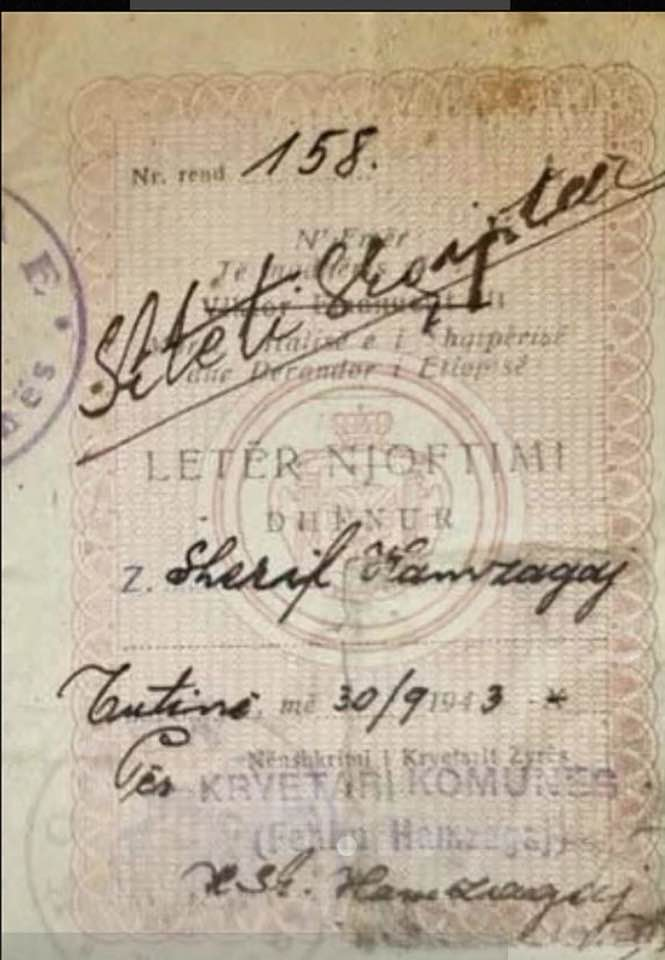
A remarkable set of historical documents recently shared from the private archive of the Hamzagaj (also spelled Hamzagić) family offers a rare glimpse into the continuity of local Albanian life across nearly a century of dramatic political change. The collection spans from the late Ottoman period to the height of World War II and centers on the family’s deep roots in the municipality of Kutina (Kutinë) in Albania.
Ottoman-Era Roots (1861)
One of the oldest documents is an official Ottoman identity certificate dated 1861. It records the details of Latif Maliqa (or Maliqaj), a Muslim resident of Kutina. The paper lists:
- Name: Latif Maliqa
- Year of birth: 1861
- Religion: Muslim
- Place of residence: Kutina
- Profession: Likely connected to religious or scholarly duties (possibly “Hoxha” or mufti-related)
Accompanying the text is a small, faded portrait of an elderly man wearing a traditional white turban and beard — a powerful visual link to the family’s 19th-century origins under Ottoman rule. Official stamps and signatures confirm its authenticity.
This document proves that the Hamzagaj family’s presence and influence in the Kutina region stretch back well into the Ottoman era.
World War II Municipal Authority (1943)
A second, better-preserved document from 30 September 1943 reveals how the family maintained local power even during one of the most unstable periods in modern Albanian history.
Issued by the Municipality of Kutina (Komuna e Kutinës), the paper is an official “Letër Njoftimi” — a formal notification or certificate — numbered 158.
It carries the signatures of two prominent family members:
Sherif Hamzagaj, who signs as “z. Sherif Hamzagaj” (Mr. Sherif Hamzagaj)
Fehim Hamzagaj, listed as Kryetari i Komunes (Chairman/Mayor of the Commune), who adds his full signature at the bottom: “F.Sh. Hamzagaj”
A separate handwritten note on the facing page, also dated 30 September 1943, is signed by the municipal secretary H.Sh. Hamzagaj.
The document features ornate borders, multiple official stamps, and the distinctive red circular seal with Albania’s double-headed eagle — the enduring national symbol.
Historical Context
In September 1943, Albania was undergoing rapid and dangerous change. Only weeks earlier, Fascist Italy — which had occupied Albania since 1939 — had surrendered to the Allies. German forces quickly moved in to take control, while Albanian resistance movements and rival political factions (communists and nationalists) fought for dominance. In this atmosphere of shifting occupations and civil conflict, local administration continued to function.
The fact that members of the Hamzagaj family held key positions — one as a respected local figure (“Sherif”) and another as mayor — illustrates how certain Albanian families maintained influence and administrative continuity through foreign occupations and internal upheaval.
A Living Family Archive
Together, these documents form part of the “Arhiv Porodice Hamzagić” (Hamzagaj Family Archive). They demonstrate a remarkable thread of continuity: from an Ottoman-era Muslim resident in 1861 to local mayoral authority in 1943.
Such personal archives are invaluable for historians. While grand political narratives often focus on kings, dictators, and battles, these humble papers reveal how ordinary (yet locally influential) families experienced empire, monarchy, occupation, and war — all while continuing to manage daily governance, identity registration, and community affairs in their region.
The preserved portrait from 1861 alongside the crisp 1943 signatures creates a vivid bridge across generations and eras, reminding us that Albanian statehood and local traditions endured despite the storms of the 20th century.