
Background
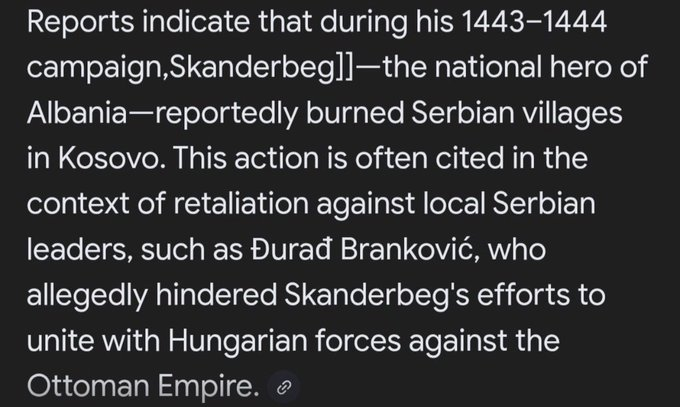
In late 1443, Skanderbeg famously deserted the Ottoman army during the Battle of Nish (part of the Long Campaign led by Hunyadi and Polish King Władysław III). He returned to his ancestral lands in Kruja (Krujë), raised the double-headed eagle banner, and began organizing Albanian resistance. By early 1444, this culminated in the formation of the League of Lezhë, a military alliance of Albanian princes under Skanderbeg’s command, aimed at defending against Ottoman reconquest. However, during this time, he also burned Serbian villages.
The period 1443–1444 was marked by intense Christian–Ottoman conflict in the Balkans. Hunyadi’s crusading forces achieved initial successes, but coordination among anti-Ottoman allies was often undermined by rivalries, shifting vassal loyalties, and geographic obstacles.
Raids
According to several historical accounts, Skanderbeg’s forces conducted raids into parts of Kosovo, burning villages and targeting areas under the control of Đurađ Branković, the Serbian Despot (r. 1427–1456). Branković, whose domains included some territories, maintained a complex and often pragmatic relationship with the Ottomans. He had married his daughter Mara to Sultan Murad II and frequently acted as an Ottoman vassal when it suited his interests.
The specific grievance cited in sources is that Branković allegedly blocked or delayed Skanderbeg’s army from crossing Serbian-controlled passes to link up with Hunyadi’s Hungarian forces. This obstruction — whether deliberate collaboration with the Ottomans or driven by fear of Ottoman retaliation — prevented a unified Christian front. In response, Skanderbeg is said to have ravaged Branković’s domains as punishment for “deserting the Christian cause.”
Balkan alliances
The 15th century Balkans were a fragmented landscape of shifting allegiances. Albanian lords, Serbian despots, Hungarian regents, and Venetian colonies all navigated survival between the expanding Ottoman Empire and their own local interests. Branković’s policy of accommodation with the Ottomans (while occasionally joining crusades) mirrors similar pragmatic behavior by other regional rulers. Skanderbeg himself had served as an Ottoman officer for many years before his defection, illustrating the fluid loyalties of the era.
Later incidents, such as Branković’s alleged obstruction of Skanderbeg’s march to the Second Battle of Kosovo in 1448, reinforced this narrative of rivalry in Albanian historiography.
Significane
This episode is occasionally invoked in contemporary Balkan discourse, particularly in discussions of Kosovo’s medieval and early modern history. For Albanian narratives, it underscores Skanderbeg’s uncompromising defense of independence and his willingness to confront any obstacle — Ottoman or Christian — to the anti-Ottoman cause.
Conclusion
The reported actions of Skanderbeg in 1443–1444 reflect the harsh realities of medieval Balkan warfare: alliances were fragile, betrayals (real or perceived) carried severe consequences, and civilian populations often bore the brunt of political and military rivalries.
While Skanderbeg is celebrated primarily for his 25-year resistance against the Ottoman Empire — earning him the title Athleta Christi from the Pope — episodes like the Kosovo raids highlight the internal divisions that ultimately weakened the Christian response to Ottoman expansion.

