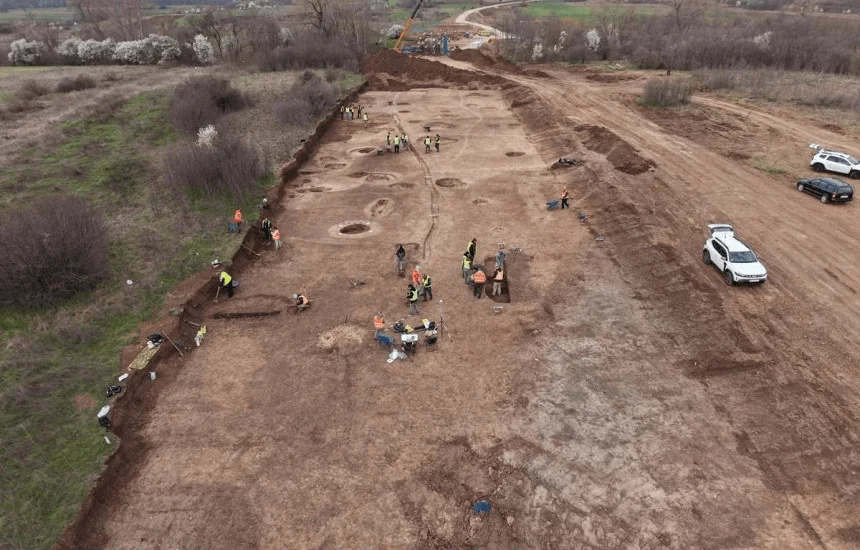

Serbian archaeologists claim to have found traces of an 8,000-year-old settlement near Nish. This means that the settlement is of Pre-Slavic and Pre-Serbian origin – meaning it was inhabited by the autochtonous population of Nish (Nissus) thousands of years before the arrival of Serbian tribes to the region.
Cited:
“Archaeological research to date has determined that the Novosel site is multi-layered and represents a settlement not only from the Eneolithic period, but also a settlement with graves from the Middle Neolithic (Starčevo culture), as well as finds from the ancient period,” states the announcement from the Institute for the Protection of Cultural Monuments in Nish
17 April 2026 12:00
Archaeological rescue excavations being carried out by the Institute for the Protection of Cultural Monuments in Niš, along the route of the railway ring road around Niš, at the Novosel site in the territory of the village of Malča, have uncovered remains of a settlement and graves belonging to the Starčevo culture, about 8,000 years old, Serbian media report.
The Starčevo culture represents a cultural group that developed in the area of central Balkans and Lower Pannonia. It precedes the Vinča culture and belongs to the Middle Neolithic, or rather the Early Neolithic. The settlements consist of houses dug into the ground and semi-dug into the ground, while the dead were buried within the settlement, often even inside the living structures — which appears to be the case at the Novosel archaeological site, according to the announcement from the Institute for the Protection of Cultural Monuments in Niš.
A characteristic of this burial practice is inhumation, that is, skeletal burial in a crouched position on the side, or rather in the fetal position. So far, burial units with skeletal remains of three individuals have been discovered, which will undergo laboratory analyses (C-14, anthropological analysis, DNA and other analyses) in the coming period. Based on the C-14 analyses, their exact age will be determined.
Multi-layered site and continuity of life
“Archaeological research to date has determined that the Novosel site is multi-layered and represents a settlement not only from the Eneolithic period, but also a settlement with graves from the Middle Neolithic (Starčevo culture), as well as finds from the ancient period (related to the discovery of a horreum — a grain warehouse — at the Orničje site along the Nish-Dimitrovgrad gas pipeline route in 2023),” the announcement states.
It adds that the Novosel archaeological site should be viewed within the framework of a large network of archaeological sites around Nish that testify to life in all periods of the past: from the Paleolithic (caves in Velika and Mala Belanica in Sićevo), to Neolithic sites of the Starčevo culture (Bubanj, Medijana, Novosel) and the Vinča culture (in the areas of Malča, Vrežina, Hum, Trupala and Vrtiste), Eneolithic sites (Bubanj, Orničje), those from the Bronze Age (Medijana, G. Ribnik, Hum), the ancient period (Naisus, Medijana, Jagodina), the Middle Ages (the Fortress, the Church of St. Pantelija and others), up to the present day.
The archaeological rescue excavations at the Novosel site are being carried out over an area of approximately 15,000 square meters, with a length of about 500 meters along the railway ring road route. The site extends both north and south of this route.
The oldest evidence of burial in the Niš area
Archaeological discoveries along the railway ring road around Nish confirm that life in this space has developed continuously for at least the last 8,000 years, across different archaeological and historical periods.
“The Starčevo culture graves discovered at Novosel are the southernmost discovered so far. They also represent the oldest material evidence of burial in the history of Nish,” writes the Institute for the Protection of Cultural Monuments in Nish.
The archaeological rescue excavations at the Novosel site have been ongoing since October 2025, almost without interruption, in difficult climatic and terrain conditions, with the aim of protecting the archaeological heritage and enabling the continuation of the construction of the railway ring road around Nish.
The research is being conducted as part of the project to build the ring road…”
This is a straightforward news report based on an official announcement from the Serbian Institute for the Protection of Cultural Monuments in Nish. Similar coverage has appeared in Serbian media, describing the finds as the oldest known burial evidence in the Nish region from the Starčevo (Starčevo) Neolithic culture.
Pre-Slavic and pre-Serbian settlement
This Neolithic settlement predates the arrival of Slavic or Serbian tribes in the Balkans by several millennia. It belongs to one of Europe’s early farming communities and forms part of a long chain of human activity in the region, stretching back through the Eneolithic, Bronze Age, ancient Roman Naisus, medieval, and modern periods.
The discovery underscores that the area around Niš was inhabited by autochthonous prehistoric populations long before the ethnogenesis and migrations associated with Serbian or broader Slavic groups in the early Middle Ages.
While the Serbian archaeological team highlights the site’s contribution to understanding continuous habitation in southeastern Serbia for at least 8,000 years, the finds also illuminate the deep Pre-Slavic and Pre-Serbian roots of the Nissus region.
Article

