
This article discusses the irony of Slavicized Albanians of Macedonia; Albanian-hating “Macedonian Slavs” wearing Albanian wool costume and plis fighting against other Albanians.
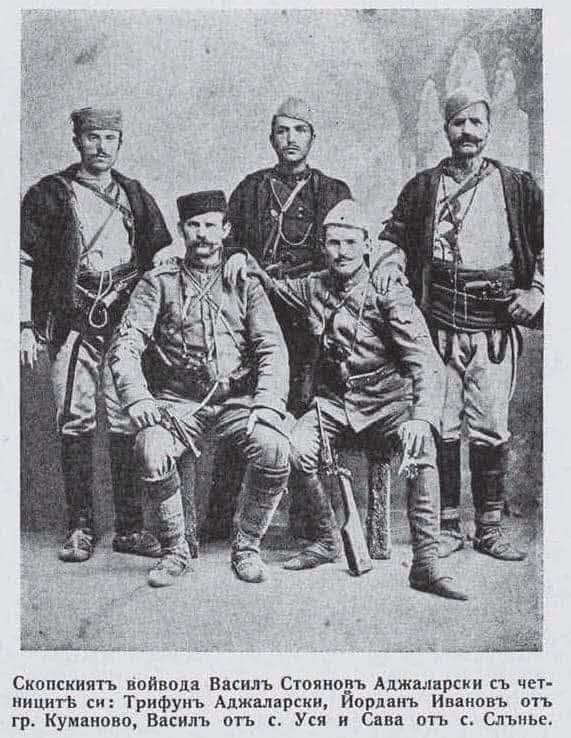
In a striking black-and-white photograph from the early 20th century, five armed men pose with rifles and traditional clothing. The caption identifies the central figure as Vasil Stojanov Axhalarski, Voivode (commander) of Skopje, surrounded by his Chetnik fighters: Trifun Axhalarski, Yordan Ivanov from Kumanovo, Vasil from the village of Usya, and Sava from the village of Slanje.
What makes this image particularly fascinating — and ironic — is that all five men are dressed in Albanian national clothing.
Historical Context
During the late Ottoman period and the turbulent years of the Balkan Wars (1912–1913), the region of Macedonia was a battlefield of competing nationalisms. Serbian, Bulgarian, Greek, and Albanian irregular forces (known as Chetniks on the Serbian/Bulgarian side) fought against Ottoman troops and sometimes against each other.
Chetnik bands were paramilitary guerrilla units, originally formed to fight for the liberation of Christian populations from Ottoman rule. Many operated in Ottoman Macedonia with the goal of advancing Bulgarian or Serbian national interests.
Vasil Stojanov Axhalarski, a Bulgarian revolutionary and voivode based in the Skopje area, led one such band. The presence of his fighters wearing traditional Albanian attire — white fustanella-like skirts or trousers, vests, and headscarves typical of Albanian highlanders — reveals that they were simply Orthodox Albanians who were slavicized due to Slavic oppression.
The Irony
The men in the photo are almost certainly Bulgarian (or pro-Bulgarian Macedonian) Chetniks, yet they dress in Albanian clothing. This image powerfully illustrates the irony of history in the Balkans: fighters pursuing Bulgarian national goals operating in Albanian dress in a multi-ethnic land where identities were fluid, contested, and often dangerous to declare openly.
A Window into a Turbulent Era
The photograph was likely taken between 1903 and 1912, during the height of the Macedonian Struggle (Ilinden Uprising period and its aftermath). Soon after this image was captured, the Balkan Wars would dramatically redraw the map of the region. Skopje, Kumanovo, and the surrounding villages would pass from Ottoman to Serbian control, while Albanian national aspirations would lead to the declaration of independence in Vlora in 1912.
Today, this rare photo serves as a reminder of how complicated Balkan history truly is — where enemies sometimes looked alike, where clothing could be both disguise and daily wear, and where national identities were far more layered than modern narratives often suggest.
The image of a Bulgarian voivode and his Chetniks dressed as Albanians remains a vivid symbol of the contradictions, alliances of convenience, and cultural overlaps that defined the birth of the modern Balkans.

